The journal: your mood at a glance
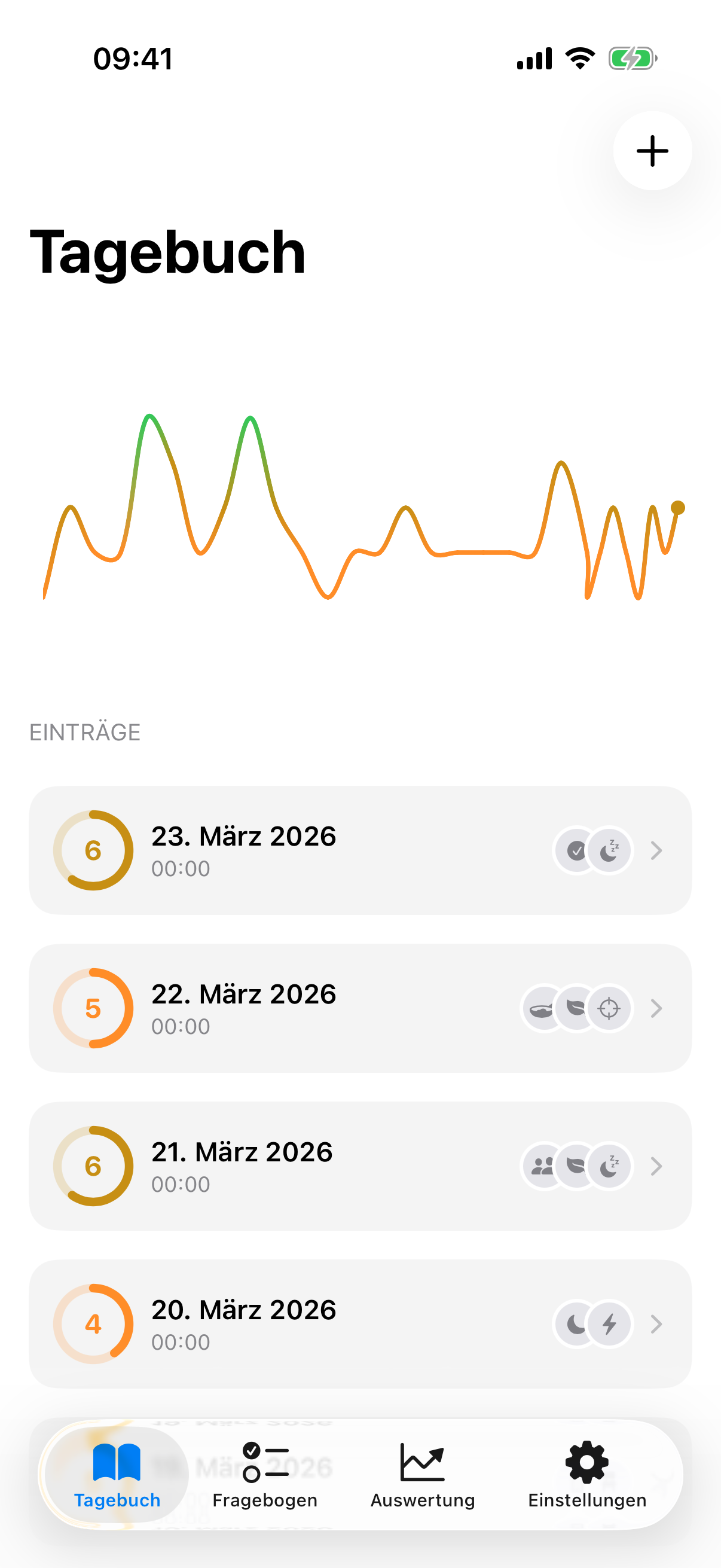
When you open InnerPulse you land in the journal. Here you see all your previous entries, sorted chronologically, with colour-coded mood-score rings and the day's factor icons.
At the top, a trend chart shows your mood trajectory over the last 30 entries. You can switch between three display types: line (smooth curve), bars (individual day values) or band (intuitive red-to-green gradient).
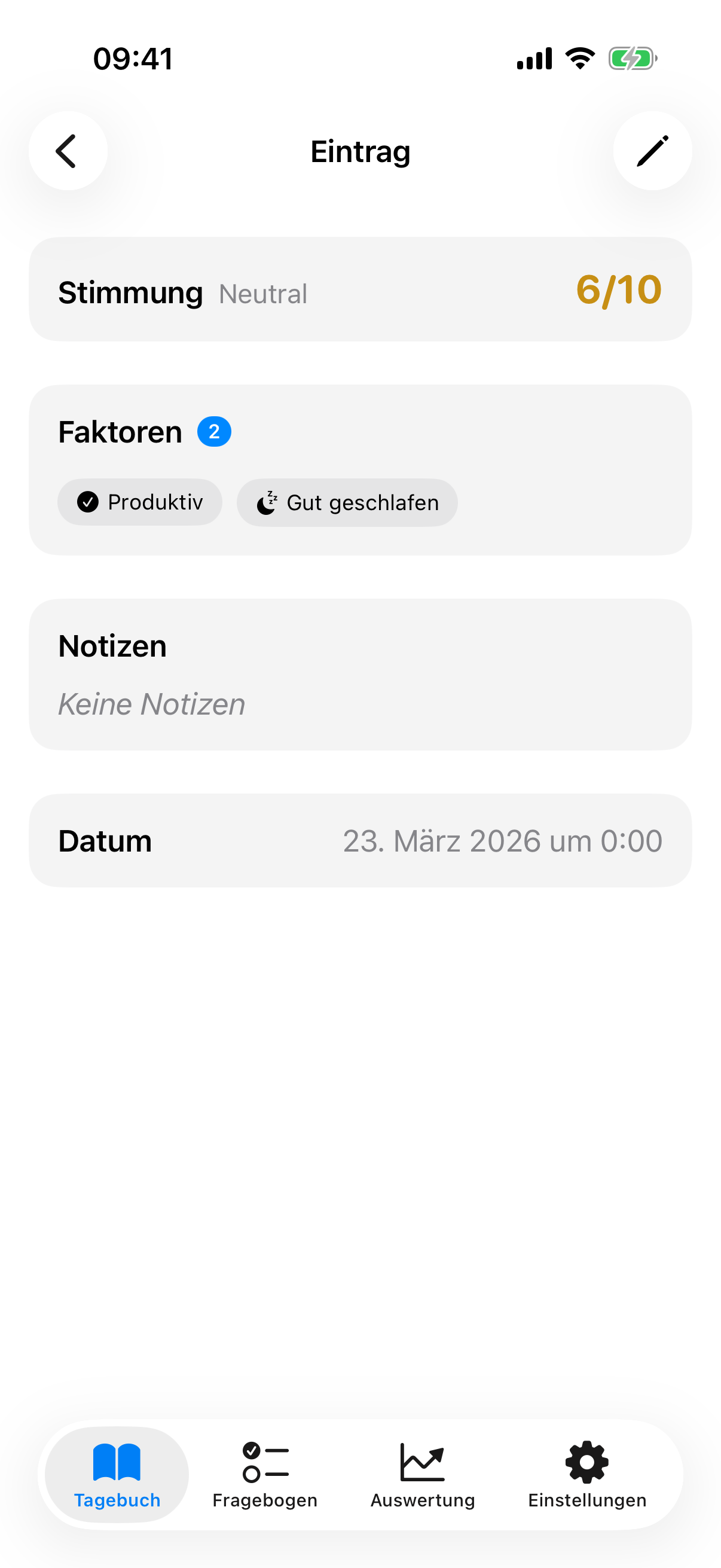
Tap an entry to see the details. Each entry shows your mood value (e.g. 6/10, "Neutral"), the selected factors (e.g. "Productive" and "Slept well"), your optional notes and the date. Use the pencil icon at the top right to edit any entry afterwards.
To delete, swipe left. If you delete by accident, shake your iPhone to restore the entry.
The four tabs at the bottom of the screen take you through the app: Journal, Questionnaire, Insights and Settings.
Your daily check-in: capture your mood in 10 seconds
The core of InnerPulse is a simple, daily check-in. Tap the + at the top right of the journal:
- Rate your mood: slide the slider on a 1 to 10 scale. The colour gradient runs from red (low) to green (high).
- Pick factors: choose what shaped your day. InnerPulse suggests factors based on time of day, day of week and your habits.
- Add a note (optional): write a short text. InnerPulse offers writing prompts that match your current mood.
Important: there's no streak pressure. No reward system, no badges, no guilt if you miss a day. Each individual entry has value in itself.
100+ influence factors: understand what moves your mood
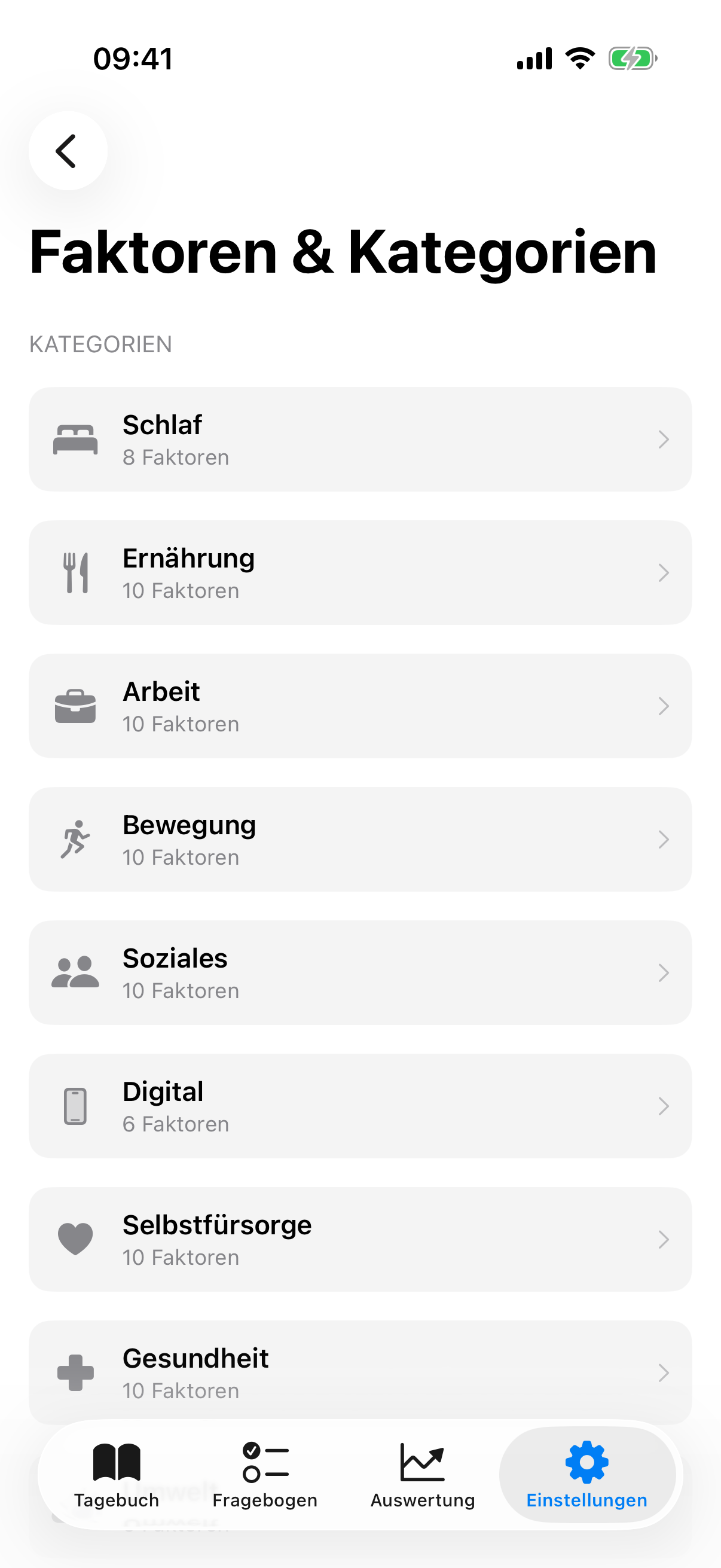
InnerPulse comes with 82 pre-defined influence factors, distributed across 10 categories:
- Sleep (8 factors): sleep quality, duration, falling asleep, staying asleep
- Nutrition (10 factors): ate healthy, drank water, caffeine, alcohol
- Work (10 factors): productivity, focus, work-life balance, meetings
- Movement (10 factors): sport, walk, outdoor time, sedentary
- Social (10 factors): friends, conversations, conflicts, romance
- Digital (6 factors): screen time, doomscrolling, social media
- Self-care (10 factors): rest, hobbies, meditation, journaling
- Health (10 factors): pain, medication, energy, illness
- Environment (6 factors): weather, noise, order, travel
- Finance (4 factors): saving, spending, income, money stress
You can create your own factors and categories at any time. If a pre-defined factor doesn't fit, just hide it.
The special part: InnerPulse learns your behaviour. Factors you use regularly are suggested automatically based on time of day, weekday and your existing patterns. If you often pick "Deadline stress" on Mondays, the factor appears higher up on Mondays.
Many factors come as opposing pairs: "Slept well" and "Slept poorly" are related. When you decline one, InnerPulse offers you the other.
Clinical questionnaires: science in your pocket
InnerPulse includes 4 clinical screening instruments used in psychological practice worldwide:
- PHQ-9 (Patient Health Questionnaire-9): depression, 9 questions, score 0 to 27
- GAD-7 (Generalized Anxiety Disorder-7): anxiety, 7 questions, score 0 to 21
- PHQ-4: short screening (2 depression + 2 anxiety questions), score 0 to 12
- K10 (Kessler-10): psychological distress, 10 questions, score 10 to 50
You can fill out each questionnaire directly in the app, or enter a score manually if you took the test elsewhere.
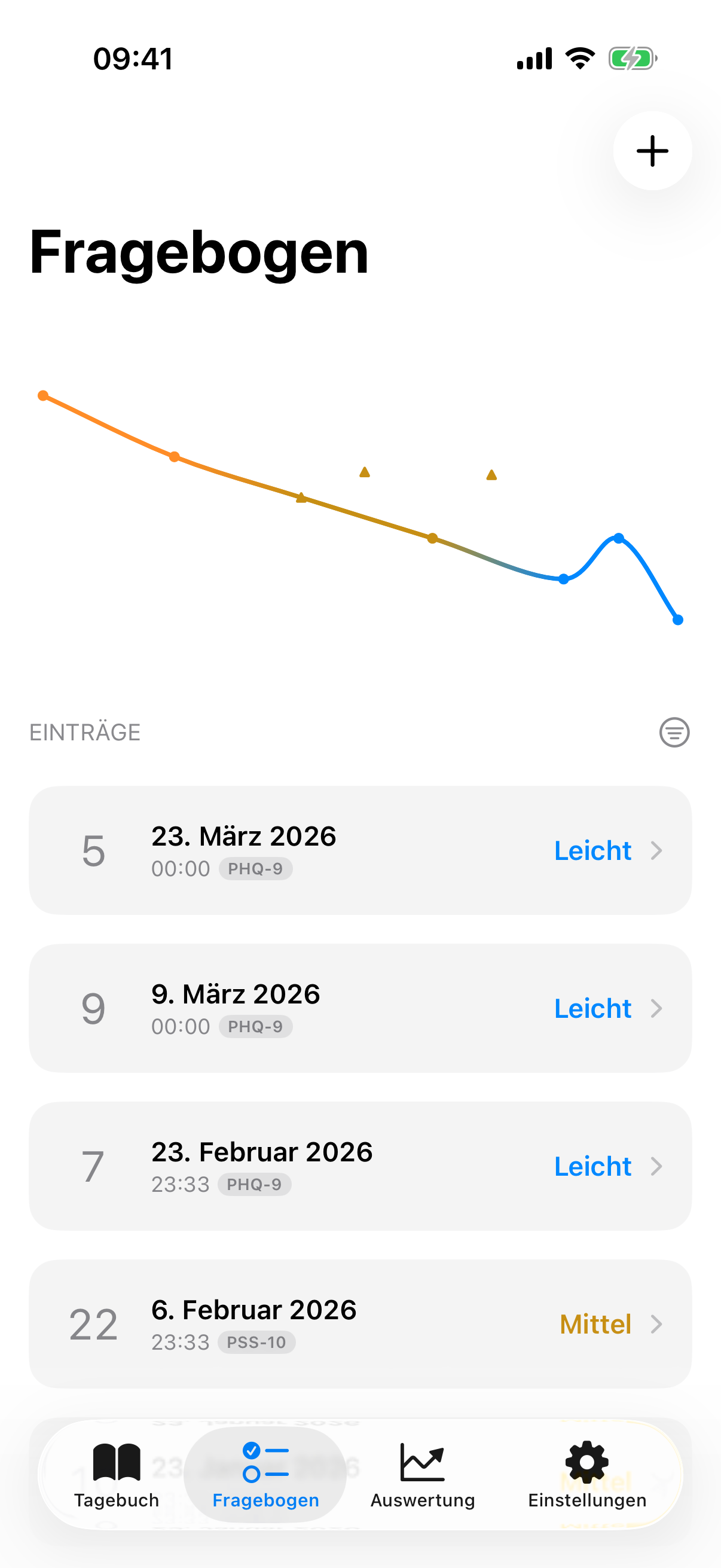
In the questionnaire tab you see all previous results with a trend chart. When filling in, each question appears one by one with a progress bar. At the end you get your score with a severity classification (e.g. "Mild") and a comparison to your last result.
The PHQ-9 also uses a diagnostic algorithm based on DSM criteria: the app checks whether the answer pattern points to a depressive syndrome.
All four instruments are scientifically validated and used in over 20 languages. The original PHQ-9 validation is published in Kroenke, Spitzer and Williams (2001), one of the most cited papers on depression screening.
Crisis detection: three levels of safety
InnerPulse evaluates questionnaire results with a 3-level system:
-
Hint (blue): a gentle hint at notable but non-critical values. For example PHQ-9 between 10 and 14.
-
Urgent (orange): a warning at repeatedly elevated values. For example PHQ-9 from 15 across two tests within 6 weeks. The app recommends contacting a professional.
-
Acute (red, full screen): on signs of acute crisis, InnerPulse shows a crisis screen with emergency numbers for your region.
Insights: spot patterns you'd otherwise miss
The Insights tab is the analytical heart of InnerPulse. Here your daily entries turn into meaningful patterns.
MoodRing and trend
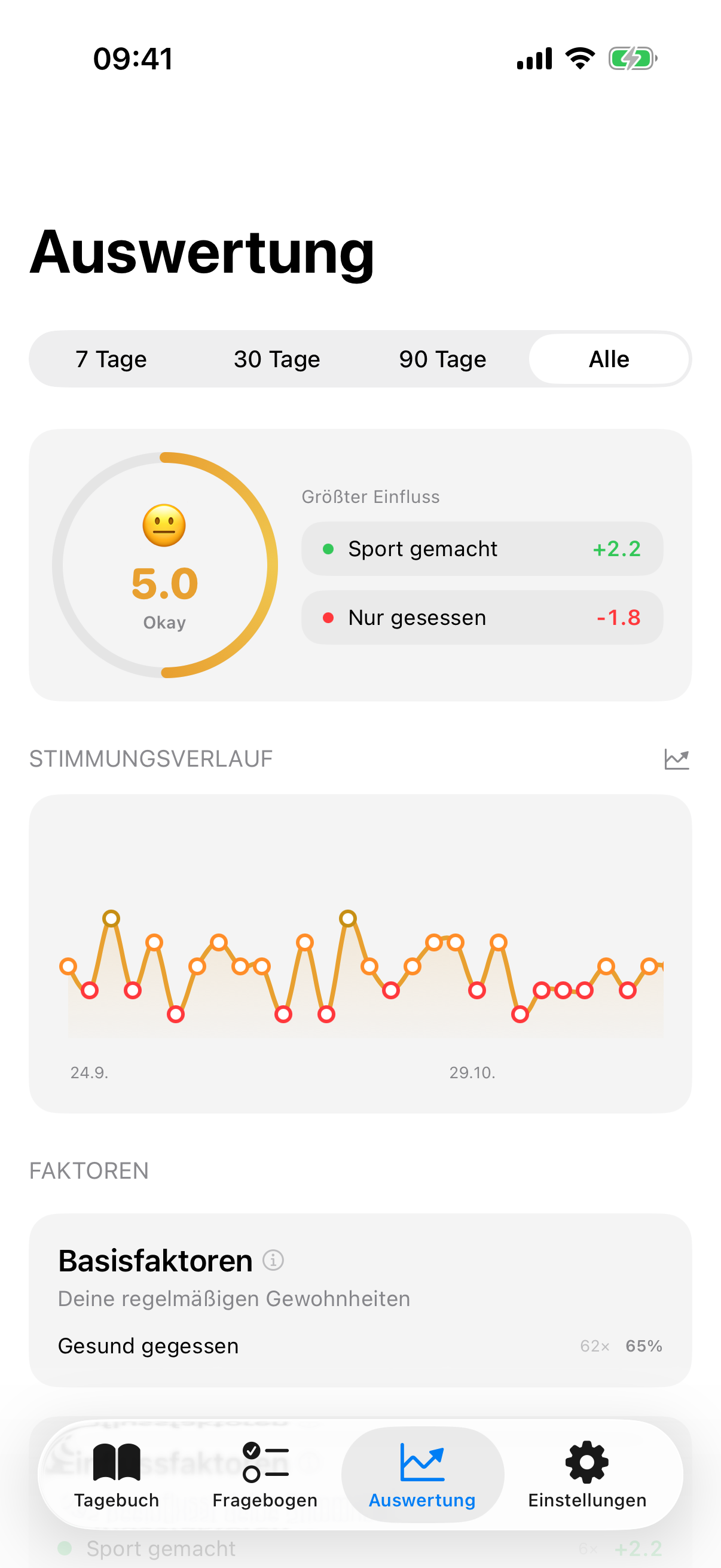
At the top you see the MoodRing: an animated circle with your average over the chosen period, an emoji and the two factors with the largest positive and negative effect. You can switch between 7 days, 30 days, 90 days or All.
Below it, the mood trajectory as a sparkline with regression line. So you see whether your mood is rising or falling long-term.
Factor analysis: baseline vs impact
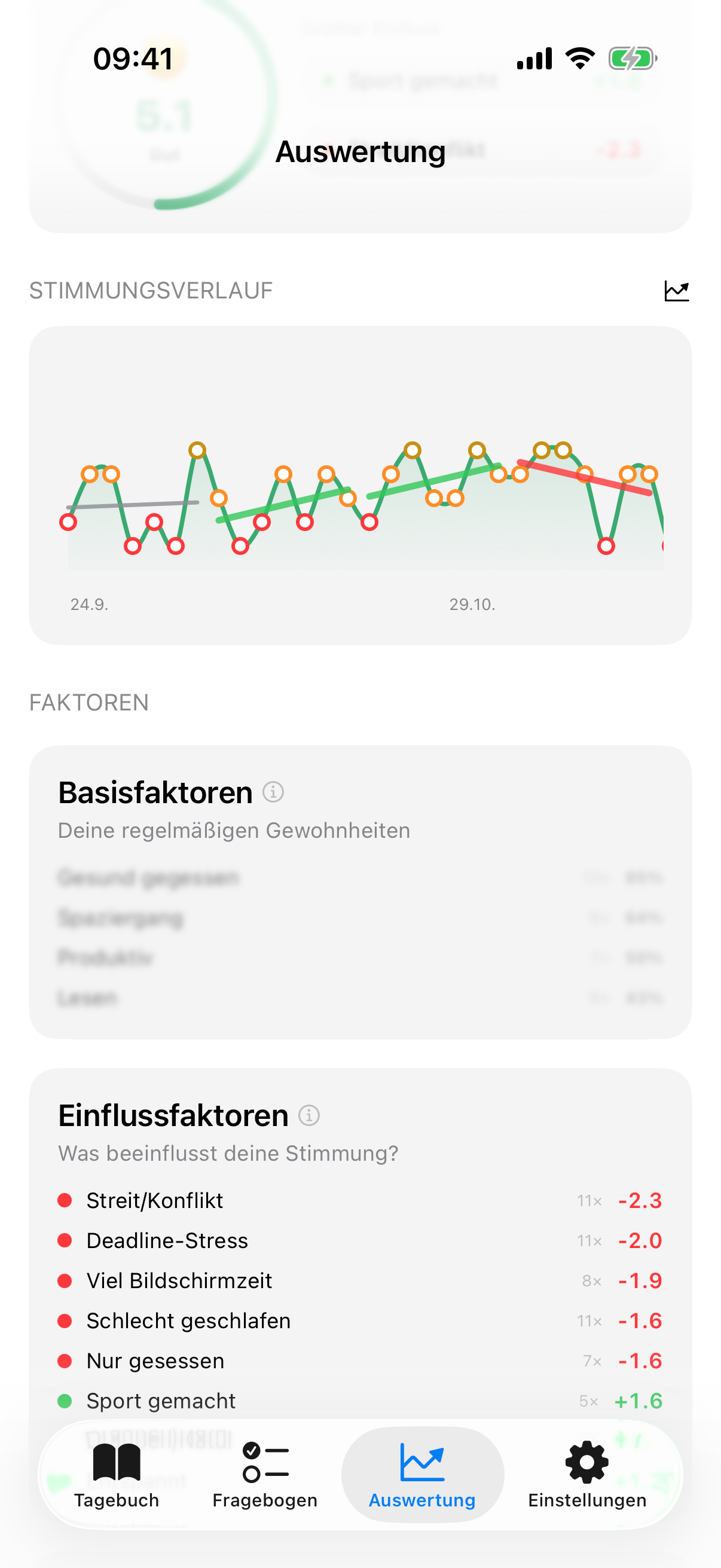
InnerPulse splits your factors into two groups:
Baseline factors (in 60% or more of entries): these are your habits. The app shows their frequency and mood stability.
Impact factors (under 60%): factors that don't appear every day, and are precisely measurable for that reason. InnerPulse calculates the "with vs without" effect. Example: "Did sport: +1.6" means your mood is 1.6 points higher on average on sport days. "Conflict: -2.3" shows the negative impact.
The reliability of each value is shown by a confidence score. The more data points, the more reliable.
Weekdays and statistics
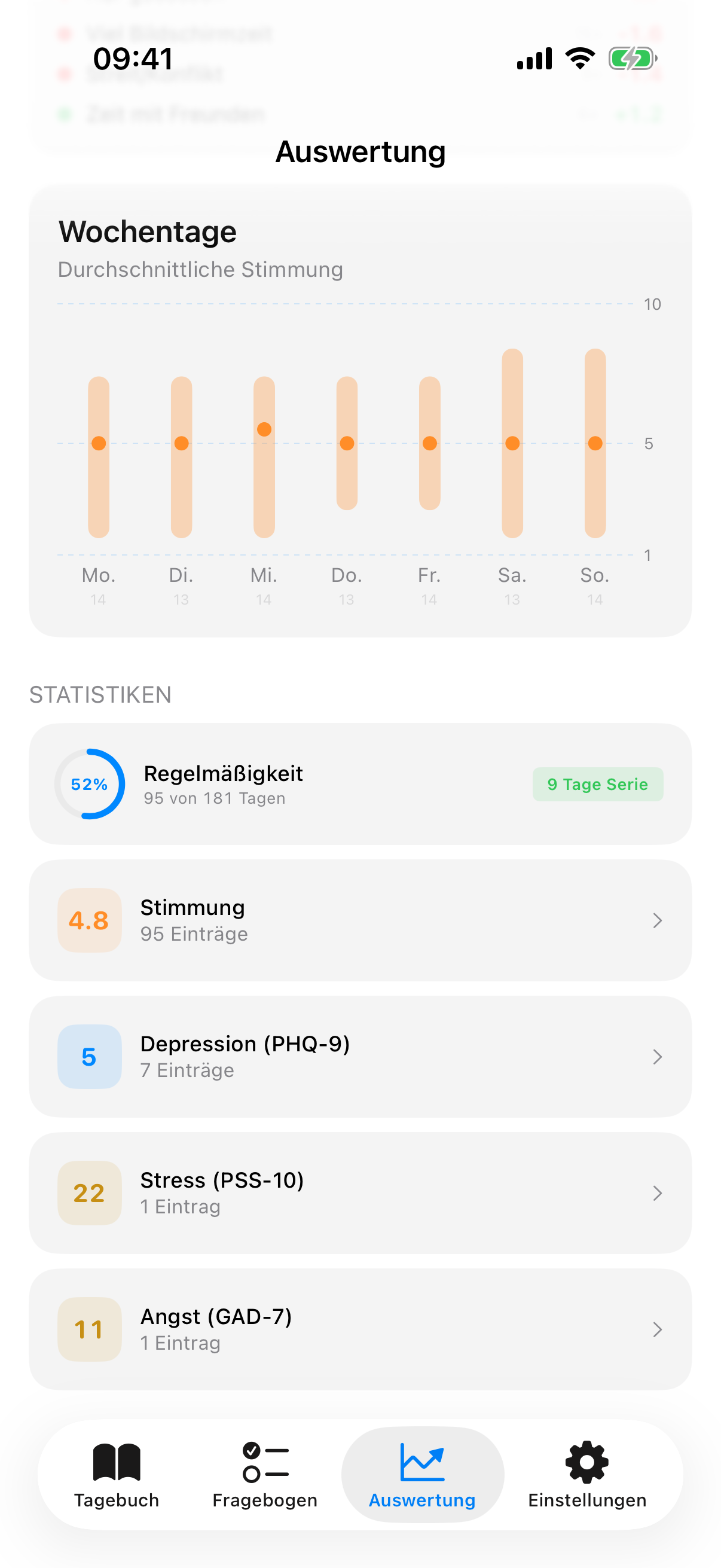
The weekday chart shows your average mood per day, with minimum, maximum and median. So you can spot whether certain days are systematically better or worse.
The statistics show:
- Regularity: how many days you've tracked and your current streak
- Mood: average across all entries
- Questionnaire results: current scores for depression (PHQ-9), stress (PSS-10) and anxiety (GAD-7) at a glance
Your data belongs to you: privacy and export
InnerPulse stores all data on your devices. There's no account and no server of ours. You turn on the optional Device sync yourself: it runs end-to-end encrypted via your iCloud storage.
- No tracking: no analytics, no Firebase, no crash reporting
- No account: no email address or registration needed
- Face ID / Touch ID: protect the app with biometric authentication, with configurable timeout
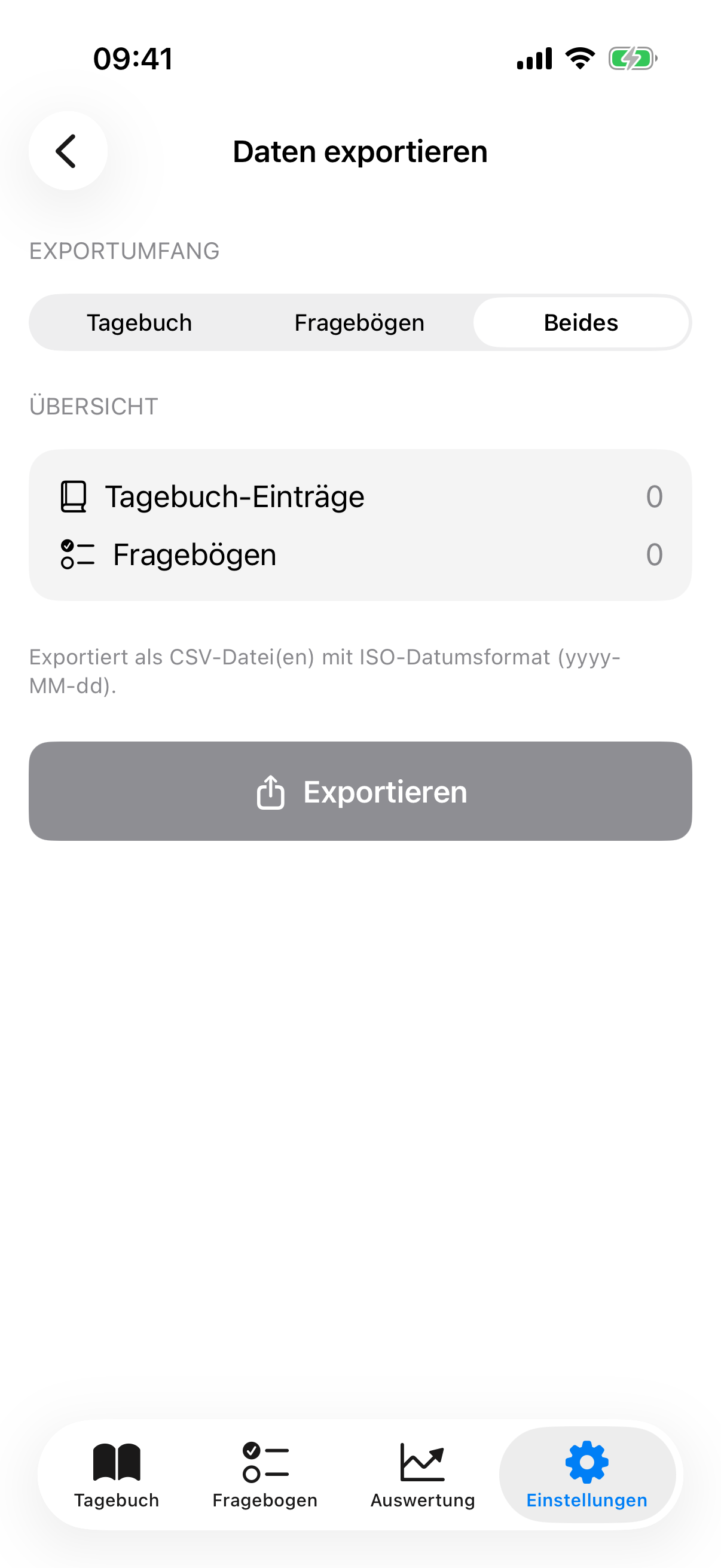
- CSV export: export journal entries and questionnaire results as CSV files. Ideal as a basis for conversation with your therapist or doctor. You choose whether to export only the journal, only questionnaires, or both.
Settings: InnerPulse adapts to you
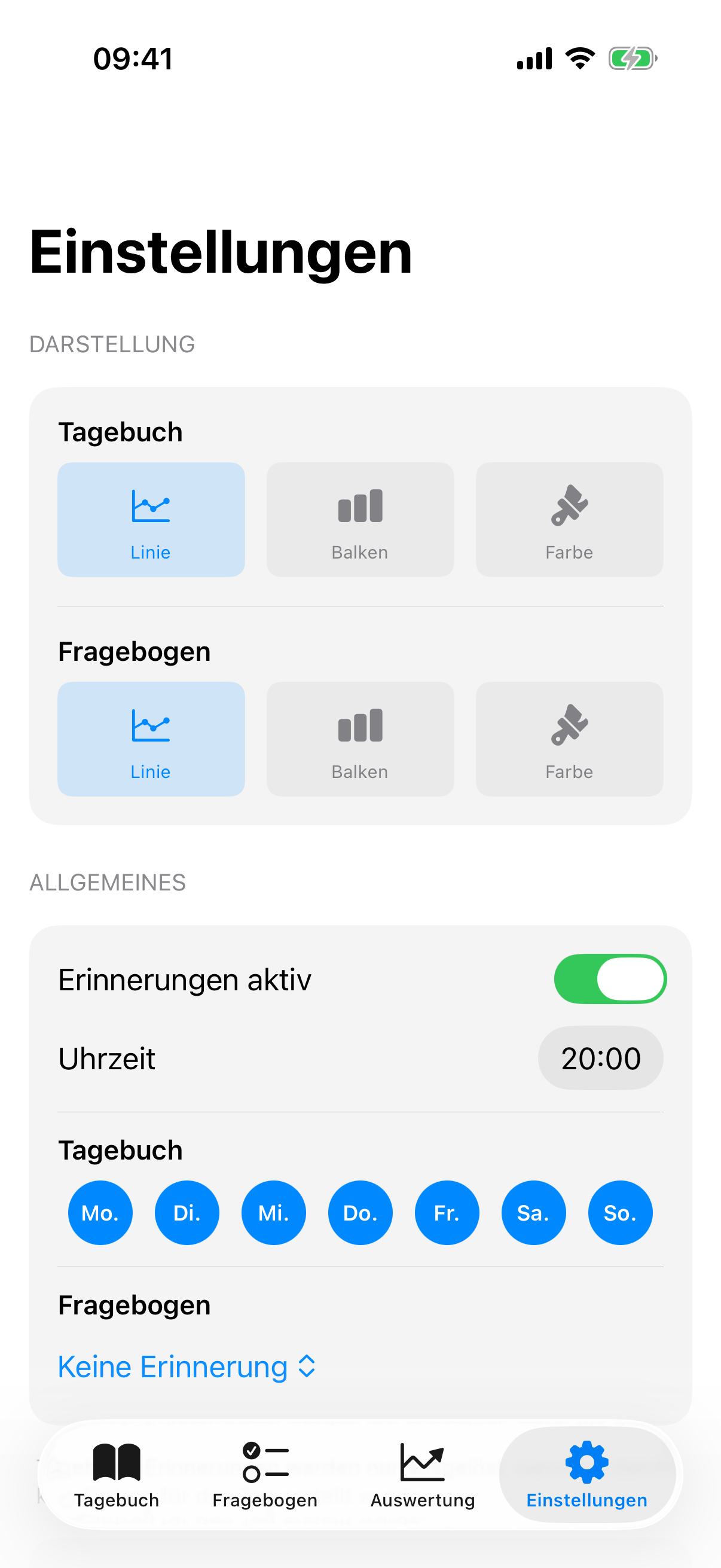
Display
Choose one of three display types each for journal and questionnaire charts: line, bar or colour.
Reminders
Activate daily reminders and set:
- Time: when should the reminder come? (Default: 8 pm)
- Weekdays: which days do you want to be reminded?
- Questionnaire interval: how often should the app remind you about a clinical questionnaire?
The reminder is smart: if you've already made an entry on a given day, it's skipped.
Factor management
Under "Factors & Categories" you manage your 100+ factors: hide or show them, create your own, and view detected weekday patterns (e.g. "You select Sport on 80% of all Tuesdays").
InnerPulse is available on the App Store as a one-time purchase for €9.99, no subscription, no hidden costs. Shareable with your whole family via Family Sharing.
Read more
If you want to dive deeper into individual topics, these articles are a good start:
- Keeping a Mood Journal: The Complete Guide explains the basics that InnerPulse automates.
- PHQ-9, GAD-7 & more places the clinical questionnaires from the questionnaire tab in scientific context.
- PHQ-9: Every question explained shows what the 9 items measure in detail.
- Recognising patterns in your mood explains how to interpret the insights.
- How sleep affects your mood and Exercise and mood are the two factors with the strongest effect.
- Is my medication working? shows how to use PHQ-9 trajectories for treatment decisions.
- Recognising burnout before it's too late explains the crisis detection in context.