Apple Health's State of Mind, Depression Risk and Anxiety Risk features landed with iOS 17 and are now the default mood-tracking layer on every iPhone. They're free, built-in, Apple-designed. If you've looked at a third-party mood tracker and thought "why would I install an app when my iPhone already has this?", that's the right question to ask.
The answer is that Apple Health and InnerPulse are built for genuinely different jobs. This page lays out the difference in the format that matters: what each tool is good at, what it can't do, and which you actually need.
| Dimension | InnerPulse | Apple Health State of Mind |
|---|---|---|
| Built for | Ongoing therapy companion | Point-in-time mental health check |
| Price | One-time €9.99 | Free (built in) |
| Instruments | PHQ-9, GAD-7, PHQ-4, K10 | Depression Risk (PHQ-9-like), Anxiety Risk (GAD-7-like), State of Mind mood log |
| Instrument frequency | On your schedule (daily, weekly, monthly) | Recommended every 2-4 weeks |
| Mood dimensions | 1-10 + up to 3 feelings (27 to choose from) | Valence + feelings + associations |
| Context factors | 100+ pre-built + correlation engine | Activities (shared with Health) but no correlation analysis |
| Trend analysis | 7-day, 30-day, 90-day; factor correlation | Trend over time; no factor correlation |
| Clinical export | CSV export formatted for GP/therapist | In-app summary; no export built for clinicians |
| Data location | On your devices; optional device sync via iCloud, end-to-end encrypted (off by default) | iCloud-synced by default (can be disabled) |
| Ongoing commitment | Designed for daily use | Designed for intermittent check-ins |
What Apple Health is genuinely good at
Apple Health's mental health features are a big step forward for iOS users, and three things about them are excellent:
- It's already there. Zero friction, zero install, zero learning. Anyone with iOS 17+ can do a Depression Risk check in two minutes without thinking about it.
- The risk questionnaires are solid. The Depression Risk and Anxiety Risk screeners are based on PHQ-9 and GAD-7 respectively. The implementation is clinically careful - results are framed as risk categories, not diagnoses, with appropriate "seek help" signposting.
- State of Mind as a general awareness layer. Logging "pleasant + calm + 5" or "unpleasant + agitated + 3" once a day in a few seconds is a gentle first step into mood awareness for people who wouldn't install a dedicated app.
For a lot of users, that's enough. If you just want occasional mental-health check-ins and live inside the Apple ecosystem, you don't need InnerPulse. Apple Health does the job.
Where Apple Health is deliberately limited
Apple's mental health features are designed for the general population, not for people who are actively in treatment. That shapes what they don't do:
- No frequent re-testing. Apple's UX actively nudges you away from weekly PHQ-9/GAD-7 repeats. The instruments are presented as periodic screeners, not tools for tracking medication response week by week.
- No correlation analysis. State of Mind logs mood but doesn't tell you which activities, sleep patterns, work loads or social contexts predict your mood. Apple Health has the data; it doesn't surface the patterns.
- No clinical export. There's no "CSV export for my therapist" button. Your data is visible in the Health app, but not in a format designed to be handed to a clinician.
- No K10. The instrument that matters for general psychological distress (K10) isn't included. For depression and anxiety alone, Apple covers it. For a fuller picture, it doesn't.
- No PMDD-style cycle overlay. Apple Health can show a mood chart and a period chart, but doesn't produce the cycle-phase correlation that PMDD diagnosis requires.
These aren't bugs - they're product decisions. Apple's liability profile doesn't allow them to ship a "therapy companion" that people might interpret as medical advice. InnerPulse lives in that space on purpose.
The four concrete differences
1. Point-in-time vs longitudinal
Apple Health gives you a Depression Risk score this Tuesday. If you take it again in three weeks, you get another score. The two points sit in a list.
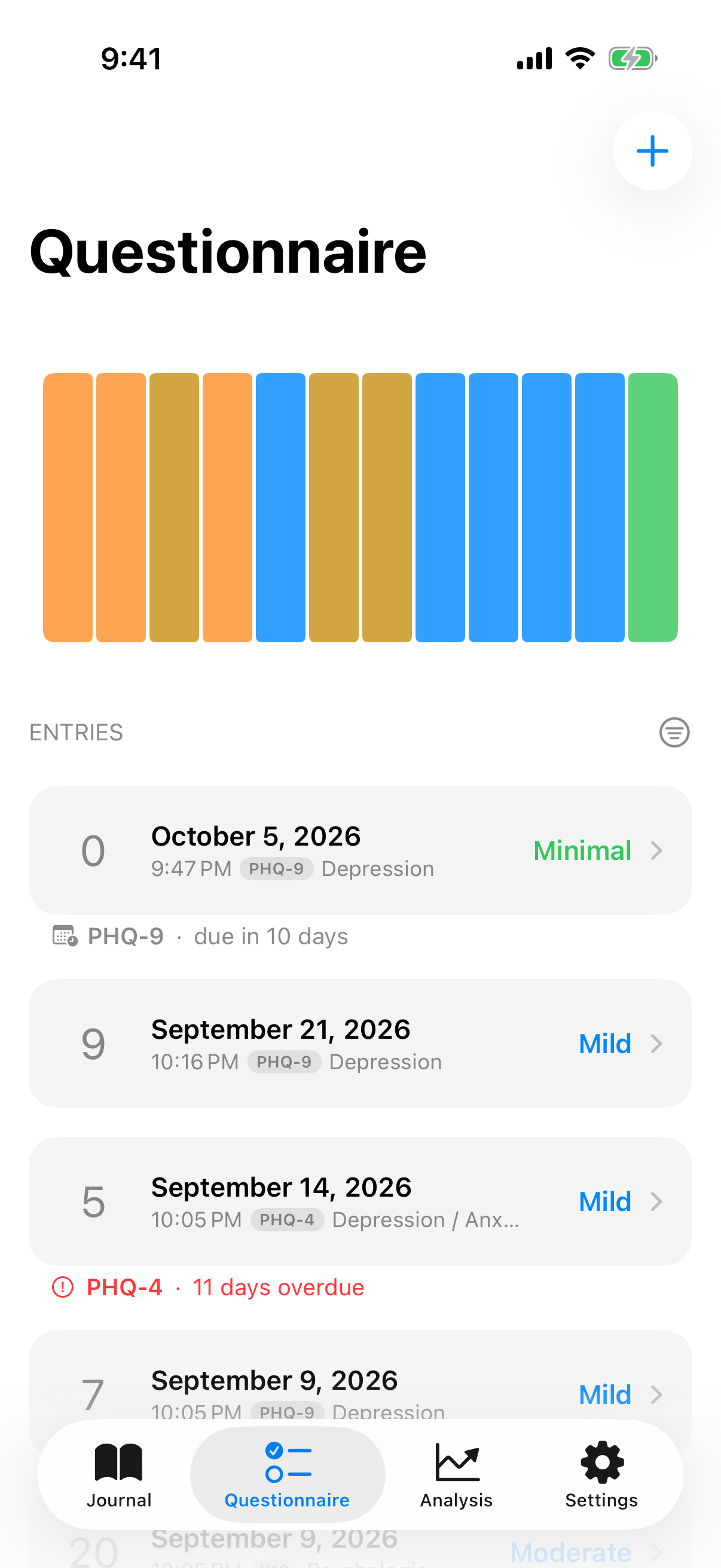
InnerPulse gives you a PHQ-9 trend with weekly datapoints, tied to your daily mood, your daily factors, and your medication timeline. The comparison isn't two scores; it's an evolution.
ApplePoint-in-time
Two dots on a list: "April 8th - moderate risk" and "April 29th - moderate risk." Periodic screening, nothing between.
InnerPulseLongitudinal
A continuous line: daily mood, weekly PHQ-9/GAD-7/K10, factor overlays, medication timeline. The evolution is the diagnosis.
2. Three instruments vs five
Apple Health: State of Mind (valence, feelings, associations), Depression Risk (PHQ-9-like), Anxiety Risk (GAD-7-like).
InnerPulse: PHQ-9 (depression), GAD-7 (anxiety), PHQ-4 (rapid weekly check), K10 (general distress + agitation). K10 in particular fills a gap - irritability, agitation, and general psychological distress don't always show up in PHQ-9 alone, which is one reason PMDD and SSRI-response cases benefit from it.
3. Isolated mood vs factor correlation
Apple Health State of Mind shows your mood over time, and you can view activities alongside. But you have to eyeball the pattern yourself.
InnerPulse runs the correlation automatically. It surfaces things like "your mood is 1.8 points higher on days you slept 7+ hours" or "caffeine after 3pm is associated with worse next-morning mood." That's the work Apple Health doesn't do.
4. Isolated use vs clinical handoff
Apple Health's data lives in your Health app. If you want to share it with a therapist, you'd screenshot a chart. That's fine for casual use.
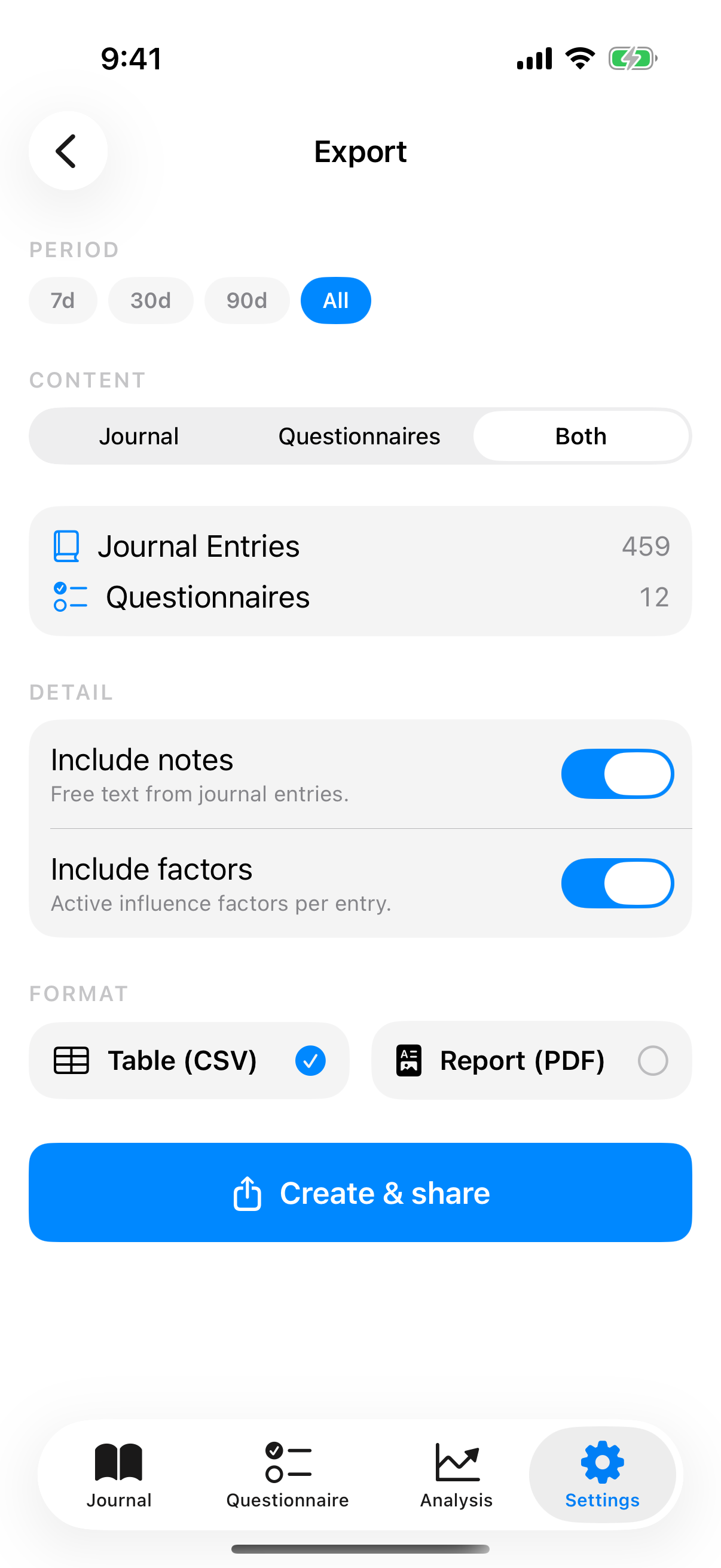
InnerPulse generates a clinical-style CSV export: PHQ-9, GAD-7, K10 trends; factor correlations; mood timeline. It's designed to be handed to a clinician at the start of a 15-minute appointment, reading like something out of a research study rather than a consumer app.
Who should stay with Apple Health only
- You're mentally well and just want an occasional check-in.
- You want zero friction and a zero-app-count phone.
- You're not in therapy, not on psychiatric medication, and don't suspect a specific pattern like PMDD or bipolar.
- You're fine with quarterly-ish Depression Risk / Anxiety Risk checks, not weekly or daily tracking.
Be honest with yourself here. If State of Mind is enough, save yourself the €9.99 and stop reading.
Who should add InnerPulse
- You're currently in therapy, between slots, or waiting for one.
- You started a psychiatric medication (SSRI, SNRI, mood stabilizer) and need to know if it's working.
- You suspect PMDD or a cycle-linked mood pattern and need two cycles of prospective data.
- You've been diagnosed with depression, anxiety, bipolar or burnout and want to track your own response to interventions.
- You've tried Apple Health State of Mind and wanted more - more instruments, more depth, actual correlation, an export you can use.
- You want your sensitive mental health data never to leave your phone, not even iCloud. For what that means in practice, see private offline mood tracker.
The combined workflow
You don't have to pick one. Plenty of InnerPulse users keep using Apple Health State of Mind for the casual pleasant/unpleasant tap and use InnerPulse for the weekly PHQ-9/GAD-7 and the factor correlation. They answer different questions at different frequencies.
You can also connect the two apps directly: turn on Apple Health in InnerPulse and keep Write data back active, and every journal entry lands in Apple Health as a State of Mind. Apple Health takes the feelings you name in the entry as the feelings of that mood entry. When you edit the entry, InnerPulse replaces it in Apple Health instead of creating a second one.
If you want to simplify: InnerPulse replaces the Depression Risk and Anxiety Risk questionnaire function entirely, with more depth and better export. State of Mind (quick log with valence and feelings) is worth keeping regardless, because it's two taps and pre-installed.
What Apple Health genuinely doesn't do
To be concrete: Apple Health cannot currently produce the artefact most useful in a follow-up therapy appointment. A therapist asks "how have you been since we increased the dose?" and wants a number. InnerPulse's CSV gives a PHQ-9 trend from 18 → 14 → 11 → 8 across six weeks. Apple Health gives you a chart and the ability to verbally describe it. For a 15-minute appointment, those are different tools.
That's the practical case for a third-party mood tracker in an iOS world: Apple handles the screener job well, but not the ongoing-evidence job.
Related comparisons
- InnerPulse vs Bearable - if you're comparing against the most customisable third-party tracker.
- InnerPulse vs Daylio - if you're comparing against the most popular casual tracker.
- InnerPulse vs How We Feel - if you're comparing against the free valence-and-arousal emotion tracker.
- InnerPulse for Medication Tracking - the six-week SSRI-trial workflow.
- InnerPulse for PMDD - the two-cycle prospective-tracking workflow.
- the best mood tracker 2026 - the overview of the whole field.
See what shapes your mood
Clinical tests, 100+ influence factors, data on your devices. One-time purchase.
Get on the App Store