If you're looking at mood trackers in 2026, Bearable is probably the name you hear first. It has a large, loyal user base and the broadest symptom-tracking feature set in the category. InnerPulse plays a different game: it's a therapy companion - fewer knobs, but clinically validated ones; no subscription, no cloud, and a deliberate bet that "emotionally light to open on bad days" beats "tracks every possible variable."
This page is an honest comparison. Bearable is a great product. So is InnerPulse. The goal is to help you pick the one that matches how you actually want to use a mood tracker - not to bash the other.
| Feature | InnerPulse | Bearable |
|---|---|---|
| Positioning | Therapy companion | General symptom tracker |
| Pricing | One-time €9.99 | Free tier + subscription (~€28/year Plus) |
| Data storage | On your devices, no account; device sync optional, end-to-end encrypted | Cloud sync (encrypted) |
| Clinical screenings | PHQ-9, GAD-7, PHQ-4, K10 built in | Custom symptom scales |
| Influence factors | 100+ pre-built, correlation analysis | Fully custom |
| Export for clinicians | CSV per-question, PDF report, ZIP with media | CSV (paid tier) |
| Platforms | iPhone, iPad, Apple Watch (native) | iOS + Android |
| Widgets | Lock screen + home screen | Home screen |
| Gamification | No streaks, no points | Streak counter, achievements |
| Languages | 7 (EN, DE, ES, FR, HI, JA, ZH) | English primarily |
| Built by | Solo indie dev, Marvin Blome | Team, UK |
The philosophical difference
Bearable trusts you to design your tracking system. You define your symptoms, your scales, your categories. That's powerful if you know what you want to measure and have the patience to set it up.
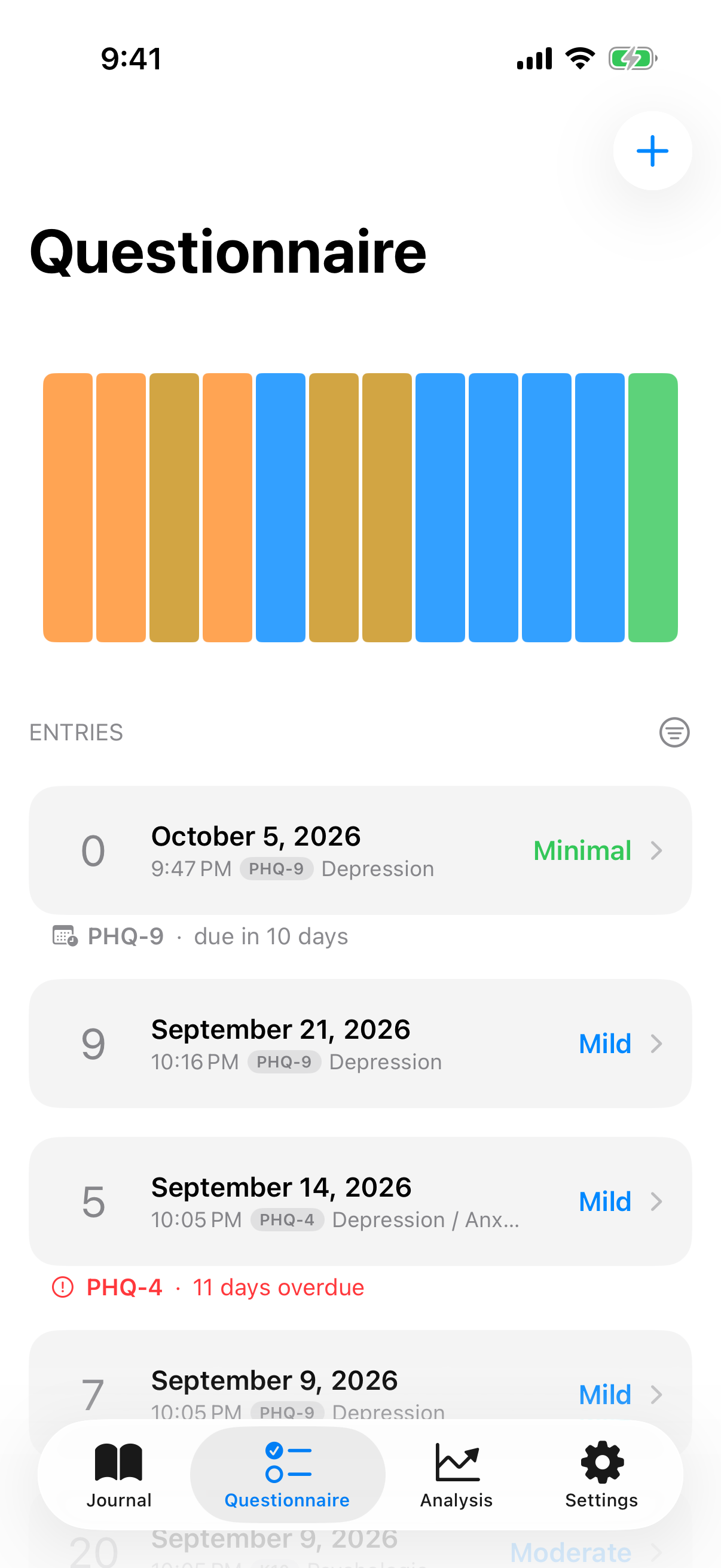
InnerPulse makes the opposite choice: the clinical literature already decided what matters. PHQ-9 measures depression on nine dimensions, validated against structured clinical interviews in millions of patients. GAD-7 does the same for anxiety. K10 (the Kessler Scale) captures general psychological distress, used routinely in Australian and UK primary care. PHQ-4 is a 2-minute weekly check. You don't design these - you take them, and your scores are directly comparable to what your therapist or GP would see in their clinic.
If your goal is to understand your own idiosyncratic symptom patterns, Bearable is the better match. If your goal is to walk into a therapy appointment with the same numbers your therapist uses, InnerPulse is.
BearableDesign your own system
You define the symptoms, the scales, the categories. Powerful for users who know what they want to measure and have the patience to configure.
InnerPulseUse validated instruments
PHQ-9, GAD-7, K10, PHQ-4 - the same scales your therapist uses. Scores map directly to clinical diagnostic bands.
Privacy: local-first vs cloud-first
This is the biggest practical difference.
Bearable syncs to their cloud. Data is encrypted, and they state it stays yours. But the reality is: every cloud-synced health app is a potential breach target, and mood data is some of the most sensitive health data there is.
InnerPulse never sends anything to its own servers. No account, no login. For the optional device sync between iPhone and iPad, the app encrypts your data end to end before it goes to your private iCloud. The database lives in the protected app container of your iPhone or iPad. The one honest caveat: if you have iCloud Backup enabled in iOS Settings, your InnerPulse data is part of that device-wide backup, the same as any other app. You can exclude InnerPulse from iCloud Backup via Settings → Apple Account → iCloud → Manage Storage → Backups if you want the data to stay strictly on one device. What InnerPulse never does is run its own cloud or ship your data to us or any third party.
There's a second, less-obvious payoff to local-only storage: data honesty. People who don't fully trust an app quietly stay vague when they log - never fully honest, never quite accurate. A mood tracker is only useful if the data it holds is truthful. Local-first is what makes honest logging feel safe.
The pricing models
Bearable's free tier is real - you can track a lot without paying. The paid tier ("Plus") unlocks more history, advanced charts, and data export. It runs around €28/year as of late 2025.
InnerPulse charges €9.99 once. No subscription, no renewal. That's the indie-software-in-2026 ethos: pay the developer once, own the tool. If you use InnerPulse for two years, you've paid roughly 18% of what Bearable Plus costs over the same period.
There's no "free" InnerPulse. That's a deliberate choice - it means no upsell loops, no "unlock this feature," no ads. You get the entire app for €9.99.
Feature depth: who wins where
Where Bearable is stronger
- Medication tracking with detailed dosing: Bearable's medication tracker is more granular.
- Symptom customization: if your therapist has given you specific symptoms to watch for, Bearable lets you model them exactly.
- Android: Bearable ships on both iOS and Android. InnerPulse runs only on iPhone, iPad and Apple Watch.
- Community templates: Bearable users share tracking templates you can import.
People with ADHD in particular value this flexibility for juggling many parallel symptoms; how InnerPulse approaches that case is covered in InnerPulse for ADHD.
Where InnerPulse is stronger
- Clinical validity out of the box: PHQ-9 scores mean the same thing in InnerPulse as in your doctor's office. With Bearable's custom scales, the comparison is fuzzy.
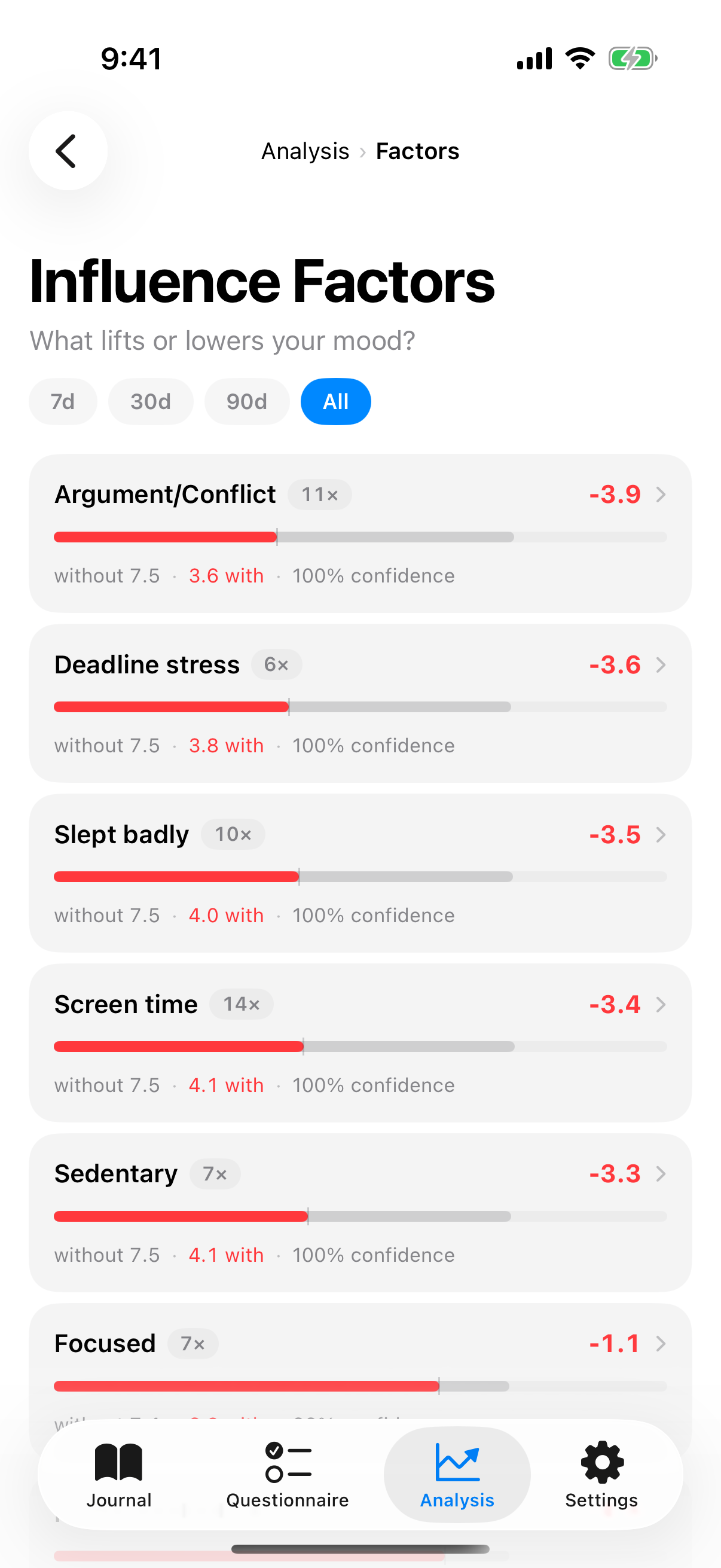
- Correlation analysis: InnerPulse auto-surfaces which of the 100+ factors most influenced your mood over the past 30/90 days. Bearable shows the data; you do the pattern matching.
- Emotionally light on bad days: 10 seconds per entry, no streak to break, no "complete your log" pressure. This is a deliberate product principle - on the days when you most need the data, the tool can't feel like work.
- Offline reliability: no "syncing…" spinner, no "login expired," no connectivity failures.
- CSV export for your doctor: InnerPulse generates a clinical-style report with PHQ-9, GAD-7, K10 trends, formatted to be handed to a GP or therapist at a 15-minute appointment.
Who should pick Bearable
- You use both iOS and Android and want sync.
- You want to design your own tracking system and have the patience to configure it.
- You want a community of users sharing templates and tips.
- You're comfortable with cloud sync and a subscription.
Who should pick InnerPulse
- You're on iOS and want native integration (widgets, Apple Watch, iPad with split screen, Health app).
- You prefer a one-time purchase over subscriptions.
- You're in therapy - or waiting for a therapy slot - and want clinically validated scores you can discuss with a clinician.
- You value privacy enough that "nothing leaves my phone" matters to you.
- You've tried gamified mood apps and noticed the streak anxiety makes things worse on bad days.
- You want the tool to do the correlation analysis for you.
What about Daylio and Apple Health State of Mind?
Daylio is the most popular consumer mood app - simpler than Bearable or InnerPulse, mostly a mood-rating-per-day tool with activities. If you want the minimum viable mood tracker, Daylio is fine. See our InnerPulse vs Daylio comparison for the full breakdown. If you want a tracker as customizable as Bearable but cheaper, MoodFlow is an alternative: InnerPulse vs MoodFlow.
Apple Health's State of Mind feature is the new default for iOS users - built-in, free, and Apple-trusted. It's a completely different philosophy: a point-in-time risk screener, not a longitudinal correlation tool. See InnerPulse vs Apple Health State of Mind if you're weighing that option.
The honest answer
Most people who try both end up picking based on one thing:
- If "I want full control over what I track" → Bearable.
- If "I want validated scores and I want my data to stay on my phone" → InnerPulse.
Both apps are excellent. Neither is a bad choice. If you're still unsure, try InnerPulse - at €9.99 one-time it's a low-risk pick, and you'll know within a week whether the clinical-screenings approach fits how your mind works. For where InnerPulse sits across the whole field, see the best mood tracker 2026.
See what shapes your mood
Clinical tests, 100+ influence factors, data on your devices. One-time purchase.
Get on the App Store