PMDD - premenstrual dysphoric disorder - is the hardest kind of mood pattern to document, because the symptoms come and go with the cycle and are easy to dismiss in hindsight. Getting a PMDD diagnosis typically requires showing your gynecologist or psychiatrist documented symptom patterns across at least two cycles. This is the exact job InnerPulse is built for.
This page isn't a medical guide. For the clinical side, read our deep-dive on mood and the menstrual cycle. This page is about how to use InnerPulse specifically if you suspect you have PMDD and want to build the evidence.
What doctors need to see
The DSM-5 criteria for PMDD require:
- At least five symptoms present in most cycles for a year.
- Symptoms appearing in the week before menstruation and remitting within a few days after onset.
- At least one core affective symptom (marked mood swings, irritability, depressed mood, anxiety).
- Clinically significant distress or functional impairment.
- Documented by prospective daily ratings across at least two symptomatic cycles.
Point 5 is the blocker. Most people realize they might have PMDD retrospectively - "I always feel like this right before my period." But doctors need the prospective daily ratings. That's what mood tracking gives you.
The two-cycle minimum
The clinical gold standard is two full cycles of daily tracking. That's roughly 60 days of consistent entries. InnerPulse's design - 10 seconds per entry, Lock Screen widget - is built exactly for this: low enough friction that you can maintain the habit through the rough weeks.
Don't wait for the "good" cycle to start tracking. The PMDD cycle is the data - you need the bad days to make the case.
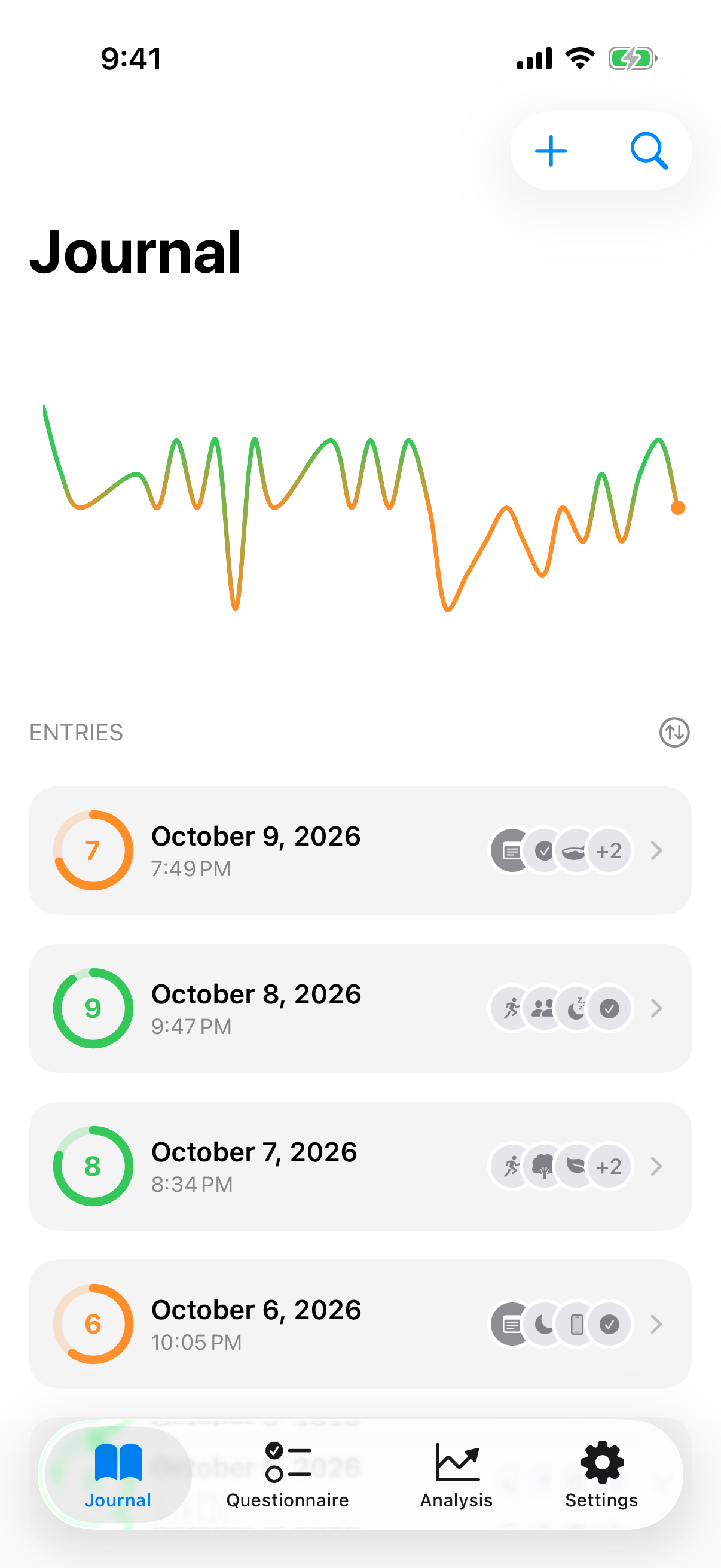
A typical PMDD cycle pattern
Which InnerPulse features matter here
1. The 1-10 mood scale + feelings
PMDD doesn't just lower overall mood. It hits specific areas: irritability, anxiety, emotional lability. Alongside the 1-10 mood score, InnerPulse lets you name up to three feelings per entry, such as "Irritated", "Nervous" or "Sad". The Feelings analysis shows how often you name each feeling and at which mood score it appears, and the export lists the feelings per entry. That lets you show: "For ten days I felt irritated almost every day, then I recovered." These are observations from your entries, not a clinical assessment. Your doctor makes that assessment.
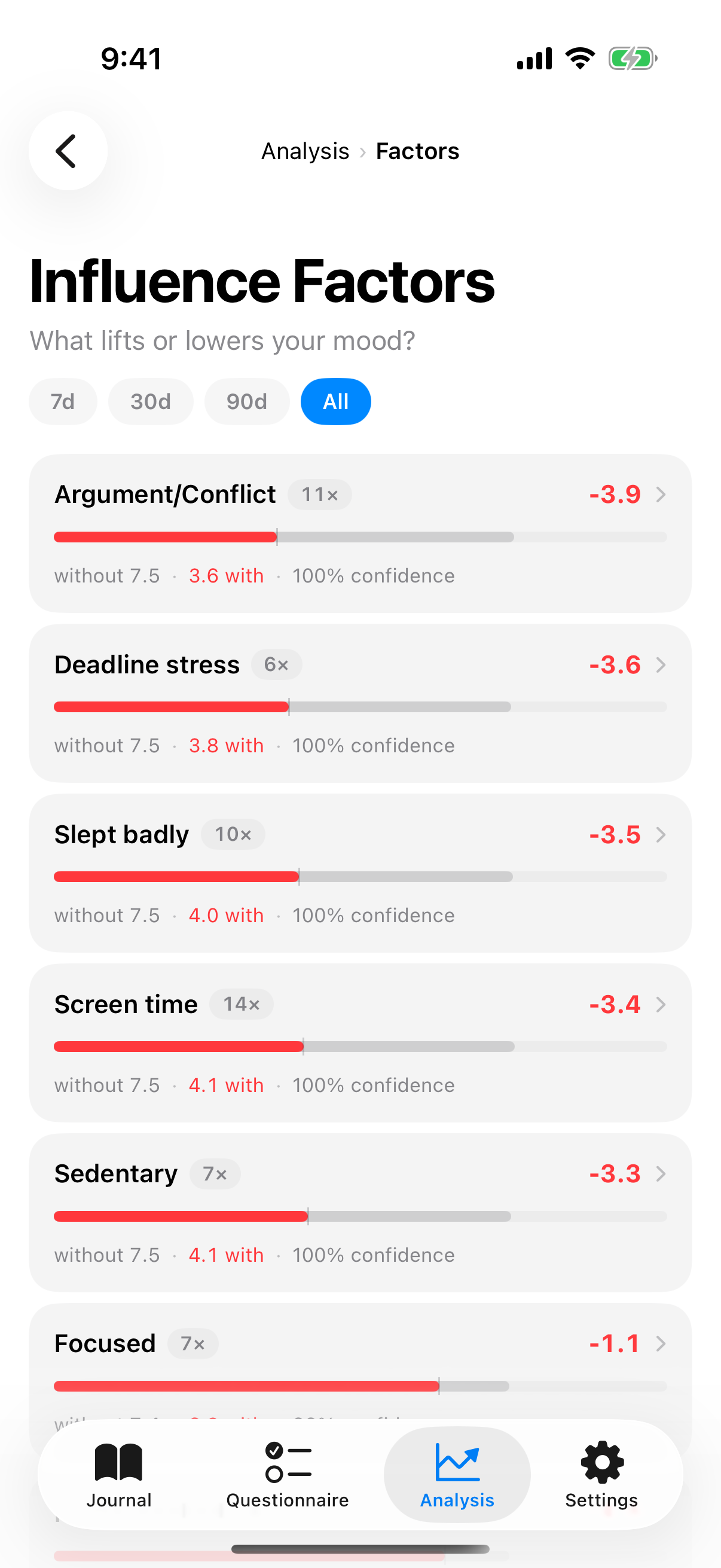
2. The 100+ influence factors
PMDD requires ruling out that the mood drop is caused by something else. With factor tracking, you can show your gynecologist: "I slept well, I exercised, no work stress - and my mood still dropped on day 24 of the cycle." That isolation of the cycle variable is what distinguishes PMDD from reactive mood changes.
3. PHQ-9, GAD-7 and K10 (weekly)
The clinical screenings produce hard numbers that cycle with your PMDD. A PHQ-9 of 4 in the follicular phase and 16 in the luteal phase is a very readable chart. K10 adds a general-distress line that captures the irritability + agitation component, which PHQ-9 alone underweights. That's the kind of pattern your doctor can't argue with. If anxiety is your dominant premenstrual symptom, the InnerPulse for anxiety workflow helps you make sense of it too.
4. The CSV export
InnerPulse generates a clinical-style report with PHQ-9 trends, GAD-7 trends, and a mood timeline. You can export it and bring it to your gynecologist or psychiatrist appointment. It looks like something from a research study, not a consumer app.
A suggested tracking pattern
- Daily (10 seconds): mood score, with up to three feelings if needed. Don't skip the bad days - they're the point.
- Weekly: PHQ-9 and GAD-7 on a fixed day (e.g., every Sunday). This gives you weekly trend data that aligns with cycle phases.
- At cycle start: note "menstruation" in the factors for the first 1-2 days. InnerPulse will use this to align your mood data with cycle phase.
- After two full cycles: export the CSV. Compare the luteal vs follicular phase. Book the appointment.
Why not just use a period tracker with mood?
Period tracking apps (Clue, Flo, Natural Cycles) have mood features. They work well for casual mood-cycle correlation. What they don't do well:
- Clinical screenings. Clue doesn't give you PHQ-9 or GAD-7. Those are the instruments doctors actually use.
- Severity quantification. A period tracker shows "sad emoji on days 22-28." InnerPulse shows "mood score dropped from 7.5 to 3.8; PHQ-9 rose from 4 to 16."
- Factor isolation. Period trackers can't rule out that sleep, stress, or substances caused the dip. InnerPulse can.
Use a period tracker for the cycle. Use InnerPulse for the mood-cycle correlation and the clinical evidence.
What InnerPulse won't do
Let's be honest about the limits:
- It won't diagnose you. That's your doctor's job. InnerPulse gives them data to work from.
- It won't replace a reproductive endocrinologist or psychiatrist. For actual treatment (SSRIs used cyclically, hormonal interventions, etc.), you need a clinician.
- It won't predict your cycle. InnerPulse doesn't track ovulation or period dates beyond what you log as factors.
- It won't help with PMS. PMS is milder and mostly doesn't need prospective tracking for diagnosis. PMDD does.
What the first month looks like
Week 1: Set up the app. Log daily. Do PHQ-9 and GAD-7 once. Skim the InnerPulse guide.
Week 2: Keep logging. Ignore the charts for now - you don't have enough data.
Week 3-4: The charts start telling a story. If PMDD is the pattern, you'll already see mood dropping. Resist the urge to diagnose yourself - you need the second cycle for a clean case.
Week 5-8 (cycle 2): Repeat. By the end of cycle 2, you have 60+ data points, two PHQ-9/GAD-7 trends, and a clear luteal-vs-follicular pattern if PMDD is what's going on.
Week 9: Export CSV. Book the appointment.
Next steps
If you want the clinical background: Mood and the Menstrual Cycle: Spotting PMDD Patterns.
If you want to see how the app handles cycle data: How InnerPulse Works.
If you're also thinking about the therapy handoff side: InnerPulse for Therapy.
If you suspect a seasonal rather than cyclical pattern: InnerPulse for seasonal affective disorder.
If you're ready to start tracking: InnerPulse is a one-time €9.99 purchase on the App Store. No subscription, no cloud of ours, no account. Two cycles of tracking gives you what a clinician needs to take your PMDD case seriously.
See what shapes your mood
Clinical tests, 100+ influence factors, data on your devices. One-time purchase.
Get on the App Store