Daylio is the default answer when someone asks "what's a good mood tracker?" Over 20 million downloads, a five-minute onboarding, hundreds of cute mood emojis. It's designed to be the easiest mood tracker on the App Store - and it is.
InnerPulse is a different kind of tool. It's built as a therapy companion - for people who are in therapy now, waiting for a slot, between slots, or working through a medication trial. The goal isn't a cheerful mood diary. It's evidence of symptom patterns, formatted in the same clinical language a therapist uses. This page explains when Daylio is the right choice and when InnerPulse is.
| Feature | InnerPulse | Daylio |
|---|---|---|
| Positioning | Therapy companion | Casual mood journal |
| Pricing | One-time €9.99 | Free with paid Premium (~€20/year) |
| Data storage | On your devices, no account; device sync optional, end-to-end encrypted | Optional cloud backup, Google-account based |
| Clinical screenings | PHQ-9, GAD-7, PHQ-4, K10 | None |
| Mood scale | 1-10 + up to 3 feelings | 1-5 mood icons |
| Influence factors | 100+ pre-built + correlation engine | Custom activities (no correlation) |
| CSV clinical export | Yes, for therapy appointments | No |
| Export | CSV per-question, PDF report, ZIP with media | CSV (Premium) |
| Gamification | None (no streaks) | Streaks, achievements |
| Target user | People engaged with their mental health or in therapy | Everyone, casual tracking |
| Scientific footing | Validated instruments only | Proprietary design, rated as dated UX in a 2020 Hussain et al. audit |
Daylio's core strength: low friction
Daylio's genius is that it makes mood tracking feel like nothing. You open the app, tap an emoji, maybe pick a few activities, done in under ten seconds. No setup, no learning curve. You can track your mood for a year and never read a single chart.
That low friction is why Daylio has 20 million downloads and roughly 3-5 million USD in annual revenue. If you have never tracked your mood before and you're not sure whether you'll stick with it, Daylio is the correct first step. It asks almost nothing of you.
InnerPulse's core strength: signal you can bring to therapy
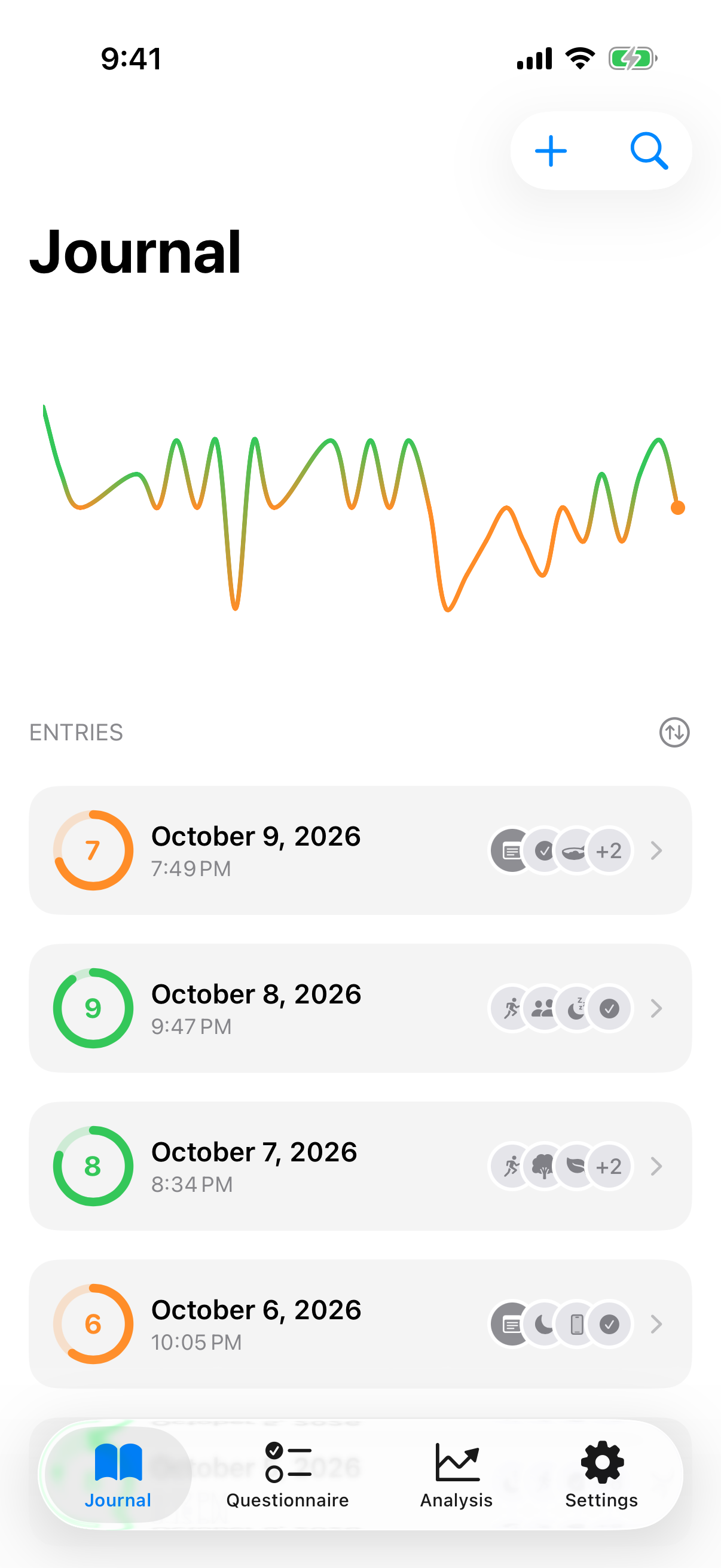
InnerPulse asks slightly more of you. Instead of "tap an emoji," you get a 1-10 mood score and, if you like, name up to three feelings, such as "Drained" or "Relieved". That takes maybe 15 seconds instead of 5. In exchange, you get data that actually tells you - and your therapist - something:
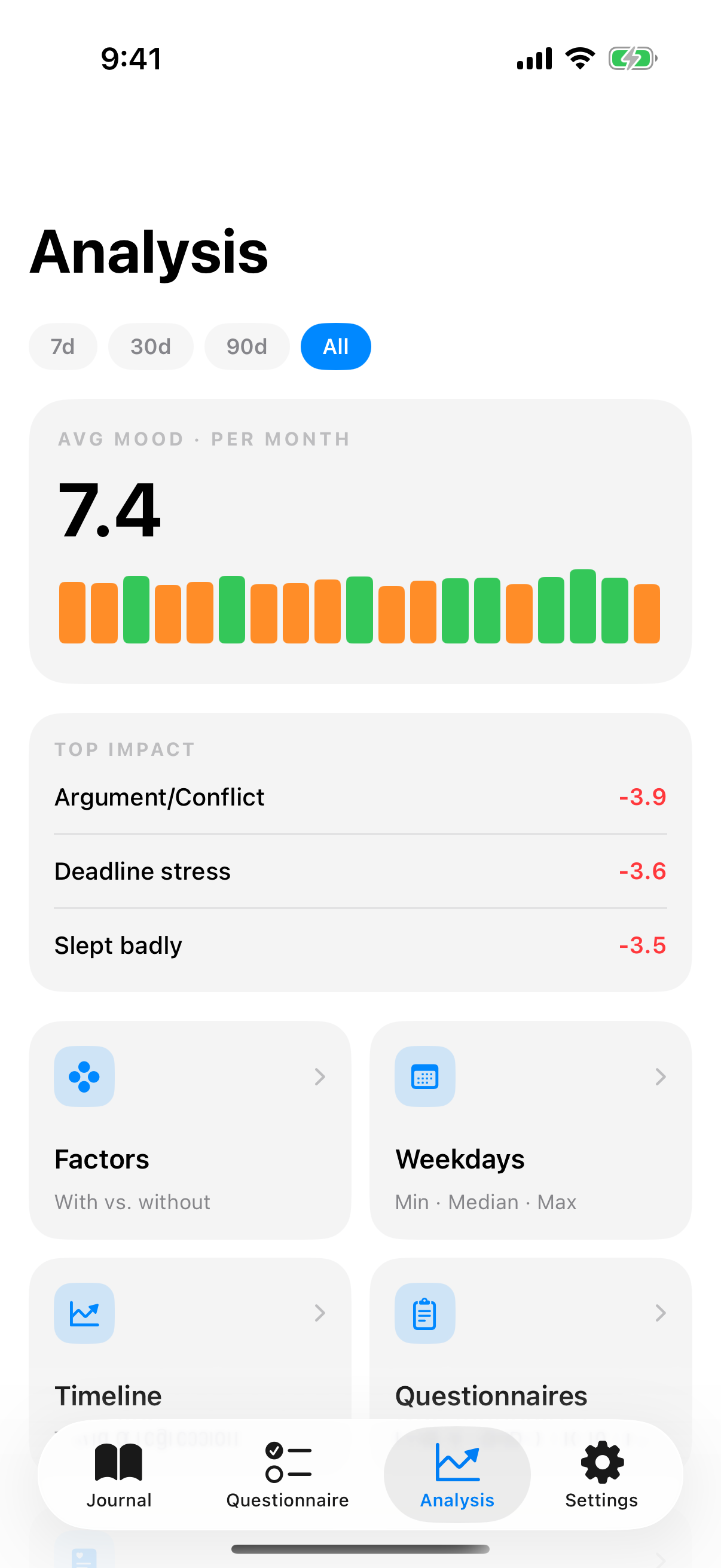
- The correlation engine looks at 100+ influence factors (sleep hours, exercise, caffeine, social interactions, weather, work hours, medication, etc.) and tells you which ones most predict your mood. Daylio has activities but no correlation analysis.
- The clinical screenings (PHQ-9 for depression, GAD-7 for anxiety, K10 for general distress, PHQ-4 for rapid checks) produce scores that map directly to clinical diagnostic criteria. Daylio produces mood emojis.
- The CSV export is something you can hand your GP or psychiatrist at a follow-up. Daylio produces a prettier but clinically meaningless chart.
The "when does it matter" test
Daylio matters when:
- You want to build a habit of reflection without commitment.
- You're curious if your mood is seasonal, weekly, or tied to specific activities.
- You want a private, pretty journal that feels like a game.
- You're not dealing with anything acute - no depression diagnosis, no medication changes, no burnout worries.
InnerPulse matters when:
- You've been diagnosed with depression, anxiety, PMDD, bipolar, or burnout - or suspect one of those - and want to track symptoms the way your doctor does.
- You're currently waiting for a therapy slot (in Germany, the average wait is 142 days). InnerPulse gives your waiting time structure and produces evidence for the first session.
- You started or stopped a psychiatric medication and want objective data on whether it's working.
- You suspect a pattern (PMDD, seasonal affective, burnout) and want to see it in actual numbers.
- You care about data privacy enough that "nothing leaves my phone" matters.
The subscription question
Daylio is free with a Premium upgrade (~€20/year) that unlocks more moods, more goals, CSV export, and themes.
InnerPulse is €9.99 one-time for the entire app. Over three years of use, InnerPulse costs about 8% of what Daylio Premium does.
That said: Daylio's free tier is generous. If you use Daylio casually and don't need Premium, Daylio is effectively free. InnerPulse has no free tier. For more on why InnerPulse deliberately skips subscriptions, see mood tracker with no subscription.
Streaks: the hidden reason Daylio fails some users
Daylio gamifies consistency with streaks. For most users, that's fine - the streak is a motivation to log daily. But for users who track mood because they're struggling, streaks can actively harm. Miss a day during a bad week, lose a 47-day streak, and what was meant to help now feels like another failure. Daylio stays relatively mild here; apps like Finch push gamification to the extreme with a virtual companion and rewards: InnerPulse vs Finch.
InnerPulse deliberately has no streak counter. The product principle is "emotionally light to open, even on bad days." A tool meant to support you through depression cannot also be a pressure system. This is one of the subtler differences between a casual mood app and a therapy companion.
Data privacy: a real difference
Daylio offers cloud backup tied to a Google account. The data is encrypted at rest, but it's still on a server. That's a trade-off many people accept for the convenience of getting their data back if they switch phones.
InnerPulse has no cloud of its own, no account, no built-in backup service. Your data lives on your device, and with the optional device sync also on your other devices, end-to-end encrypted. The one caveat: if you have iOS iCloud Backup enabled, the InnerPulse database is part of that device-wide backup (you can exclude the app in iOS Settings). The upside: no third-party server, no account to recover passwords for. The downside: without iCloud Backup, device sync or a CSV export, losing your phone means losing the data.
Mood data is sensitive. For some people - especially those tracking medication use, substance use, or clinically relevant symptoms - local-only is the right answer. For others, cloud backup is worth it.
What about depth of features?
Daylio is wider than it is deep. It has lots of customizable moods, activities, goals, streaks, and themes. It's very configurable in a surface-level way. A 2020 academic audit of mental health apps (Hussain et al., JMIR Mental Health) flagged Daylio's UX as visibly dated, with unclear icons and inconsistent iOS/Android design.
InnerPulse is deeper than it is wide. It has one mood-rating system (the 1-10 plus feelings), one set of clinical screenings, and one correlation engine - but each of those is built to actually work, not just to give you another button to press.
If you like configuring things, Daylio feels more fun. If you like when tools actually surface insights you couldn't see yourself, InnerPulse feels more useful.
Where they agree
Both apps:
- Let you log daily mood in seconds.
- Store your data privately (with different trade-offs).
- Work offline.
- Don't sell your data.
What about Bearable and Apple Health State of Mind?
Bearable sits between Daylio and InnerPulse: broader custom symptom tracking than InnerPulse, more serious than Daylio. See InnerPulse vs Bearable for that comparison.
Apple Health's State of Mind is the new default on every iPhone - free, built-in, apple-trusted. It's a point-in-time risk screener with three instruments (State of Mind, Depression Risk, Anxiety Risk), not a longitudinal correlation tool. InnerPulse vs Apple Health State of Mind covers that. For the whole field at a glance, see the best mood tracker 2026.
The honest answer
If you've never tracked your mood before and you're not sure you'll keep at it: start with Daylio. It's free, fast, and you'll know within two weeks whether mood tracking is something you want in your life.
If you've been dealing with depression, anxiety, PMDD, medication changes, or burnout - or if you already tried a casual mood tracker and wanted something you could actually bring to a therapist: get InnerPulse. €9.99 once, built for exactly this use case, and you'll know within a week whether the clinical-screening approach works for how your mind works.
See what shapes your mood
Clinical tests, 100+ influence factors, data on your devices. One-time purchase.
Get on the App Store