Starting or switching a psychiatric medication is hard because the judgment call - is this working? - has to be made mostly from memory. SSRIs take four to eight weeks to show effects. Your psychiatrist will ask "how do you feel compared to when we started?" and most people genuinely can't remember. That's exactly the gap InnerPulse fills.
This page is about using InnerPulse for a specific job: tracking whether a psychiatric medication is working, with objective data that holds up in a 15-minute follow-up appointment.
Why memory isn't enough
There's a known problem with medication follow-ups: patients forget how bad things were at the start. After four weeks on an SSRI, you don't remember the specific weight of the mornings in week one. You just remember "it was bad." The medication might have helped a lot, a little, or not at all - and you can't tell without a baseline.
Psychiatrists call this recall bias. It's why the clinical standard for medication trials is prospective symptom measurement - PHQ-9 at baseline, at week 2, at week 4, at week 8. That's how real trials evaluate whether a drug works. You can run the same protocol on yourself.
What the first eight weeks look like
The recommended trial length for an SSRI or SNRI is 6-8 weeks at a therapeutic dose before declaring it effective or ineffective. Here's the InnerPulse-backed version:
Day 0 (baseline): Take the PHQ-9 and GAD-7 in the app. Record whatever else is relevant - sleep, appetite, current stressors. This is your "before" snapshot.
Days 1-14 (adjustment phase): Daily mood score (10 seconds). Log side effects as factors: "nausea," "insomnia," "sexual side effects," "headache," "emotional blunting." InnerPulse will track which ones persist vs resolve.
Day 14: Second PHQ-9 and GAD-7. Usually too early to see real effect on mood, but side-effect pattern is already visible.
Days 15-42 (therapeutic window): Daily logging continues. Take PHQ-9/GAD-7 weekly. This is the period where real change starts showing up if the medication is going to work.
Day 42-56: Third and fourth weekly PHQ-9/GAD-7. You now have 4-5 data points on the scales plus 40+ daily mood scores. Export the CSV.
Follow-up appointment: Bring the CSV. Your psychiatrist gets six weeks of numerical data in the same format they use in clinic.
Why this beats the "how have you been?" approach
A typical follow-up appointment asks "how have you been since we started the medication?" You answer from memory, under the pressure of a 15-minute appointment. The psychiatrist has to make a dosing decision from a summary you gave them in 90 seconds.
With a CSV showing:
- PHQ-9 went from 18 to 14 to 11 to 8 over six weeks
- GAD-7 went from 12 to 11 to 9 to 8
- Nausea resolved at week 3
- Insomnia persists
- Mood score trend: +1.4 over baseline
…the conversation changes. You have evidence. The psychiatrist sees what's actually happening instead of asking you to summarize six weeks in one sentence.
PHQ-9 response curve, typical 6-week SSRI trial
Which InnerPulse features matter here
1. Medication as a factor
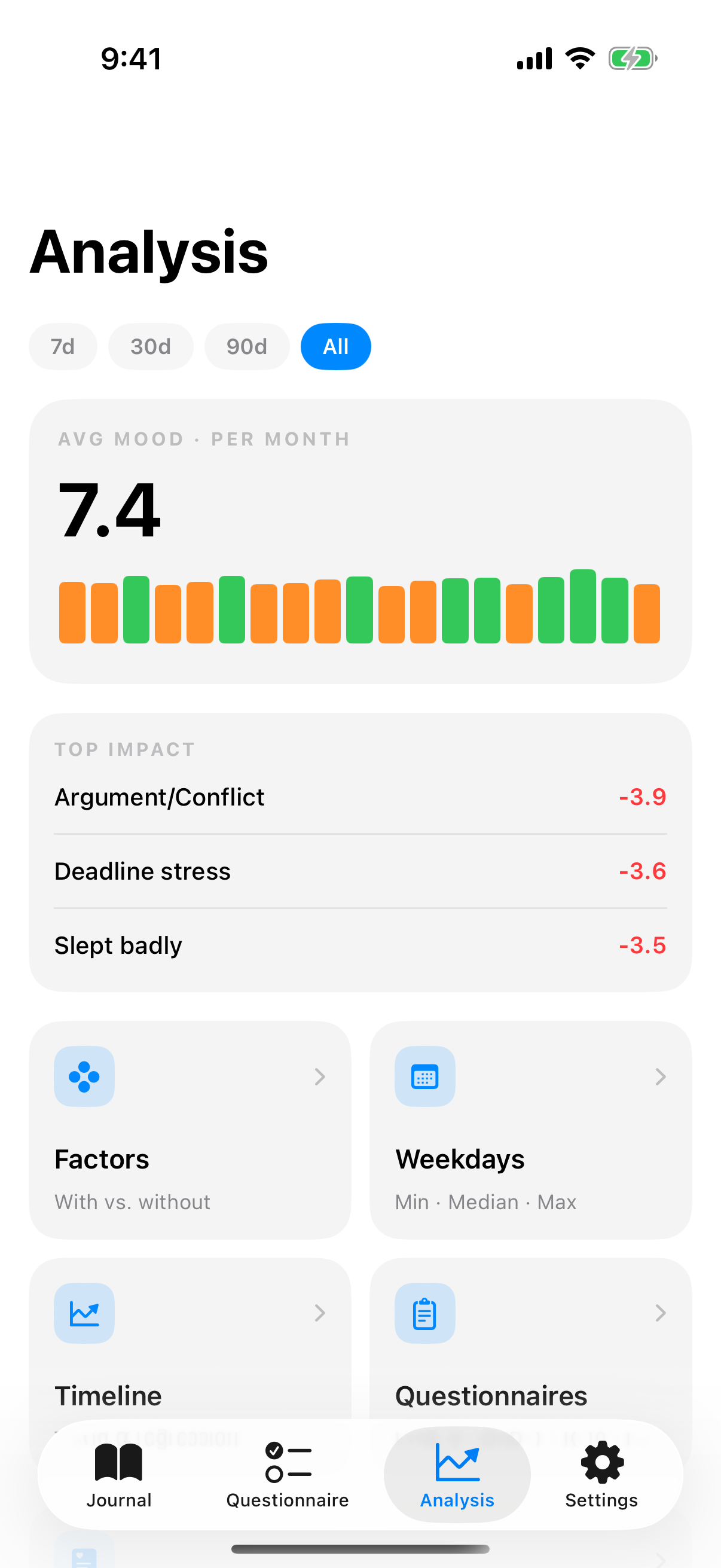
Add your medication name and dose as a factor. InnerPulse will correlate it with mood trend. When your dose changes, add it as a new version. Over three months, the factor chart shows your mood response to each titration step. This is not just for antidepressants: mood stabilizers for bipolar disorder or stimulants for ADHD can be tracked through the same factor chart.
2. Side-effect tracking
Common SSRI/SNRI side effects are trackable as factors: nausea, headache, insomnia, sexual dysfunction, emotional blunting, yawning, GI symptoms. Because each gets its own frequency count, you'll know at the follow-up: "nausea was there days 1-10, then gone. Insomnia is still present. Sexual side effects started week 4."
3. PHQ-9, GAD-7 and K10 trends
These are the instruments psychiatrists actually use. Your numbers are directly comparable to what they'd measure in clinic. A 5-point drop in PHQ-9 is a clinically meaningful response. A 10-point drop is remission. K10 captures the general-distress and agitation dimensions that SSRIs take longer to shift than core depression - tracking it separately prevents a false "it's not working" conclusion at week 4.
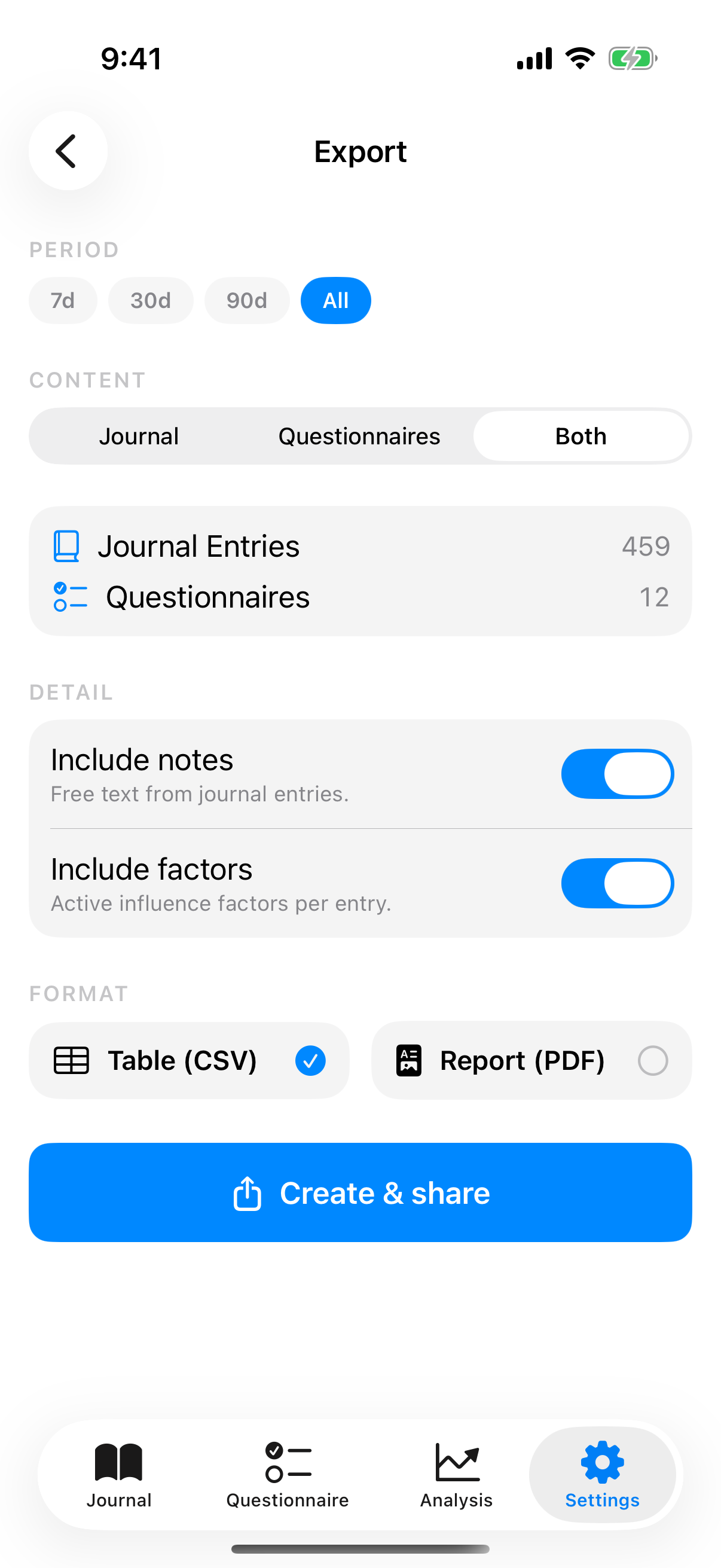
4. The CSV export
Same as for PMDD: exportable, professional-looking, maps to clinical instruments. Hand it to your psychiatrist at the appointment.
What you're actually answering
After eight weeks, the questions you and your psychiatrist can now answer clearly:
- Did PHQ-9 drop 5+ points? If yes, the medication is working. If no, you're likely in the 30-40% of patients who don't respond to the first choice and need a switch or augmentation.
- Are side effects acceptable? Some fade, some don't. Tracking them separately from mood is important because mood recovery can hide ongoing side effects.
- Is there a dose-response pattern? If your mood improved after the dose went from 10mg to 20mg, you can see that transition in the data. Useful for deciding whether to go higher.
- Did mood improve and did you attribute to the medication or to something else? With factor tracking you can often see "mood rose, but so did sleep, exercise, and light exposure" - letting you and your psychiatrist disentangle medication effect from lifestyle confounders.
What this is not
- Not a substitute for your psychiatrist. Dose changes, switches, augmentation - these are clinical decisions. InnerPulse gives you and your clinician better data for them.
- Not medical advice. Never stop, reduce, or change a psychiatric medication based on mood tracking alone. SSRI discontinuation syndrome is real. Always coordinate with your prescriber.
- Not a cure for treatment-resistant depression. If you've tried three medications and none worked, mood tracking doesn't change that - but it makes the case cleaner when you bring it to a specialist.
Related reading
- InnerPulse for Therapy - the broader therapy companion use case.
- InnerPulse while waiting for therapy - many start medication before a therapy slot opens up.
- Is My Medication Working? How to Use Mood Data - the clinical logic in more detail.
- What Actually Acts as an Antidepressant: 25 Levers That Shift Your Mood - the bigger picture of non-medication levers.
- PHQ-9: Every Question Explained - how each PHQ-9 item maps to depression.
Getting started
InnerPulse is a one-time €9.99 App Store purchase. No subscription, no cloud of ours, no account. Set it up in five minutes, log for eight weeks, export the CSV, go to your follow-up with evidence instead of memory. That's the whole workflow.
See what shapes your mood
Clinical tests, 100+ influence factors, data on your devices. One-time purchase.
Get on the App Store