This is the use case InnerPulse was originally built for. The starting observation was simple: the average wait for a psychotherapy slot in Germany is 142 days. During those months, people are generally left to their own devices - no structure, no instrument, no evidence of symptom patterns to bring to the first session. And once therapy starts, the 15-minute follow-up appointment often devolves into "how have you been?" answered from memory. That's a data gap that a well-designed mood tracker can fill.
InnerPulse is the tool for that job. Not a replacement for therapy. A companion to it.
Why the mood tracker most people use doesn't work for therapy
Most mood trackers (Daylio, Moodflow, and so on) are designed for the general population - casual mood awareness, emoji ratings, activity logging. They're designed to be simple and consumer-friendly. That design makes them, by definition, not suitable for clinical work. A therapist receiving a screenshot of your Daylio chart cannot do much with it - the rating scale is proprietary, the comparison to clinical norms is impossible, and the mood summary doesn't map onto diagnostic criteria.
InnerPulse's core difference is that it uses the same instruments your therapist uses. PHQ-9 (depression). GAD-7 (anxiety). PHQ-4 (rapid weekly check). K10 (general psychological distress). These are the scales published in peer-reviewed journals, used in primary care and psychiatric practice around the world. When your clinician sees a PHQ-9 score of 14, they know exactly what that means.
The three distinct therapy-companion use cases
1. While waiting for a therapy slot
Germany has among the longest therapy waiting lists in Europe - average 142 days from request to first session (Bundespsychotherapeutenkammer, 2024). Other European countries aren't much better. For the person waiting, this period is often the worst: you've decided you need help, you can't get it yet, and there's no structure.
What InnerPulse offers:
- Daily mood score (10 seconds) gives structure to each day. Logging "I was at 4/10 today" is itself a small act of reflection.
- Weekly PHQ-9/GAD-7 produces a symptom severity baseline. When the therapy slot opens, you walk in with three months of weekly scores instead of a vague "I've been bad."
- Factor correlation starts answering questions. Is sleep the biggest lever? Work stress? Social contact? By the first session, you already have hypotheses to test.
More on this phase and how to structure it: InnerPulse while waiting for a therapy slot.
2. While in active therapy
Good therapy is bounded - typically 12-50 sessions over 6-24 months, depending on the modality and severity. Between sessions is where most of the actual change happens, and where most of the slippage happens, too. InnerPulse is for between-sessions:
- Symptom tracking between sessions. Your therapist can ask you to watch for specific symptoms or situations, and you have a tool to record them systematically.
- Homework accountability. If your therapist assigned an ACT exercise, a behavioral activation list, a sleep hygiene protocol - factors track whether you actually did it, and the mood trend tells you whether it helped.
- Trend summaries for follow-ups. Every session is more productive if it starts with "here's the PHQ-9 trend since last time" instead of "how have you been?"
3. Medication management
The six-to-eight-week SSRI trial is one of the hardest things to evaluate from memory. Did the medication help? Was the side-effect profile acceptable? Should we go to 20mg? These decisions deserve data, not impressions. We have a detailed page on medication tracking for this specific workflow.
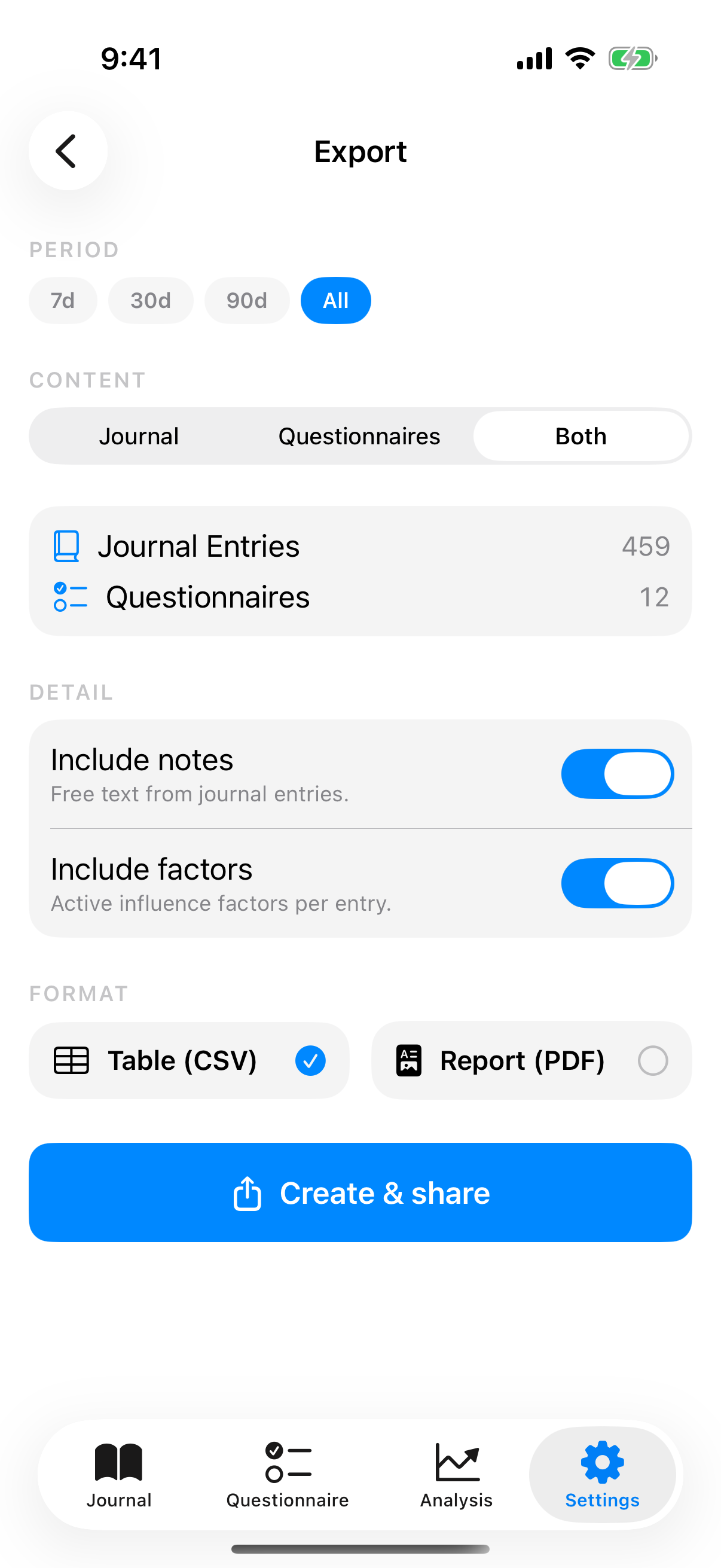
The CSV export: what it actually contains
This is the artefact most users find most valuable. After a few weeks of tracking, InnerPulse can generate a CSV export that contains:
- PHQ-9 trend - every weekly score on one chart, with the clinical severity bands colored in.
- GAD-7 trend - same for anxiety.
- K10 trend - general psychological distress over time.
- Mood timeline - your daily mood scores with a 7-day rolling average.
- Top factor correlations - the 5-10 factors most associated with higher and lower mood days.
- Date-ranged summary - so you can export "last 30 days" for a single session or "last 90 days" for a quarterly review.
The format is deliberately clean. No branding, no marketing, no "InnerPulse recommends." It's designed to slide into a therapist's clinical notes alongside their own documentation. Several therapists who saw early versions told us they appreciated that it looked like a research-study output, not a consumer app export.
For therapists: what InnerPulse gives you
If you're a therapist reading this, the short version: InnerPulse is designed to be recommendable without liability concerns. Specifically:
- No medical claims. The app describes itself as a reflection companion. It does not diagnose, prescribe, or recommend treatment.
- Validated instruments. You can trust that PHQ-9 scores in the app are calculated correctly and scored against the published severity bands.
- No data access for us. We don't see your patient's data. There's no server of ours and no account. The data stays on their phone. If they use the optional device sync, the app encrypts everything end to end before it goes to their private iCloud. You don't need to worry about what we're doing with the data, because there's nothing for us to do.
- Privacy-first is the selling point for patients. The highest-friction moment when you recommend a tracking app is your patient thinking "my therapist is going to read my logs." InnerPulse removes that friction - the app has no cloud of its own, no account, no server-side logging. The only off-device copy ever created is an iCloud Backup the patient opts into in iOS (excludable per-app). The data never reaches us or any third party.
- CSV export with per-question granularity. If your practice uses spreadsheet tracking or any clinical software, patients can export their data in a format you can work with.
- One-time price. You can recommend it to a patient on a tight budget with a clean conscience. €9.99 one-time, no subscription, no upsells.
If you'd like to try it yourself with a promo code, or have a 15-minute feedback conversation, we're genuinely interested. Write to marvin.blome@gmail.com. This is a real outreach channel for InnerPulse, not a marketing pitch.
The product principle you should know about
Every product decision in InnerPulse is filtered through a single rule: the app must be emotionally light to open, even on a bad day. A therapy companion cannot also be a pressure system. That principle leads to concrete choices:
- No streaks. Users who miss a day during a depressive episode don't need a broken-streak notification to make things worse.
- No "complete your log" nagging. A missed day is fine. The tool is there on good days and bad days alike, without judgment.
- Factors are optional. If a user has energy for the full log, they can do it. If not, just the mood score counts - the minimum is two taps.
- The onboarding is intentionally short. 90 seconds. The longer the onboarding, the more people in crisis who install the app, get overwhelmed, and uninstall before they log the first entry.
- No gamification of any kind. Mental health is not a game.
This is the opposite of most mood-tracking apps, which are optimized for engagement metrics. InnerPulse is optimized for the harder question: does the user still open the app in week 12?
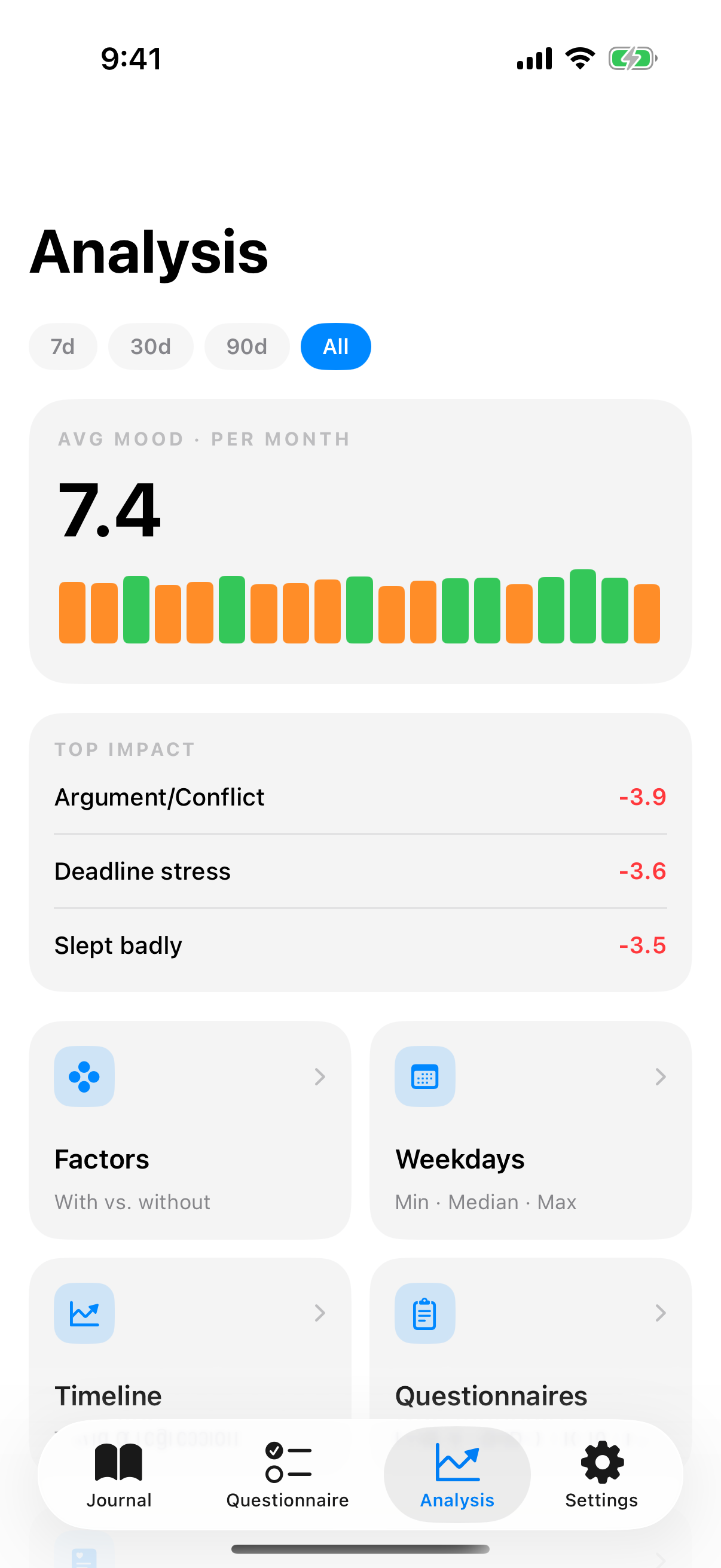
Practical workflow: the first 30 days
Day 1-7: Log mood daily (10 seconds). Do one PHQ-9 and one GAD-7 at the start of the week. Don't worry about factors yet - getting the daily-log habit is enough.
Day 8-21: Add factors as you log. Start with the ones that are easy - sleep, exercise, caffeine. Don't try to capture everything. Take a weekly PHQ-9 and GAD-7.
Day 22-30: The charts become useful. Check the "factors" tab and see which are correlating with your mood. Add a weekly K10 for broader distress tracking.
After 30 days: Export your first CSV. If you have a therapy appointment soon, bring it. If not, use it for your own understanding.
Related reading
- InnerPulse for Medication Tracking - the six-week SSRI workflow.
- InnerPulse for PMDD - the two-cycle prospective-tracking workflow.
- InnerPulse for burnout - when persistent exhaustion is the trigger.
- How InnerPulse Works - the full app walkthrough.
- What Actually Acts as an Antidepressant - 25 non-medication levers.
Getting started
InnerPulse is one-time €9.99 on the App Store. No subscription, no cloud of ours, no account. More on why InnerPulse deliberately works without a subscription. Built by Marvin Blome as a solo indie project. The best entry point if you want to try it is to install, log for a week, and then decide if the clinical-screening approach fits how you want to understand your own mental health.
See what shapes your mood
Clinical tests, 100+ influence factors, data on your devices. One-time purchase.
Get on the App Store