The hardest phase is often not therapy itself, it's the time before it. You've recognized that you need help, you've started calling around to practices, and now you're on a waitlist. In Germany the average wait for a psychotherapy slot is around 142 days, a good four and a half months with no structure, no instrument, and no systematic record. You're on your own, precisely at the moment you decided you can no longer manage on your own.
InnerPulse isn't here to close that gap, it's here to put it to good use. Instead of letting the months slip by, you build a base of data during this time: a record of your symptoms, a sense of your triggers, and a concrete foundation for the first conversation. Important: InnerPulse does not replace therapy and does not diagnose. It is a tool for self-observation. In acute distress the app surfaces crisis contacts, and in an emergency professional help is what counts, not an app.
The wait is a data gap, not an empty space
When therapy finally starts, the therapist asks about your history: how long have you felt like this? How severe is it? What makes it better, what makes it worse? Most people answer from memory, and memory is notoriously unreliable under psychological strain. Someone in the middle of a low remembers the whole past as dark. Someone having a better day underestimates, in hindsight, how bad it was.
This is exactly where the wait can turn into an advantage. If you document the months before the first session cleanly, you walk in not with a vague impression but with a documented course. You save sessions that would otherwise go to taking stock, and you give your therapist something to work with from the start.
What "usable evidence" actually means
Usable means: in the language a therapist or doctor already uses. That's why InnerPulse relies on clinical self-tests available in the UI rather than its own, non-comparable scale. Over the wait you build three things with it:
- Symptom trends instead of snapshots. If you fill in the PHQ-9 (depression) and the GAD-7 (anxiety) roughly weekly, a curve forms across weeks and months. A single value says little, a trend says a lot: is it getting worse, holding steady, improving?
- A daily baseline. The 1-10 mood score plus five sub-dimensions (energy, calm, focus, sleep quality, social energy) takes about ten to fifteen seconds and puts a marker on every day.
- Factor correlations. InnerPulse ships with more than 100+ factors (sleep, exercise, caffeine, work stress, social contact and more) and evaluates on the device which ones relate to your mood. So you enter therapy with first hypotheses instead of starting from scratch.
The correlation engine translates this into plain-language sentences, for example: "After days with little sleep, your mood is lower the next day." That's not a finding, it's a lead you can follow up on in conversation.
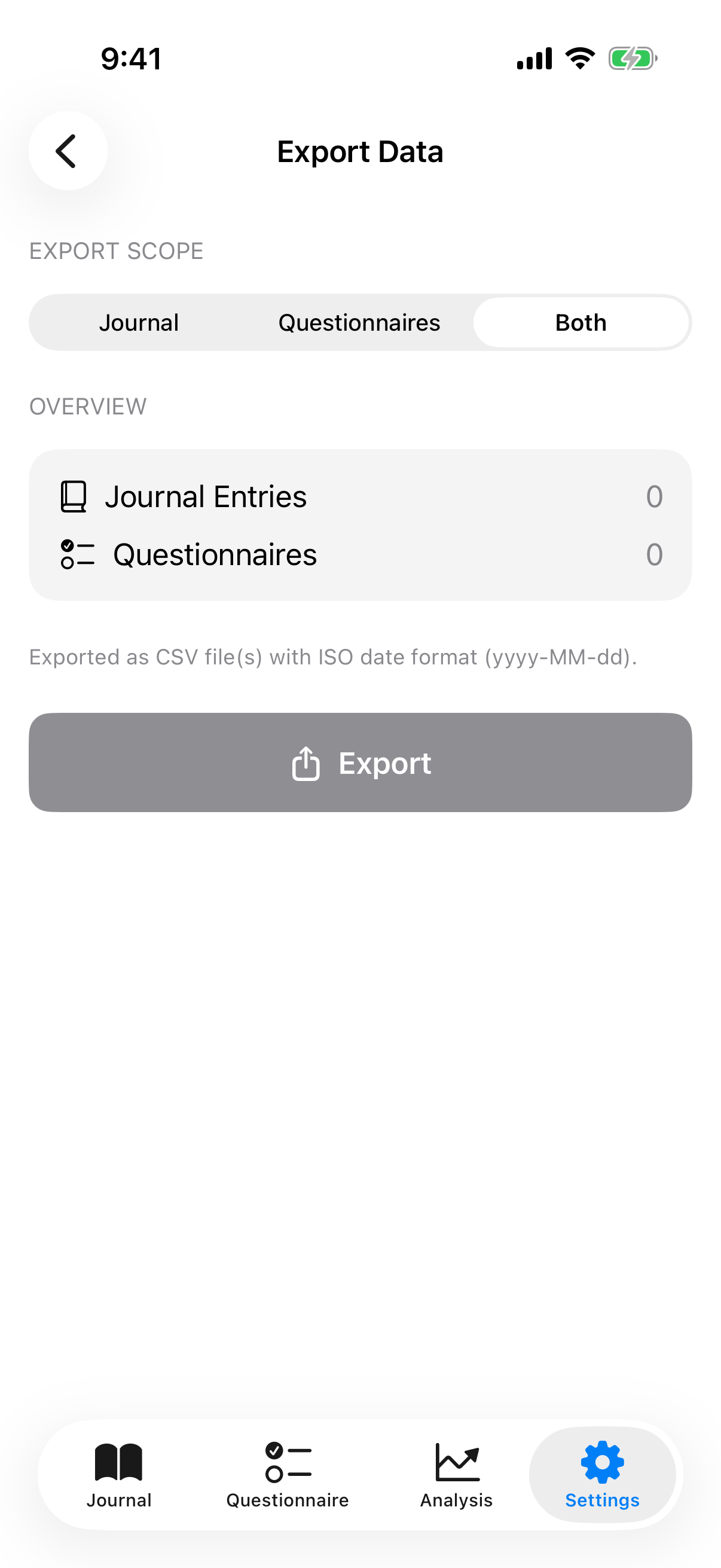
The export: the artifact for the first session
After a few weeks you can export your data in a format you can hold and bring along. InnerPulse offers CSV (including per individual question), JSON, and a PDF report. For the first appointment the PDF report is usually the most practical: it shows the PHQ-9 and GAD-7 trends with colored severity bands, the mood timeline, and the strongest factor correlations, date-filtered to the period you care about.
The format is deliberately plain. No branding, no marketing message, no app recommendation. It's meant to sit alongside a therapist's documentation, not to look like a consumer export. You decide whether and what to show. None of it is sent anywhere automatically.
A concrete waiting-time plan
You don't have to do everything at once. A suggestion that fits the length of a typical waitlist:
Weeks 1 to 2: Just log the daily mood score. The point at first is to build the habit, not to be complete. Once at the start, take the PHQ-9 and GAD-7 as a starting point.
Weeks 3 to 6: Add factors, starting with the easy ones (sleep, movement, caffeine). PHQ-9 and GAD-7 weekly. A first trend slowly takes shape.
Weeks 7 to 12: The charts become meaningful. In the factors area you see first correlations. If useful, add the K10 for broader distress coverage.
From week 13 to the appointment: Let the trend run and, shortly before the first session, generate a PDF report over the whole period. That way you walk in with four and a half months of data instead of an "I felt bad."
When anxiety is the main thing
Many people are waiting not for depression but for anxiety. The GAD-7 is the right instrument for that, and the daily mood score with the calm sub-dimension helps make restless phases visible. If that's your focus, also read InnerPulse for anxiety, which goes into this use case in more detail.
Privacy here is trust, not just a feature
Especially during the wait, when you write down things you haven't told anyone yet, it has to be clear where that data ends up: nowhere except on your device. InnerPulse stores everything locally (SwiftData), with no account, no cloud, no analytics or tracking SDKs. With a network monitor like Little Snitch you can verify in minutes that nothing leaves the phone. A biometric lock via Face ID or Touch ID is optional. More on the privacy page.
The honest flip side: there is no cloud of its own. Without an iCloud backup or an export, the data is gone if you lose the device. That's why it's worth exporting now and then, if only so you don't lose the evidence you carefully gathered during the wait.
An important boundary
InnerPulse is a bridge, not a replacement. The app does not diagnose, does not prescribe, and is not a crisis service. It's built to make the wait more structured and the first session more productive. If you feel acutely very bad, don't wait for the regular slot: the app's three-tier flag system responds to critical answers and surfaces crisis contacts for the DACH region (142 in Austria, 143 in Switzerland, free 0800 numbers in Germany). There are also psychiatric outpatient clinics and emergency services that aren't subject to the long waitlists.
When another app fits better
If during the wait you mainly want guided programs, exercises, and monitoring with an account, a medically positioned app may be the better choice. We compare that honestly at InnerPulse vs MindDoc. InnerPulse pays off when your goal is to build a solid symptom trend for the first appointment while keeping full control over your data.
Going further
- InnerPulse overview: features, privacy, price.
- InnerPulse in therapy: what comes next once therapy is underway.
- InnerPulse for anxiety: the GAD-7-oriented workflow.
Getting started
InnerPulse is €9.99 one-time on the App Store. No subscription, no cloud, no account. The best start once you're on a waitlist: install today, log daily, and export shortly before the first session. Observation and self-assessment, explicitly not a diagnosis. In acute distress, the app surfaces crisis contacts.
See what shapes your mood
Clinical tests, 100+ influence factors, fully offline. One-time purchase.
Get on the App Store