Burnout creeps up on you. There is rarely a single day when it becomes obvious that "this is too much." Instead something shifts over weeks: the evening no longer recharges you, the weekend feels shorter, energy does not return in the morning. Precisely because it happens so gradually, it is hard to grasp, and precisely there daily, honest logging is useful.
InnerPulse is a tool for self-observation, not a diagnostic tool. It can help you make the relationship between workload and how you feel visible over time, notice early signs of exhaustion sooner, and take something concrete to your GP or therapist. This page shows how to use InnerPulse for that without it becoming another source of pressure.
First: burnout, diagnosis, and honesty
An important framing up front: in the strict sense, burnout is not a standalone psychiatric diagnosis like depression. In ICD-11 it is described as a phenomenon in the context of work, not as a disease. What sits behind exhaustion symptoms can be very different things, for example a depressive episode, an anxiety disorder, or a physical cause.
For you that means: InnerPulse does not make a diagnosis and does not tell you whether you "have" burnout. It provides self-observation, that is, documented signals about how you are doing that you can discuss with professionals. When distress is acute, the app shows crisis contacts for the DACH region (AT 142, CH 143, DE 0800 numbers). If you feel acutely very unwell, those numbers and emergency services are the right path, not an app.
The core: workload next to energy and mood
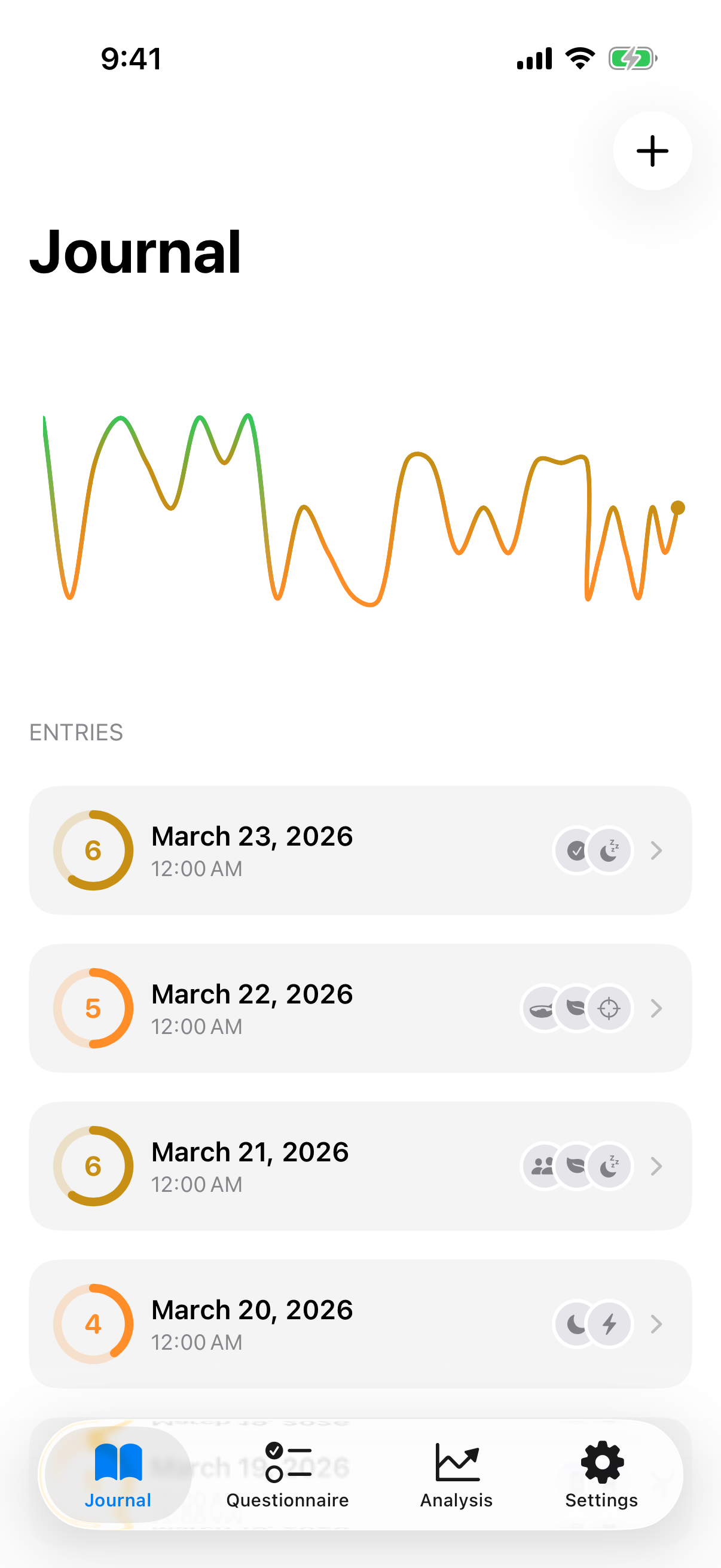
The most telling pattern with exhaustion is the relationship between strain and how you feel. InnerPulse makes both sides loggable at the same time.
On the strain side, you can choose from over 85 pre-built factors or create your own, for example "overtime," "long meetings," "deadline," "travel day," or "no time off." Factors can carry an intensity slider from 1 to 5, so it is not just "work yes/no" that counts but how much.
On the well-being side you have the 1-10 mood score and five sub-dimensions, two of which are especially telling for burnout:
- Energy is often the first thing to fade. A line that drops over weeks is a clearer sign than a single bad day.
- Calm shows whether you can actually switch off or keep running inside.
Correlation: what your data can show you
InnerPulse has a correlation engine that runs entirely on the device and analyzes your own entries. It looks for connections between factors and well-being and phrases them as plain-language sentences, both for the same day and with a time lag onto the next day.
Concretely, something like "on days with overtime your energy is lower on average" or "after days with high strain, your mood the next day is lower" can become visible. That is not a diagnosis and not a prediction, but an observation about your own past. With exhaustion in particular this feedback is valuable, because it confirms or refutes something that is only a feeling in daily life. You can find more about analyses like this on the InnerPulse blog.
K10 as a general strain screening
For exhaustion and general psychological distress, the K10 is a fitting self-test. It asks about signs of tension, nervousness, low mood, and fatigue over the past weeks and produces an objective score, not a diagnosis.
The K10 works well here because it is not tied to a single condition but captures general distress, which is exactly what builds up in burnout. InnerPulse also includes PHQ-9 (depression), GAD-7 (anxiety), and PHQ-4 (quick check). If you complete the K10 every one to two weeks, you get a second, structured line alongside the daily tracking. If the score rises over time, that is a clear reason to discuss it with a professional. If a screening hits signs of acute distress, the app shows the crisis contacts.
Trends over time, not daily form
A single exhausted day means little. Burnout shows up over the course. InnerPulse makes exactly that course visible.
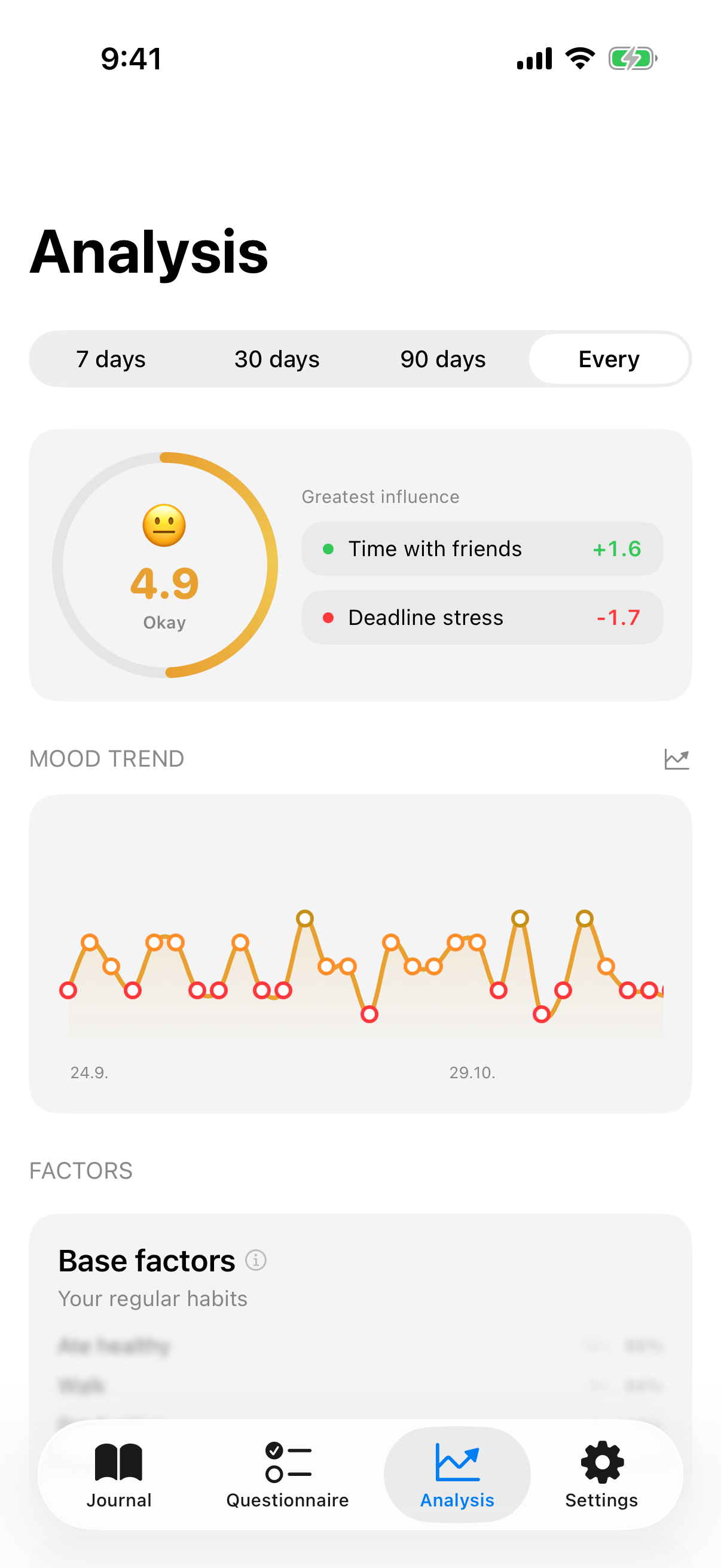
In the insights you see mood and energy trends over weeks and months, weekday statistics (is Monday systematically worse, does it tip around Thursday?), and the year-in-pixels view that shows a whole year as a grid. An energy line that slowly sinks over two months is an early sign that gets lost in daily life but is hard to miss in a chart. That is the bird's-eye view you need so you do not react only at the point of collapse.
Noticing early signs of exhaustion sooner
The real gain is noticing something sooner. If your energy line has been falling for weeks, your calm scores stay low, and your strain factors are high in parallel, that is a pattern you do not ignore just because a single day happened to be okay.
InnerPulse makes no decisions for you here and issues no warning in the sense of a diagnosis. It makes the pattern visible so that you, on your own and together with professionals, can act sooner, for example by planning breaks, talking to your GP, or requesting a therapy slot. If you are currently waiting for a slot, tracking gives your in-between time structure and evidence.
Anti-guilt: no extra pressure
The last thing an exhausted person needs is an app that adds pressure. InnerPulse is deliberately built so that it stays easy to open, even on bad days.
There are no streaks and no achievements. If you skip three days, you lose nothing and get no nagging effect. An entry takes about ten seconds, a lock-screen widget makes it a single tap, and missed days can be backfilled. The principle behind it: a self-care tool must not become a burden itself. If you like the topic, the blog has more on why we deliberately skip streak mechanics.
CSV and PDF for your GP or therapist
The practical point is to walk into a consultation with something tangible. InnerPulse exports your data as CSV (including per-question), as JSON, and as a clear PDF report.
Instead of "I have just been exhausted lately" you can show a record: declining energy over eight weeks, a rising K10, high strain factors in parallel. That makes a first conversation more concrete and helps the professional judge sooner whether there is more behind it. The export includes a note that this is self-observation, not a diagnosis.
A possible tracking pattern
- Daily (ten seconds): mood score plus energy and calm, along with the day's main strain factors.
- Strain with intensity: not just "work" but how much, via the 1-5 slider.
- Every one to two weeks: a K10 on a fixed day.
- Monthly: look at trends and year-in-pixels without fixating on single days.
- Before the appointment: export the PDF or CSV and bring it.
What InnerPulse explicitly is not
- Not a diagnostic tool. It does not detect burnout, depression, or an anxiety disorder.
- Not a replacement for treatment. It does not replace therapy, medical workup, or, where needed, changes in your work context.
- Not a crisis service. In acute need, emergency services and crisis numbers matter.
- Not a performance rating. It does not measure whether you "work enough," but how you are doing while you do.
Privacy, especially with work-related data
Notes about workload, stress, and well-being are sensitive, especially when the job is involved. InnerPulse stores everything on the device only (SwiftData), with no account, no cloud of its own, and no tracking SDKs. No one, not even an employer, has access to your data through it. Optionally you can lock the app with Face ID or Touch ID. More on that at InnerPulse privacy.
To be honest about it: without iCloud Backup or your own export, everything is gone if you lose the device. Regular exports therefore also serve as a backup.
Next steps
If you want to build the tracking specifically for therapy: InnerPulse in therapy.
If your lows come more seasonally: InnerPulse for seasonal affective patterns.
If you are considering a free stoic reflection app: InnerPulse vs Stoic.
InnerPulse costs a one-time €9.99 on the App Store. No subscription, no account, no cloud. It does not hand you a diagnosis and does not replace treatment. But it gives you a calm, honest record that helps you see exhaustion sooner and tackle the right thing in time.
See what shapes your mood
Clinical tests, 100+ influence factors, fully offline. One-time purchase.
Get on the App Store