Seasonal depression (clinically: Seasonal Affective Disorder, SAD, often called "winter depression") is hard to reconstruct from memory. In February you can't quite recall how November felt, and in July, when you feel better, the last dark stretch seems far away. That memory gap is exactly the problem: if you suspect a seasonal pattern, you need a record across months and ideally several years, not a single snapshot.
InnerPulse is built as a companion for precisely this kind of long-term observation. You log your mood in about ten seconds a day, record the factors that matter in winter (daylight, time outside, movement, sleep), and watch over the years whether a recurring low takes shape. One thing up front: InnerPulse does not diagnose. It gives you a structured self-observation that you can interpret yourself or discuss with a doctor.
Why a seasonal pattern only appears in the long-term course
The hallmark of seasonal depression is not a single bad low, it's the recurrence. Mood and energy drop in the dark half of the year and rise again in spring, year after year in a similar rhythm. You can almost never reconstruct that cleanly from memory, because how you feel right now distorts the recollection: on a grey January day it feels as if it has always been like this.
That's why the decisive step is to record early and continuously. A single winter tells you whether there was a low. Two or three winters tell you whether there's a pattern. InnerPulse is designed for exactly that: light enough to log daily without pressure, with tools that make the course readable across months and years.
Year-in-Pixels: the whole year on one screen
The most important tool for this use case is the Year-in-Pixels view. Each day is a colored dot, shaded by mood band: reds for low scores, yellow in the middle, green for good days. Across a full year that produces a grid of 365 dots.
A seasonal pattern jumps out immediately in this view. If the months from November to February are clearly redder than the rest of the year, you don't see it as a statistic, you see it as a picture. And because InnerPulse keeps your data across years, you can compare winter with winter: was the last one worse than the one before? Did a change (more daylight, a move, therapy) shift anything? The year-over-year comparison turns a vague feeling into a concrete observation.
The weather factor: optional WeatherKit connection
With seasonal depression it's natural to suspect that weather and light play a role. InnerPulse can help here without you having to keep a log by hand. If you enable the optional WeatherKit connection, the app automatically adds the current weather to your entry and maps it to a factor (sunny or rainy, for example). The correlation engine can then evaluate whether your mood is systematically different on sunny days than on grey ones.
This is deliberately opt-in. The weather lookup goes through Apple, and you decide whether to use it. If you'd rather not, you can track the weather link by hand or leave it out. None of this changes the privacy principle: your entries stay on the device.
Daylight, time outside, movement: the factors that matter in winter
When you suspect winter depression, a few factors are especially revealing. InnerPulse ships with more than 85 pre-built factors in 10 categories, and you can freely edit them or add your own. For this use case, the ones worth tracking most are:
- Time outside and daylight. How much time did you spend outdoors in daylight today? Especially in winter this is often the lever with the biggest effect.
- Movement and exercise. Did a morning walk noticeably lift the day?
- Sleep and sleep quality. Seasonal lows often come with changed sleep needs. InnerPulse captures sleep quality as one of the five sub-dimensions alongside the 1-10 mood score.
- Social contact. Do you withdraw in winter, and does your mood follow that withdrawal?
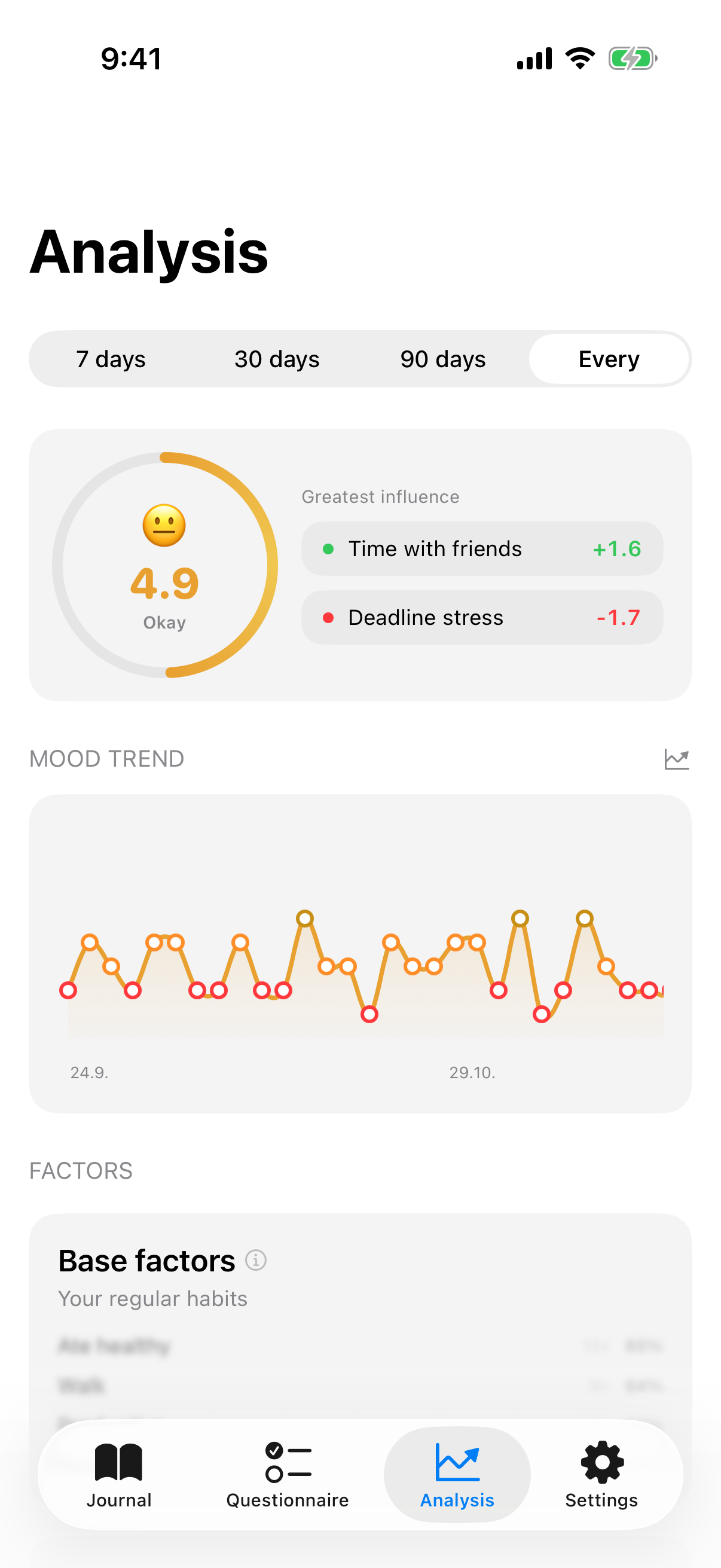
The correlation engine runs entirely on the device and translates the data into plain-language sentences. Instead of a chart you have to interpret yourself, you read something like: "On days with time outside, your mood was higher on average." There's also the next-day analysis (lag), which surfaces effects that carry over a day, such as whether an active day still supported your mood the next morning.
PHQ-9 for tracking the trend
Beyond the daily mood score, InnerPulse lets you take clinical self-tests that are available in the UI: PHQ-9 (depression), GAD-7 (anxiety), PHQ-4 (rapid check), and K10 (general distress). For the seasonal use case the PHQ-9 is particularly useful, because it expresses symptom severity as a standardized score.
The point here is explicitly trend observation, not self-diagnosis. If you fill in the PHQ-9 roughly every one to two weeks, you get a curve that shows whether symptom load climbs with the dark season and falls again in spring. That curve is exactly the kind of evidence that supports a medical assessment. InnerPulse scores the values correctly against the published severity bands, but it makes no claim about whether you have seasonal depression. That is a doctor's job.
One important safety note: the app's three-tier flag system responds to critical answers. If a screening points to acute distress, InnerPulse surfaces crisis contacts for the DACH region (142 in Austria, 143 in Switzerland, free 0800 numbers in Germany). In an acute situation an app never replaces professional help.
A concrete scenario across three winters
Imagine you start in October because you suspect the cold season hits you every year. In the first winter you log daily, add factors like time outside and sleep, and fill in the PHQ-9 every two weeks. In spring you look at the Year-in-Pixels view and see a distinct red band from December to February.
In the second winter, thanks to the correlations, you already know that daylight is your strongest lever, and you can act on it deliberately. The year-over-year comparison shows whether it helped. By the third winter you have a solid base of data grown over years, something you can put on the table in an appointment instead of recalling it from memory. A vague "I always feel worse in winter" becomes a curve you can follow.
Privacy: your mood data is yours
Mood and symptom data are sensitive. InnerPulse stores everything exclusively on the device (SwiftData), with no account, no cloud, no analytics or tracking SDKs. With a network monitor like Little Snitch you can verify in minutes that nothing leaves the phone. The optional connections to Apple Health and WeatherKit share data only with Apple, and only if you enable them. A biometric lock via Face ID or Touch ID is available.
The honest flip side: there is no cloud of its own. Without an iCloud backup or an export, your data is gone if you lose the device. For export there's CSV (including per individual question), JSON, and a PDF report, for a doctor's appointment for example.
When another app fits better
InnerPulse is built for depth and the long-term course, not for light-therapy instructions or guided programs. If you mainly want structured exercises, an account, and cloud sync across devices, a medically positioned app with guided courses may be the better choice. If you only want a pretty, simple icon diary with no clinical ambition, a lighter app is enough. InnerPulse pays off when you genuinely want to understand the seasonal pattern and document it across years.
Going further
- InnerPulse overview: features, privacy, price.
- InnerPulse for PMDD: the cycle-prospective tracking workflow, a related case of recurring patterns.
- InnerPulse in therapy: how to prepare the data for appointments.
- InnerPulse vs Apple Health State of Mind: the difference between a snapshot and a long-term course.
- Blog: data analyses and background on mood and factors.
Getting started
InnerPulse is €9.99 one-time on the App Store. No subscription, no cloud, no account. The best start if you suspect a seasonal pattern: install before the dark season, log daily, and look at the course in spring. Observation and self-assessment, explicitly not a diagnosis. In acute distress, the app surfaces crisis contacts.
See what shapes your mood
Clinical tests, 100+ influence factors, fully offline. One-time purchase.
Get on the App Store