How We Feel is one of the most credible free mental health apps out there. Non-profit, ad-free, no subscription, built with scientists and clinicians. At its heart is the mood meter: instead of just "good" or "bad," you learn to tell "anxious" from "overwhelmed" from "lonely" from "calm." That skill is called emotional granularity, and the research behind it is real and valuable.
InnerPulse solves a different job. It is a therapy companion for people who are in therapy, waiting for a slot, or working through a medication trial. Rather than widening your vocabulary for feelings, InnerPulse collects structured evidence over weeks: a 1-10 score plus five sub-dimensions, clinical self-tests, and a correlation engine that surfaces patterns you would not spot on your own.
This page compares the two honestly. It is not a price comparison, because How We Feel is free. It is a comparison between "name your emotions better" and "measure your symptoms over time."
| Feature | InnerPulse | How We Feel |
|---|---|---|
| Positioning | Therapy companion | Emotional granularity, well-being |
| Backing | Indie developer, one-time purchase | Non-profit, built with experts |
| Pricing | One-time €9.99, no subscription | Free, no ads |
| Core mechanic | Mood score + factors + screenings | Mood meter, naming feelings |
| Mood scale | 1-10 + 5 sub-dimensions | Emotion words (valence/energy) |
| Clinical screenings | PHQ-9, GAD-7, PHQ-4, K10 | No validated tests |
| Correlation engine | Yes, same day + next day (lag) | No |
| Therapy export | CSV per question, JSON, PDF report | Limited |
| Data storage | 100% on-device, no account | Account-based, cloud |
| Platform | iPhone + Apple Watch + widgets | iOS + Android |
| Best for | Symptom tracking, therapy prep | Building emotion vocabulary, mindfulness |
What How We Feel gets right
How We Feel tackles a genuine problem: most people have a very small vocabulary for their feelings. "I'm good" or "I'm bad" covers a huge range, and that fuzziness makes emotions harder to work with. How We Feel solves it through the mood meter: you first pick energy and pleasantness, then refine to a precise word. Over time you learn to separate "irritated" from "drained" and "nervous" from "excited."
This is not a gimmick. Emotional granularity is a well-studied concept in affect research, and the ability to name feelings finely is linked to better emotion regulation. How We Feel is built by a non-profit, with scientists and clinicians involved, free, and ad-free. That is a rare and fair offer, and we recommend it without reservation for exactly this purpose.
What InnerPulse solves instead
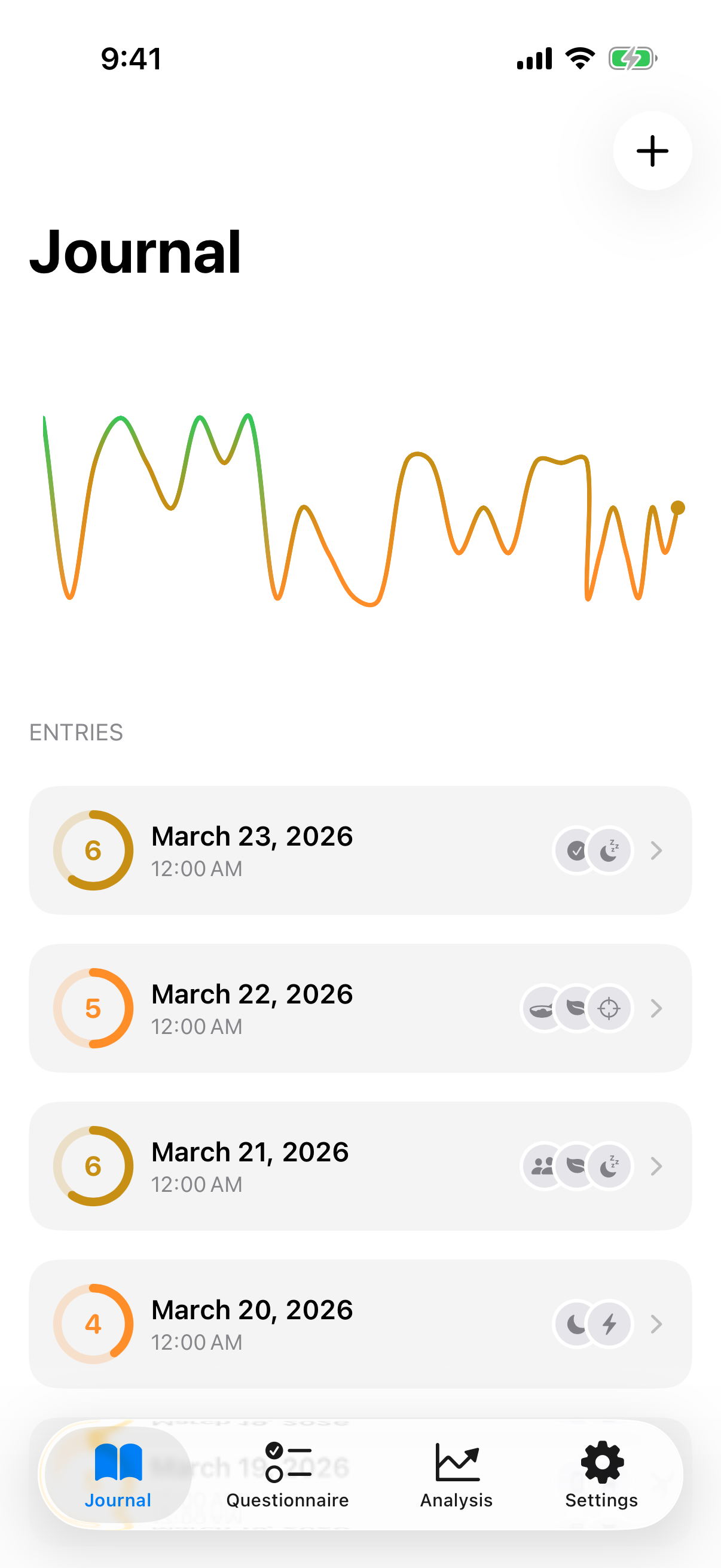
InnerPulse does not primarily ask "which word describes this feeling?" It asks "what is connected to your mood, and how does it change over weeks?" Instead of an emotion word, you get a 1-10 mood score and five sub-dimensions: energy, calm, focus, sleep quality, and social energy. Those numbers are comparable over time and can be analyzed.
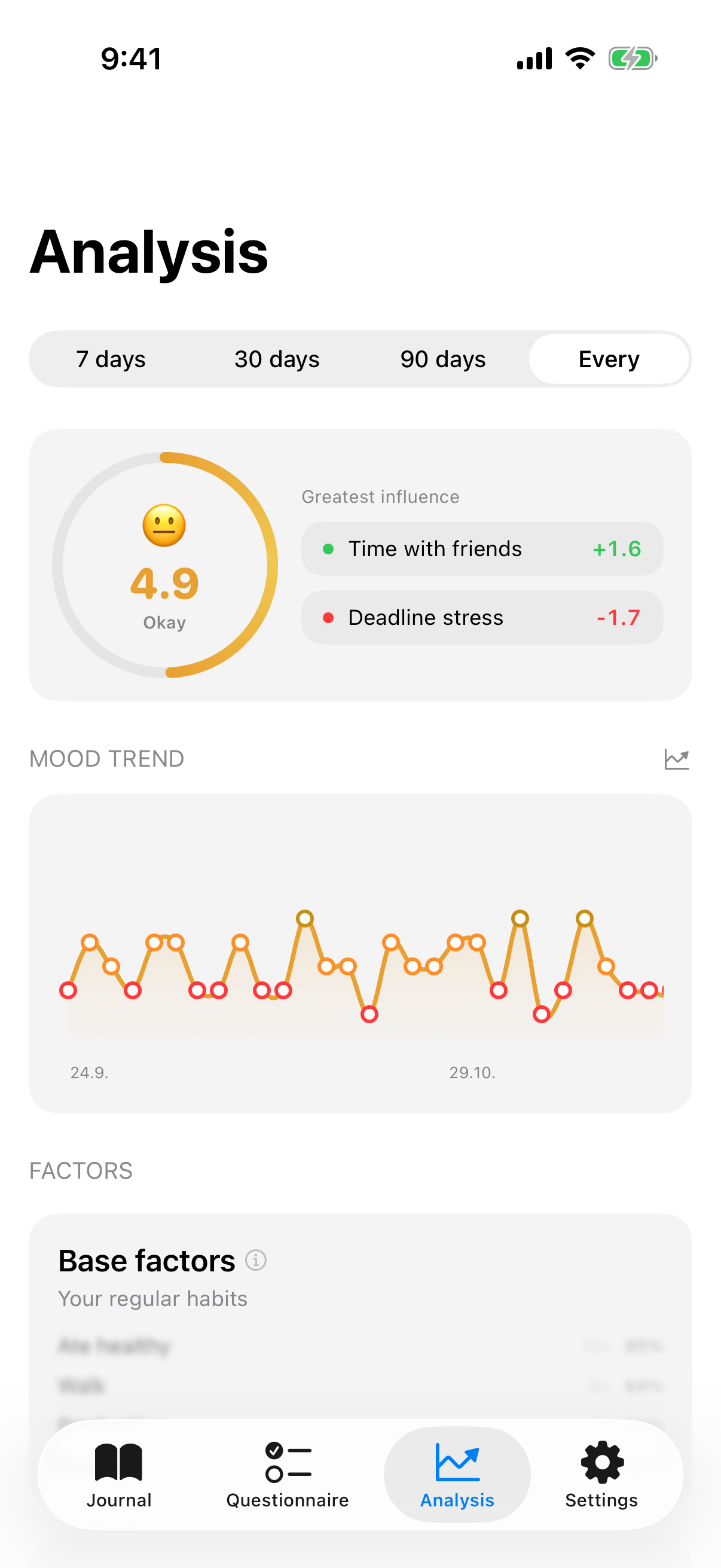
On top of that sits the correlation engine. It looks at 100+ pre-built factors (sleep, exercise, caffeine, social contact, work hours, medication, weather, and more) and shows you relationships in plain-language sentences, such as "On days with exercise you ate healthily 40% more often" or "After days with little sleep, your mood is lower the next day." It computes not only the same day but also the following day (lag analysis). That is a fundamentally different kind of insight than a refined feeling label.
How We Feel helps you understand the moment better. InnerPulse helps you understand the pattern over weeks. More on the InnerPulse product page.
Clinical depth: the central difference
This is where the two diverge most clearly. How We Feel deliberately includes no clinical diagnostic instruments, that is not its purpose.
InnerPulse integrates four validated self-tests right in the UI: PHQ-9 for depression, GAD-7 for anxiety, K10 for general distress, and PHQ-4 as a rapid check. These tests produce scores phrased in the language of clinical thresholds your doctor or therapist already uses. A 3-tier flag system contextualizes the results, and during acute distress the app surfaces crisis contacts for the DACH region (AT 142, CH 143, DE 0800 numbers).
To be explicit and clear: this is self-assessment and observation, not a diagnosis. No mood tracker replaces a professional evaluation. What InnerPulse delivers is structured evidence you can bring into a conversation, not a verdict about you.
The "when does which app matter" test
How We Feel matters when:
- You want to widen your vocabulary for feelings and notice that "good" and "bad" are not enough.
- You want a free, ad-free app with serious expert grounding.
- Mindfulness and in-the-moment self-awareness are your goal, not long-term data analysis.
- You are on Android too, or want to support a non-profit project.
InnerPulse matters when:
- You have or suspect a diagnosis (depression, anxiety, PMDD, bipolar, burnout) and want to track symptoms the way your doctor does.
- You are waiting for a therapy slot and want to bring real data to the first session. See InnerPulse for therapy.
- You want to know which factors actually drive your mood, not just name the moment.
- You want to track a medication trial with objective numbers.
- You care about privacy enough that "nothing leaves my phone" matters.
Privacy: a subtle but real nuance
Both apps take your data seriously. The difference is in the architecture.
How We Feel uses an account and a cloud component, which makes sense for cross-device sync and the Android version. As a non-profit with no ads, there is no data-driven business model behind it, an important trust point.
InnerPulse takes the radically local route: 100% on-device via SwiftData, no account, no cloud of its own, no analytics or tracking SDKs. You can verify with Little Snitch or an HTTP proxy in minutes that the app sends nothing. There is an optional Face ID/Touch ID lock. The honest catch: without iCloud Backup or a manual export, losing your device means losing the data, because there is no server copy. Details on InnerPulse privacy.
For clinically relevant or medication-related tracking, local-only is often the right answer. For others, cloud sync is worth the convenience. Both are legitimate choices.
Platform and daily use
How We Feel ships on iOS and Android, making it the broader option if not everyone around you has an iPhone.
InnerPulse is iOS-focused and leans fully into the Apple ecosystem: Apple Watch with quick entry via the Digital Crown, lock-screen and home-screen widgets, Year-in-Pixels, and optional links to Apple Health and WeatherKit. An entry takes about ten seconds, missed days can be backfilled, and there are deliberately no streaks (an anti-guilt principle: easy to open, even on bad days).
Where they agree
Both apps:
- Treat mental health seriously, not as a gamification playground.
- Do not sell your data.
- Are usable without ad pressure.
- See themselves as a companion, not a replacement for professional help.
Related comparisons
If you are coming from a casual rating app, read InnerPulse vs Daylio. If you already use Apple's built-in State of Mind, InnerPulse vs Apple Health is the relevant comparison. And if you track mood specifically in an ADHD context, InnerPulse for ADHD goes deeper. To see how real logs turn into findings, browse the data write-ups on the InnerPulse blog.
The honest answer
If your goal is to name feelings more precisely and build a better relationship with your emotions in the moment: use How We Feel. It is free, expert-backed, ad-free, and built for exactly that. It costs you nothing to try, and for emotional granularity there is hardly a better choice.
If you are dealing with a diagnosis, therapy, a waiting period, or a medication trial and need structured evidence you can bring into a clinical conversation: use InnerPulse. €9.99 once, on-device, with PHQ-9/GAD-7/K10, a correlation engine, and a therapy export. Many people end up using both: How We Feel to sense what is happening right now, and InnerPulse to measure how it develops over weeks.
See what shapes your mood
Clinical tests, 100+ influence factors, fully offline. One-time purchase.
Get on the App Store