With bipolar disorder, the decisive things happen between appointments. An episode builds over days or weeks, and in hindsight it is hard to reconstruct: when did sleep start getting shorter? When did energy tip over? When did productive become driven? These are exactly the trajectories your psychiatrist wants to see, and exactly the ones memory struggles with most.
InnerPulse is a tool for self-observation between appointments. It does not replace a diagnosis or treatment. What it does: capture a 1-10 mood score plus five sub-dimensions every day in about ten seconds, make sleep and other factors visible as possible early signs, and produce a clean export you can bring to your appointment. This page shows concretely how to use InnerPulse for that.
First: what this page is and is not
This is not medical advice and not a diagnostic tool. InnerPulse does not produce a diagnosis, does not detect bipolar disorder, and gives no treatment recommendation. Bipolar disorder is diagnosed and treated by clinicians, not by an app.
What InnerPulse offers is observation and self-assessment: you document how you are doing, and you bring that documentation into your treatment. When distress is acute, the app shows crisis contacts for the DACH region (AT 142, CH 143, DE 0800 numbers). If you are in a crisis, use those numbers or emergency services, not a tracking app.
Why daily logging makes a difference with bipolar
Mood diaries (often called mood charting) have long been part of self-management for bipolar disorder. The reason is simple: memory smooths things over. In a slightly elevated phase a lot feels normal, and in a depressive phase everything looks bleak in retrospect. Daily entries made in the moment are less distorted than a memory two weeks later.
InnerPulse is deliberately built for low friction. An entry takes about ten seconds, and a lock-screen widget turns it into a single tap. There are no streaks and no pressure mechanics, because a tool meant to accompany you through a depressive phase must not feel like one more duty you can fail at. You can backfill missed days.
The 1-10 score plus five sub-dimensions
A bipolar swing is more than "good" or "bad." A hypomanic phase may show up as high energy with little calm, a depressive one as low energy and low social energy. A single smiley cannot capture that.
Alongside the 1-10 overall score, InnerPulse records five sub-dimensions:
- Energy often rises first in (hypo)manic phases, sometimes before the baseline mood changes.
- Calm drops with inner restlessness and a driven feeling, a common early sign.
- Focus swings both ways: scattered and racing upward, blocked and ruminative downward.
- Sleep quality is, for many people with bipolar disorder, the most sensitive indicator (more on that below).
- Social energy shows withdrawal in depression and over-sociability in hypomania.
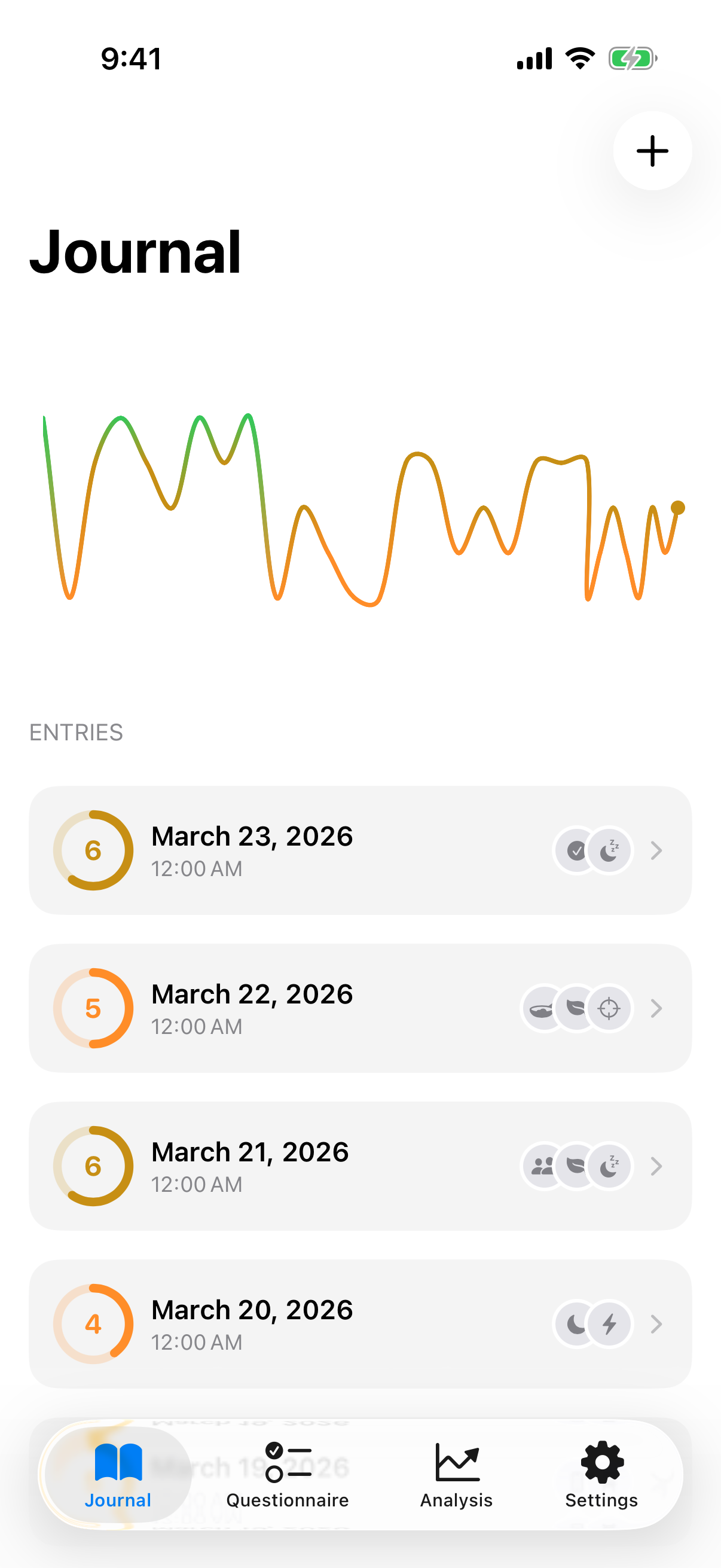
Over weeks this produces not a single dot but five lines. A phase where energy and social energy climb while calm and sleep quality fall is a far more readable picture than "mood was high."
Sleep as an early-warning factor
For many people with bipolar disorder, a change in sleep is one of the earliest observable signals. Shortened sleep can precede an elevated phase, increased sleep need a depressive one. This is a connection many people who live with the condition and their clinicians know well, and it is exactly where consistent logging helps.
In InnerPulse you can capture sleep two ways: through the sleep-quality sub-dimension and through factors (such as "little sleep" or "woke up early"). Factors can carry an intensity slider from 1 to 5. The on-device correlation engine also works with a time lag: it can surface patterns like "after days with little sleep, mood the next day is lower" as a plain-language sentence. That is an observation about your own data, not a prediction and not a clinical judgment, but it can help you and your clinician watch for a change earlier.
If you want to dig deeper into data patterns, we collect analyses like this on the InnerPulse blog.
Medication: timing only, no efficacy claim
Medication plays a central role in treating bipolar disorder, and starting or changing a medication is often the most uncertain time. InnerPulse lets you record medication factors over time: when you start something, when a dose changes, when you stop something (always in consultation with your doctor).
Important and deliberately limited: InnerPulse only makes statements about timing, never about efficacy. The app does not tell you whether a medication "works" and gives no dosing advice. It only shows your own documented course, for example that your sleep was logged as more stable or more restless in the weeks after a change. What that means is for your clinician to judge. The medication category carries a mandatory note for this, and the same disclaimer appears in the PDF report.
If medication is a focus for you, read InnerPulse for medication documentation.
Year-in-pixels: seeing episode patterns across months
A single week says little with bipolar disorder. What matters are the patterns across months: how long were phases, what did the transitions look like, are there seasonal tendencies?
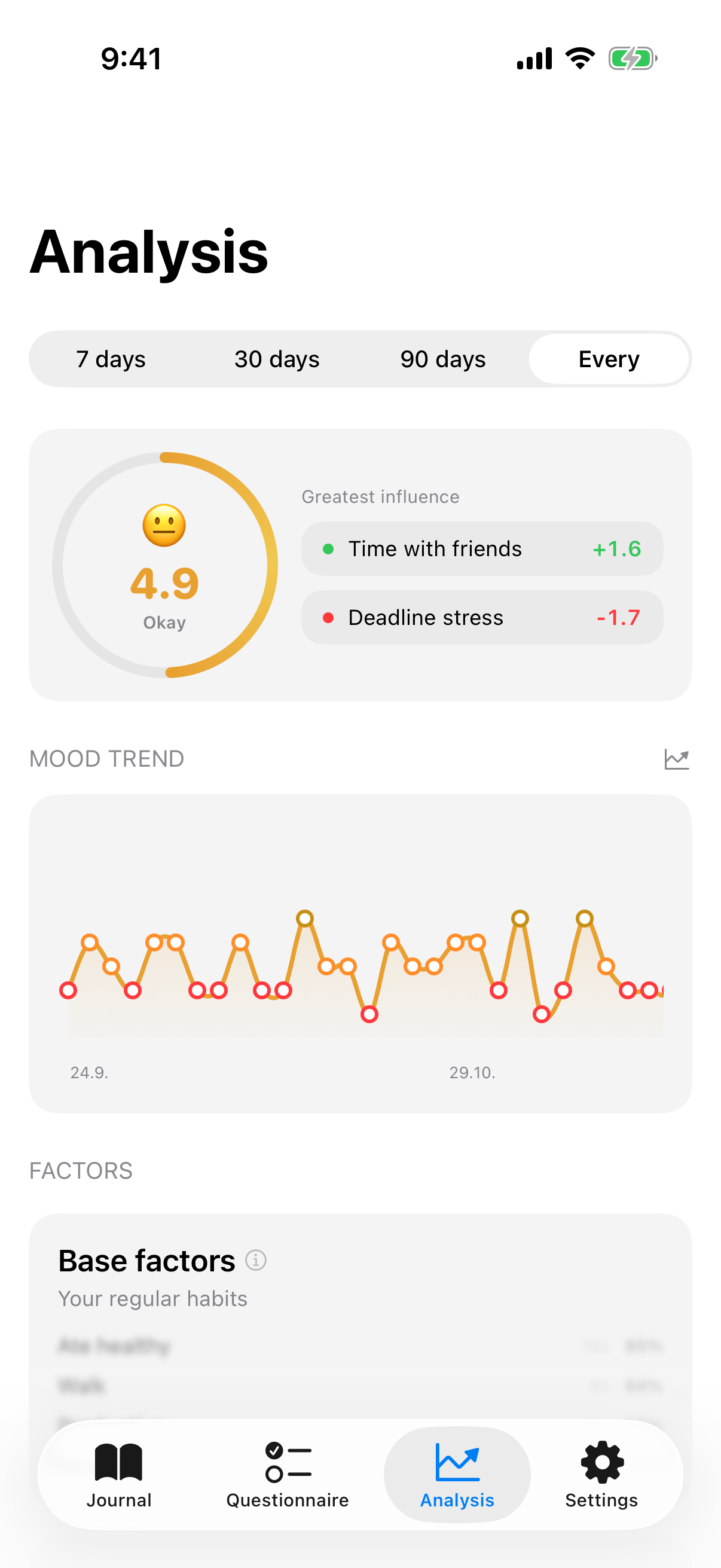
The year-in-pixels view shows each day as one colored square, a whole year at a glance. Weeks-long highs and lows appear as connected blocks of color, brief mood swings as single outliers. This is exactly the bird's-eye view that gets lost in daily life and that is often the most helpful overview in a consultation. There are also weekday statistics and mood trends.
CSV and PDF for the psychiatrist appointment
The practical point of tracking is to end up with something you can share. InnerPulse exports your data as CSV (including per-question), as JSON, and as a clinically styled PDF report.
So you can walk into your next appointment not with "the last few weeks were kind of mixed" but with a record: mood timeline, sub-dimensions, sleep factors, medication timing. That makes the conversation more concrete and saves time. The export includes a note that this is self-observation, not a diagnosis.
K10, PHQ-9, and GAD-7 as optional self-assessment
Beyond daily tracking, InnerPulse includes four validated self-tests: PHQ-9 (depression), GAD-7 (anxiety), PHQ-4 (quick check), and K10 (general psychological distress). They produce objective scores, not diagnoses.
For the depressive side of bipolar disorder, a regular PHQ-9 (say weekly) can put the severity of low phases into numbers. Note: these screenings are not specific to bipolarity and do not capture the manic side. They are a supplement to self-observation, not a bipolar test. If the PHQ-9 hits the item on suicidal thoughts, the app shows crisis contacts.
A possible tracking pattern
- Daily (ten seconds): mood score plus five sub-dimensions. Log the bad and the "too good" days too, both belong in the picture.
- Mark sleep deliberately: short or restless nights as a factor, with intensity if useful.
- Record medication as timing: start, dose change, stopping, always with medical guidance.
- Optional weekly: a PHQ-9 or K10 on a fixed day.
- Before the appointment: export the PDF or CSV and bring it.
What InnerPulse explicitly is not
- Not a diagnostic tool. Determining bipolar disorder is the clinician's job, not the app's.
- Not a replacement for treatment. It does not replace medication, psychotherapy, or medical care.
- Not a crisis service. In acute danger, emergency services and crisis numbers matter, not an app.
- No medication efficacy claim. Only timing is documented; the judgment belongs to the clinician.
This honesty is part of how InnerPulse is positioned: a companion between appointments, not a pseudo-clinic.
Privacy, because this data is especially sensitive
Mood and medication data are among the most sensitive things on your phone. InnerPulse stores everything on the device only (SwiftData), with no account, no cloud of its own, and no tracking SDKs. You can verify this with a network monitor in minutes. Optionally you can lock the app with Face ID or Touch ID. More on that at InnerPulse privacy.
One downside belongs in the picture: without iCloud Backup or your own export, your data is gone if you lose the device. Regular exports are therefore useful not only for the appointment but as a backup.
Next steps
If you want to build the documentation specifically for therapy: InnerPulse in therapy.
If medication is your focus: medication documentation with InnerPulse.
If you are wondering how InnerPulse differs from a casual mood app: InnerPulse vs Daylio.
InnerPulse costs a one-time €9.99 on the App Store. No subscription, no account, no cloud. It does not hand you a diagnosis and does not replace treatment. But it gives you an honest, structured record that you keep between appointments and can share in the appointment.
See what shapes your mood
Clinical tests, 100+ influence factors, fully offline. One-time purchase.
Get on the App Store