Finch is one of the most beloved self-care apps on the App Store. The idea is clever: you raise a virtual bird, and every time you look after yourself, do a breathing exercise, or check in on your mood, your companion grows. Self-care becomes a game, and for a lot of people that is exactly the spark that turns good intentions into a routine.
InnerPulse goes the other way. It is not a game and does not want to be one. It is a therapy companion for people who are in therapy, waiting for a slot, or working through a medication trial. There is no bird, no reward, no streak you can lose. Instead there are clinical screenings, a correlation engine, and an export you can bring into your next session. This page explains honestly when Finch is the better choice and when InnerPulse is.
| Feature | InnerPulse | Finch |
|---|---|---|
| Positioning | Therapy companion | Gamified self-care |
| Core idea | Clinical signal for therapy | Companion bird that grows through self-care |
| Gamification | None (deliberate, no bird, no reward) | Central (bird, energy, quests) |
| Streaks | None (anti-guilt) | Yes, part of the motivation |
| Clinical screenings | PHQ-9, GAD-7, PHQ-4, K10 | No validated instruments |
| Mood scale | 1-10 + 5 dimensions | Simple mood check-in |
| Influence factors | 100+ pre-built + correlation engine | Reflection prompts, no correlation |
| Therapy export | CSV per-question, JSON, PDF report | Not built for it |
| Data storage | On-device only, no account | Account/cloud based |
| Pricing | One-time €9.99 | Freemium with subscription |
| Target user | People engaged with their mental health | People who want motivation through cuteness and routine |
Finch's core strength: motivation through cuteness
Finch's real achievement is psychological, not technical. Self-care is hard for many people because it feels abstract and unrewarding. Finch solves that by placing a creature between you and the task: you do the breathing exercise not for yourself but for your bird. That sounds simple, but it works, because it externalizes care. Caring for yourself is hard, caring for someone else is easier.
If every self-care routine you have tried has quietly died after a few days, this mechanic might be exactly what you need. Finch is warm, charming, and low-pressure. It takes mental health seriously, but wraps it so that opening the app feels like a small joy rather than a chore.
InnerPulse's core strength: a signal that fits into therapy
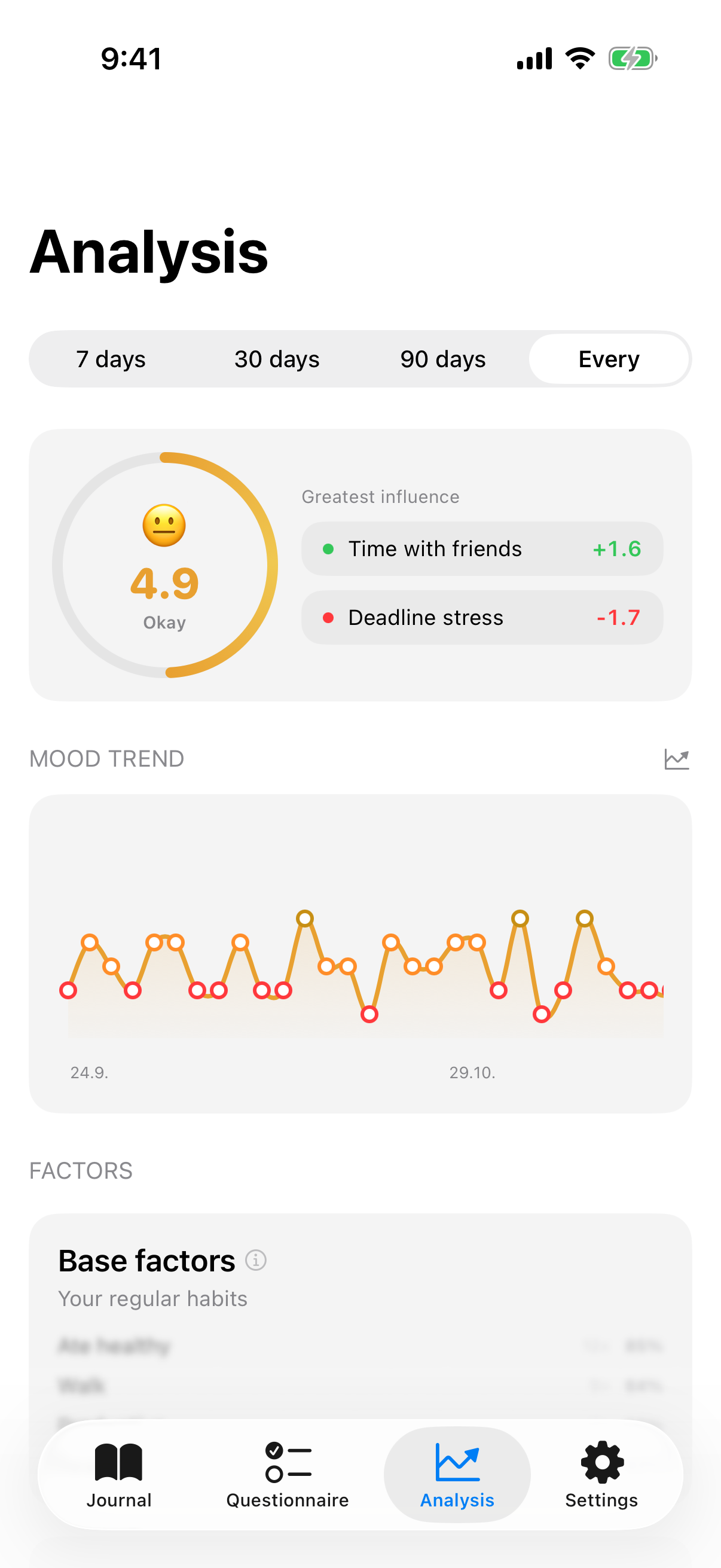
InnerPulse has a different goal. It is not trying to help you keep a habit going, it is trying to show you and your therapist what is actually happening. Instead of a simple mood check-in, you get a 1-10 score plus five sub-dimensions (energy, calm, focus, sleep quality, social energy). That takes a few seconds longer, but it produces data you can work with.
- The correlation engine analyzes 100+ influence factors (sleep, exercise, caffeine, social contact, weather, work hours, medication) and shows the relationships in plain sentences, for example "On days with exercise you ate healthy 40% more often" or "After days with little sleep your mood is lower the next day." There is more on this in the InnerPulse blog on data analysis.
- The clinical screenings (PHQ-9 for depression, GAD-7 for anxiety, K10 for general distress, PHQ-4 as a quick check) produce scores that connect directly to clinical criteria. This is explicitly self-assessment and not a diagnosis, but it is the language your clinician already speaks.
- The export (CSV, JSON, PDF report) is built to be carried into an appointment. Finch has neither the intent nor a mechanism for that.
The big difference: no gamification, no streaks
This is the heart of the comparison. Finch motivates through growth, reward, and consistency. For many people that is a gift. But there is a group for whom that exact mechanic becomes a problem: people who track their mood because they are struggling.
Someone in a depressive episode often already feels like they are failing at everything. A system that rewards consistency quietly turns that feeling up. Miss a day during a bad week, break a reward chain, watch the bird go hungry, and the tool that was supposed to help now feels like another accusation. We describe the same effect in the comparison with Daylio, where streaks are a central feature.
InnerPulse deliberately has no streak counter, no companion, no reward. The product principle is: emotionally light to open, even on bad days. You can backfill missed days with no penalty. A tool meant to support you through a hard stretch must not also be a pressure system. So if you have ever abandoned a self-care app because the guilt outweighed the benefit, this approach is built for you.
When does each app matter?
Finch matters when:
- Every routine you have tried has faded after a few days and you need an external nudge.
- Cuteness, growth, and small rewards motivate you rather than stress you.
- You want lightweight self-care prompts and breathing exercises wrapped in a friendly game world.
- Nothing acute is going on and you mainly want warm, motivating company.
InnerPulse matters when:
- You have or suspect a diagnosis (depression, anxiety, burnout, PMDD, bipolar) and want to document symptoms the way your clinician sees them.
- You are waiting for a therapy slot (in Germany the average wait is around 142 days) and want to give that time structure. The page on InnerPulse for anxiety shows what that looks like in practice.
- You started or stopped a medication and need objective data on whether anything is shifting.
- You experience reward systems as added pressure and want a tool with no guilt mechanic.
- Maximum privacy matters to you and "nothing leaves my phone" counts.
Privacy: account and cloud vs. your device only
Like most self-care apps with social and cloud elements, Finch uses an account and server-side storage. For many people that is no problem and enables conveniences like cross-device access.
InnerPulse has no cloud of its own, no account, and no tracking SDKs. Your data lives only on the device (SwiftData), and you can verify that in a few minutes with a network monitor like Little Snitch. You can optionally lock the app with Face ID or Touch ID. The honest downside: without an iCloud backup or an export, the data is gone if you lose the device. InnerPulse is GDPR-native and built in Europe, more on the page about the developer. If local privacy is your main criterion, also see mood tracker without a subscription.
The price question
Finch is free to use, but many features sit behind a subscription, and over the years that adds up. InnerPulse costs a one-time €9.99 for the entire app, no subscription, no in-app purchases, Family Sharing included. You pay once and you own the tool.
To be fair: Finch's free tier is generous enough that many people never pay. If the free features are enough for you, Finch is effectively free. InnerPulse has no free tier, but also no subscription.
Clinical boundaries
InnerPulse is a tool for observation and self-assessment, explicitly not a diagnosis and not a replacement for treatment. The screenings produce objective scores, not verdicts. If the app detects acute distress, it surfaces crisis contacts for the DACH region (AT 142, CH 143, DE 0800 numbers). For factors like medication, InnerPulse shows only temporal relationships and never any efficacy claims.
The honest answer
If you struggle to start at all and need a warm, motivating system that makes self-care feel light and even joyful: start with Finch. The companion bird is not a gimmick, it is a well-designed motivation mechanic, and for many people it is exactly the on-ramp they needed.
If, on the other hand, you are dealing with depression, anxiety, burnout, or a medication change, if reward systems tend to pressure you, or if you want data you can genuinely bring to therapy: get InnerPulse. A one-time €9.99, no gamification, no streaks, built for exactly the days when opening any app is already hard. You can learn more about the app on the InnerPulse page.
See what shapes your mood
Clinical tests, 100+ influence factors, fully offline. One-time purchase.
Get on the App Store