Stoic is a beautifully designed app built around journaling, mood, and mindfulness. You get guided writing prompts, check-ins for how you feel, and a collection of exercises meant to help you think more clearly and feel calmer. Newer versions add AI-assisted reflection. For many people it is a pleasant, quiet space for daily self-reflection.
InnerPulse starts somewhere else. It is a therapy companion, not a guided journal. Instead of accompanying your writing, it measures your mood in numbers, lets you take clinical self-tests, and computes on the device which factors actually influence how you feel. There is no AI in the cloud and no account. This page explains honestly when Stoic is the better choice and when InnerPulse is.
| Feature | InnerPulse | Stoic |
|---|---|---|
| Positioning | Therapy companion | Journaling + mindfulness |
| Core idea | Clinical measurement and correlation | Guided writing and reflection |
| Clinical screenings | PHQ-9, GAD-7, PHQ-4, K10 | No validated instruments |
| Mood scale | 1-10 + 5 dimensions | Mood check-in |
| Analysis | On-device correlation engine, lag analysis | Reflection, trends |
| AI | None (deliberate, no cloud AI) | Some AI-assisted features |
| Mindfulness exercises | None (focus on measurement) | Yes, core of the offering |
| Data storage | On-device only, no account | Account/cloud based |
| Therapy export | CSV per-question, JSON, PDF report | Journal export, not clinical |
| Pricing | One-time €9.99 | Subscription |
| Target user | People who want symptoms made measurable | People who want guided prompts and mindfulness |
Stoic's core strength: guided reflection
Stoic is good at getting writing started. A blank journal leaves many people stuck, and that is exactly where Stoic steps in: it asks you questions, offers morning and evening prompts, and walks you through short exercises that help organize your thoughts. The AI features can pick up what you wrote and reflect it back, which for some feels like a calm conversation with yourself.
If your goal is to build a writing and mindfulness practice, this is a strong offering. Stoic brings mood, words, and exercise together in a space that invites you to linger. It is less about numbers and more about language, pausing, and slowly understanding your own patterns through writing.
InnerPulse's core strength: measuring rather than phrasing
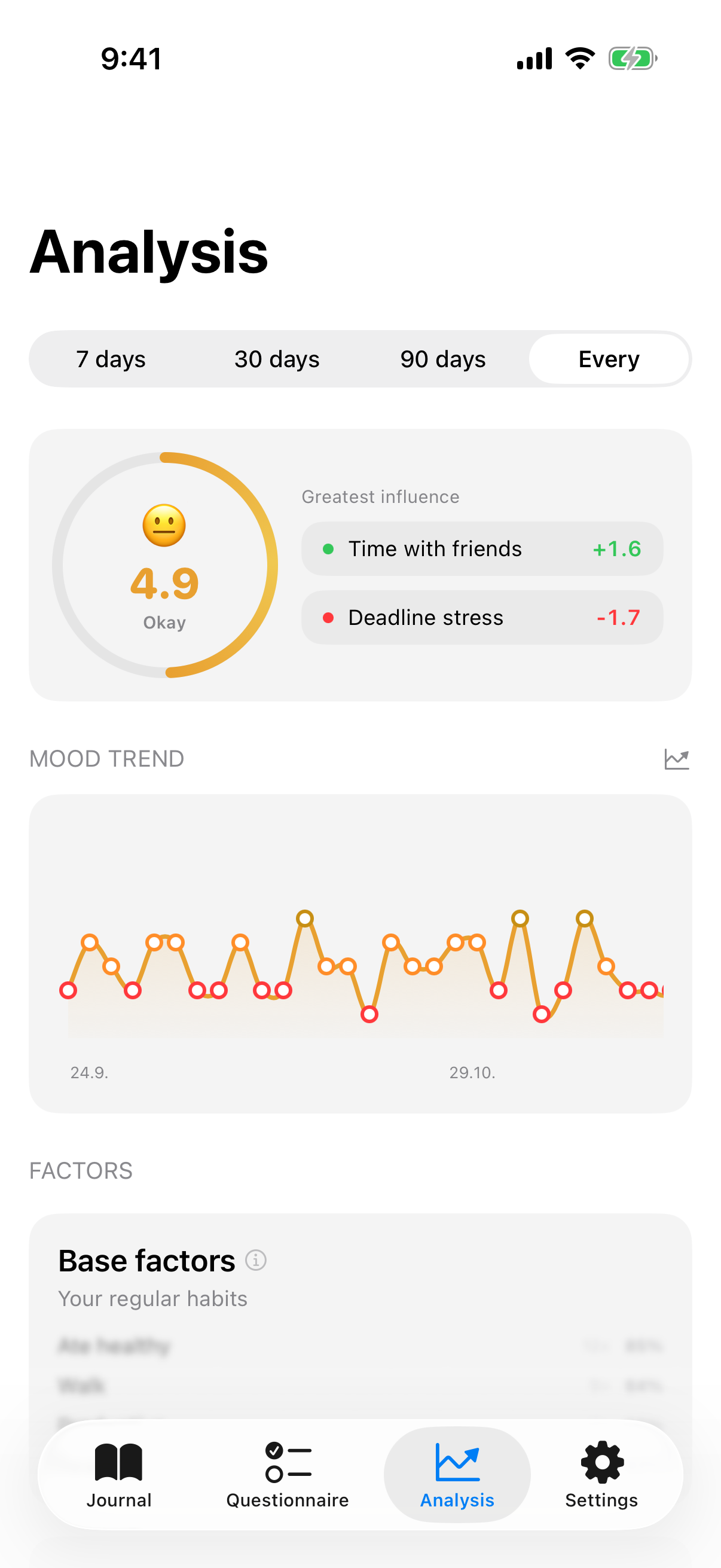
InnerPulse has a different goal. It does not try to put how you feel into words, but into data that you and your clinician can read. Instead of a writing prompt, you get a 1-10 score plus five sub-dimensions (energy, calm, focus, sleep quality, social energy). A journal note is possible, but it is the supplement, not the core.
- The correlation engine runs entirely on the device and analyzes 100+ influence factors. It shows relationships in plain language, including beyond the same day, for example "After days with little sleep your mood is lower the next day." This lag analysis is something guided journaling structurally does not provide. There is more on this in the InnerPulse blog.
- The clinical screenings (PHQ-9, GAD-7, K10, PHQ-4) give you objective scores over time, explicitly as self-assessment and not as a diagnosis. They speak the language used in treatment anyway.
- The export (CSV, JSON, PDF report) is built to be carried into an appointment. A journal export is personal and valuable, but not analyzable in a clinical sense.
The big difference: no AI, no cloud
This is the decisive point. Stoic's AI reflection is the appeal for some and exactly the problem for others. For an AI to pick up and respond to your entries, the content usually has to be processed, often server-side. Mood and journal data are among the most sensitive things you can reveal about yourself.
InnerPulse deliberately forgoes AI and any cloud of its own. There is no account, no tracking SDKs, and no data that leaves the device. The entire analysis, including the correlation engine, runs locally with SwiftData. You can verify that in a few minutes with a network monitor like Little Snitch. If you are looking for a mood diary with no AI and no cloud, there are more details on the page private offline mood tracker.
This is not a general verdict on AI. It is a choice for a specific audience: people who do not want their mental-health data on someone else's servers under any circumstances, especially when it involves medication, substances, or clinically relevant symptoms.
When does each app matter?
Stoic matters when:
- You want to build a writing and reflection practice and guided prompts make starting easier.
- Mindfulness exercises and calm rituals matter more to you than hard numbers.
- AI-assisted reflection appeals to you and you are comfortable with server-side processing.
- You experience language as your path to self-understanding.
InnerPulse matters when:
- You have or suspect a diagnosis and want to document symptoms measurably, the way your clinician sees them.
- You want to understand patterns like exhaustion phases, for example in the context of InnerPulse for burnout.
- You are waiting for a therapy slot (in Germany the average wait is around 142 days) and want to give that time structure.
- It matters to you that no AI and no cloud processes your sensitive data.
- You want to pay once and own the tool rather than maintain a subscription.
The price question
Stoic uses a subscription that unlocks the guided content and AI features, and over the years that adds up. InnerPulse costs a one-time €9.99 for the entire app, no subscription, no in-app purchases, Family Sharing included. You pay once and keep everything.
To be fair: if guided writing and mindfulness matter to you, with Stoic you are paying for exactly that content, which InnerPulse does not have. The subscription is then not a surcharge but the core of the offering. If, on the other hand, you mainly want to measure, you get that with InnerPulse without ongoing costs. There is a broader look at one-time-purchase apps in the comparison with Daylio.
Clinical boundaries
InnerPulse is a tool for observation and self-assessment, explicitly not a diagnosis and not a replacement for treatment. The screenings produce objective scores, not verdicts. If the app detects acute distress, it surfaces crisis contacts for the DACH region (AT 142, CH 143, DE 0800 numbers). For factors like medication, InnerPulse shows only temporal relationships and never any efficacy claims.
The honest answer
If you want to build a writing and mindfulness practice, if guided prompts make starting easier, and if AI reflection appeals to you: start with Stoic. It is a thoughtful, beautiful space for daily self-reflection, and for many people language is the most honest route to themselves.
If, on the other hand, you want to make how you feel measurable, if you want to document symptoms the way your clinician reads them, and if it matters to you that no AI and no cloud touches your sensitive data: get InnerPulse. A one-time €9.99, everything on-device, built for people who do not only want to reflect but also want to see what the numbers say. You can learn more about the app on the InnerPulse page.
See what shapes your mood
Clinical tests, 100+ influence factors, fully offline. One-time purchase.
Get on the App Store