Of all the mood apps InnerPulse can be compared to, Moodistory is the closest to its own core values. Both are a one-time purchase rather than a subscription. Both work offline. Both respect that your mood data belongs to you. So if you are looking for an honest, subscription-free iOS diary, this is a fair and close comparison.
Moodistory is an icon-based mood diary: fast, pretty, with a tidy interface where you capture your day through symbols and short notes. It does not try to be clinical, it tries to be a pleasant daily ritual, and it does that well.
InnerPulse shares the offline, one-time-purchase foundation but deliberately goes further toward being a therapy companion: with clinical self-tests, a more detailed mood model, and an analysis engine that surfaces relationships. This page shows where the two meet and where they part.
| Feature | InnerPulse | Moodistory |
|---|---|---|
| Positioning | Therapy companion | Icon-based mood diary |
| Pricing model | One-time €9.99, no subscription | One-time purchase, no subscription |
| Offline | Yes, 100% on-device | Yes, offline |
| Data storage | On-device, no account | On-device, no account |
| Mood scale | 1-10 + 5 sub-dimensions | Stepped scale with icons |
| Clinical screenings | PHQ-9, GAD-7, PHQ-4, K10 | None |
| Factors | 100+ pre-built, fully editable, intensity 1-5 | Activities/tags |
| Analysis | Correlation engine (same day + lag) | Statistics, charts |
| Apple Watch | Yes, quick entry + sync | No |
| Export | CSV per question, JSON, PDF report | Limited |
| Best for | Symptom tracking, therapy prep | A pretty, simple daily diary |
Where Moodistory and InnerPulse agree
It is worth naming the common ground first, because it is the reason this comparison is so close.
- One-time purchase, not a subscription. Both apps reject the subscription model. You pay once and own the app. No recurring pressure, no paywall that gets more expensive over time.
- Offline. Both work without an internet connection. Mood tracking should work on a plane, in a dead zone, or simply without a connection.
- Your data stays with you. Both rely on local storage with no forced account.
- A fast daily ritual. Both are designed so an entry takes seconds, not minutes.
If those four points are what matter most to you, you can be happy with either app. The rest of this page is about where they differ, so you can pick the right one for you.
Moodistory's strength: a pretty, light diary
Moodistory's appeal is its clarity. The icon language makes logging playful and fast, the interface is tidy, and over time you build a visual record of your days. It is a diary in the best sense: low-friction, pleasant to look at, and free of any clinical pretension.
For many people that is exactly right. Not everyone who logs their mood wants to measure symptoms or see correlations. Some just want a beautiful, private look back at their days, without an app implying they have a problem. For that wish, Moodistory is an honest, good choice, and we recommend it without hesitation for exactly that purpose.
InnerPulse's strength: measuring, not just recording
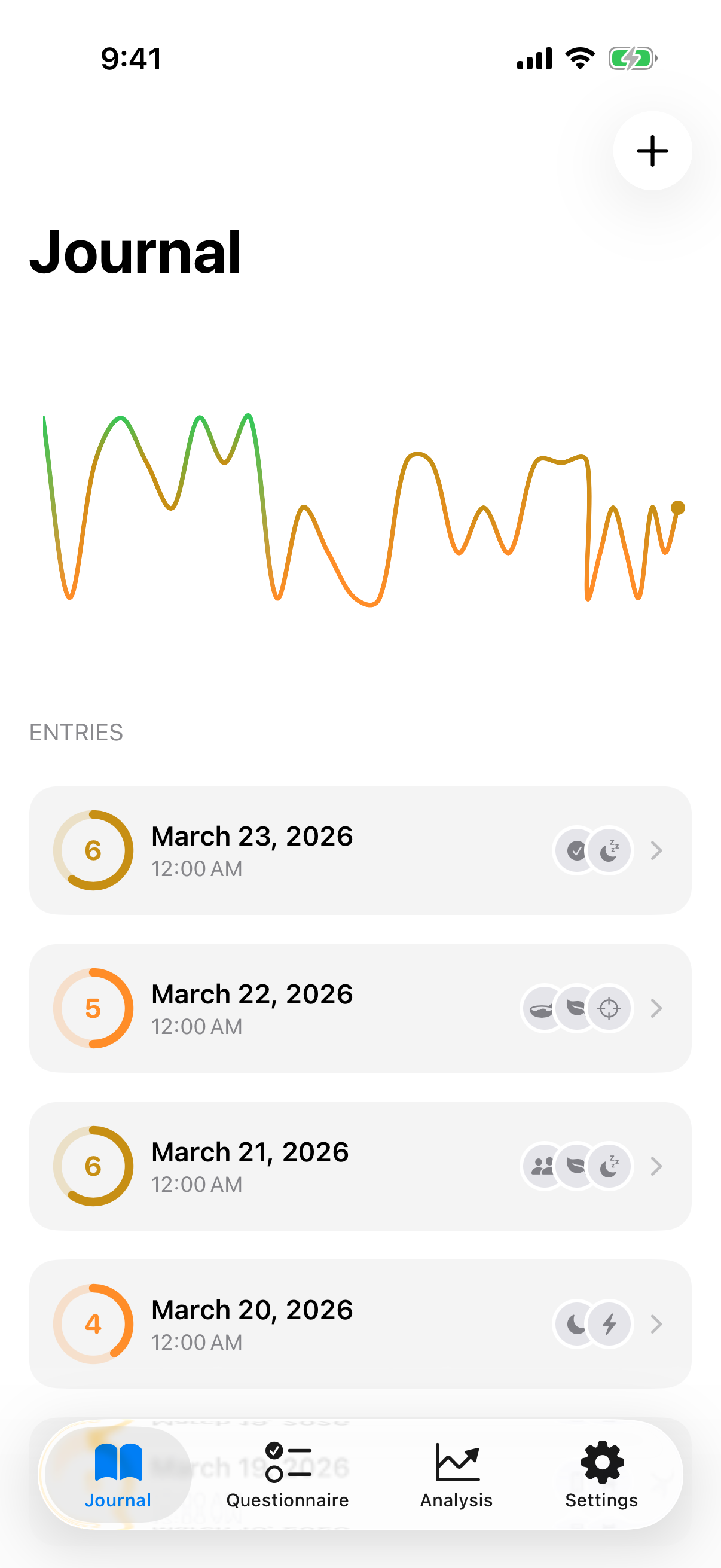
InnerPulse begins where a pure diary ends. Instead of an icon step, you get a 1-10 mood score plus five sub-dimensions (energy, calm, focus, sleep quality, social energy). Factors are not just tags: they can carry an intensity from 1 to 5, be fully edited, and be organized into your own categories. From this finer data, the app then actually draws conclusions.
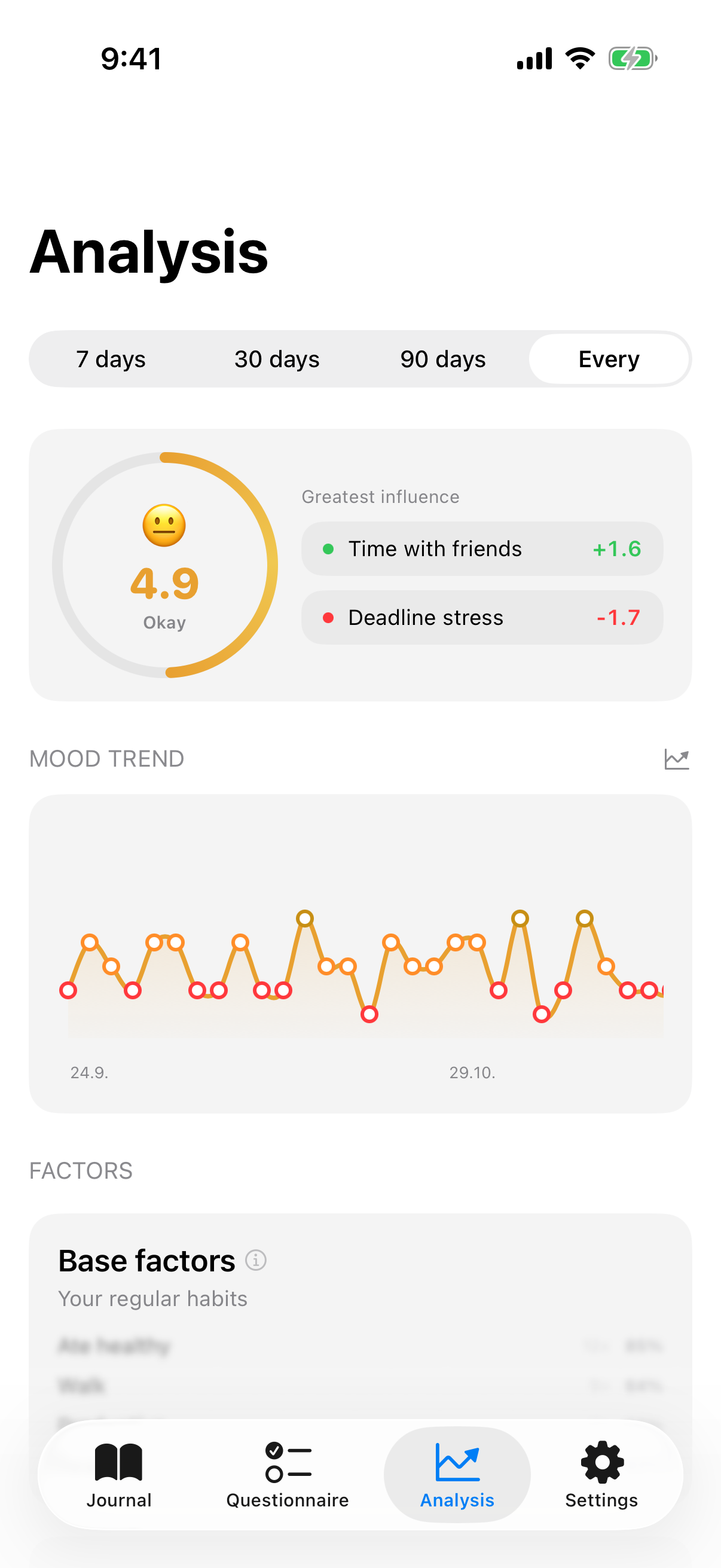
The centerpiece is the correlation engine. It analyzes on-device which factors relate to your mood and phrases the result in plain language: "On days with exercise you ate healthily 40% more often" or "After days with little sleep, your mood is lower the next day." It looks at both the same day and the following day (lag analysis). A classic diary shows you what happened. InnerPulse tries to show what is connected to what. More on the InnerPulse product page.
Clinical depth: the clear dividing line
Moodistory contains no clinical tests, which is consistent with its goal as an everyday diary.
InnerPulse integrates four validated self-tests right in the UI: PHQ-9 (depression), GAD-7 (anxiety), K10 (general distress), and PHQ-4 (rapid check). A 3-tier flag system contextualizes the results, and during acute distress the app surfaces crisis contacts for the DACH region (AT 142, CH 143, DE 0800 numbers).
To be explicit: this is observation and self-assessment, not a diagnosis. InnerPulse does not pass judgment on you, it delivers structured evidence you can bring into a conversation with professionals. If you are waiting for a therapy slot, InnerPulse for therapy goes deeper.
The "when does which app matter" test
Moodistory matters when:
- You want a simple, beautiful offline diary with no clinical pretension.
- The icon language and a tidy visual record matter to you.
- You log mood as a pleasant ritual, not as data analysis.
- One-time purchase and offline are enough, and you do not need deeper analytics.
InnerPulse matters when:
- You have or suspect a diagnosis (depression, anxiety, PMDD, bipolar, burnout) and want to track symptoms the way your doctor does.
- You want to know which factors really drive your mood, not just how the day went.
- You want to track a medication trial with objective numbers.
- You want to log on Apple Watch or export data as PDF/CSV for an appointment.
Apple Watch, widgets, and daily use
Here InnerPulse draws a practical distinction. It ships a full Apple Watch app: quick entry via the Digital Crown, factor quick-add, a today glance, and two-way sync that works offline too. On top of that come home- and lock-screen widgets (one tap starts an entry, optionally with the mood score hidden), a weekly pulse, and Year-in-Pixels.
An entry takes about ten seconds, missed days can be backfilled, and there are deliberately no streaks. The principle behind it: emotionally light to open, even on bad days, without a missed day feeling like a failure.
Privacy: both local, with the same honesty
Both apps store locally, and that is a real shared advantage. InnerPulse is 100% on-device via SwiftData, with no account, no cloud of its own, and no analytics or tracking SDKs. You can verify with Little Snitch or an HTTP proxy in minutes that nothing is sent.
The same honesty applies to the downside: without iCloud Backup or a manual export, losing your device means losing the data, because there is no server copy. That is the price of radical locality, and it applies to local diaries in general. If you want to go deeper on privacy, see private offline mood tracker and mood tracker with no subscription.
Related comparisons
If you are coming from a casual rating app with a subscription, InnerPulse vs Daylio is the obvious comparison, since it is precisely about the difference between casual and clinical.
The honest answer
If you want a beautiful, simple offline diary that values one-time purchase and privacy and makes no clinical claim: use Moodistory. It does exactly what it was built for, and it shares the values InnerPulse cares about too.
If you want the same foundation (one-time purchase, offline, local) but need more, clinical screenings, a finer mood model, a correlation engine, Apple Watch, and a therapy export, then InnerPulse is the natural extension. €9.99 once, on-device, built for people who want not just to record their mental health but to understand it.
See what shapes your mood
Clinical tests, 100+ influence factors, fully offline. One-time purchase.
Get on the App Store