In Germany, MindDoc is one of the best-known apps for mental health with a clinical claim. It is medically positioned, classified as a medical device (CE marked), and combines ongoing mood monitoring with questionnaires plus guided courses and exercises in a therapy style. All of that runs through an account and a cloud, funded by a subscription.
InnerPulse starts from a different place. It also takes clinical self-tests seriously: PHQ-9 (depression), GAD-7 (anxiety), PHQ-4 (rapid check), and K10 (general distress) are right inside the app, with a three-tier flag system and crisis contacts for the DACH region during acute distress. The difference is in how it is built: no account, no cloud, everything stays on the device, a one-time purchase instead of a subscription. And instead of guided courses, you get a correlation engine that turns your own data into plain-language sentences.
This page explains honestly when MindDoc is the better choice and when InnerPulse is.
| Feature | InnerPulse | MindDoc |
|---|---|---|
| Positioning | Therapy companion, tracking + analysis | Medically positioned (CE), monitoring + programs |
| Pricing | One-time €9.99, no subscription | Subscription model |
| Data storage | On-device only, no account | Account + cloud |
| Clinical screenings | PHQ-9, GAD-7, PHQ-4, K10 (in app) | Ongoing monitoring + questionnaires |
| Guided courses/exercises | None (by design) | Yes, core feature |
| Analysis | On-device correlation engine, plain-language insights | Trend monitoring |
| Mood scale | 1-10 + 5 sub-dimensions | Recurring mood check-ins |
| Influence factors | 100+ pre-built, intensity, correlation | Limited |
| Export for therapy | CSV per-question, JSON, PDF report | Varies |
| Platform | iPhone + Apple Watch | iOS + Android |
| Privacy | 100% on-device, no tracking SDK, GDPR-native | Account and cloud based |
MindDoc's core strength: support with structure
MindDoc's strength is guidance. You are not left alone with your data. Instead you are led through recurring mood check-ins, trend monitoring, and guided courses and exercises. The approach is deliberately therapy-adjacent: content that teaches you something step by step, combined with ongoing monitoring of how you are doing. The medical positioning as a CE-marked product is a real signal that it was built with a clinical claim.
If that is exactly what you want, a program that takes you by the hand, walks you through exercises, and tracks your progress through an account, then MindDoc is a serious choice. That is not a marketing line, it is an honest recommendation: for guided content and account-based monitoring, MindDoc is built for it, InnerPulse is not.
InnerPulse's core strength: your own data, translated into plain language
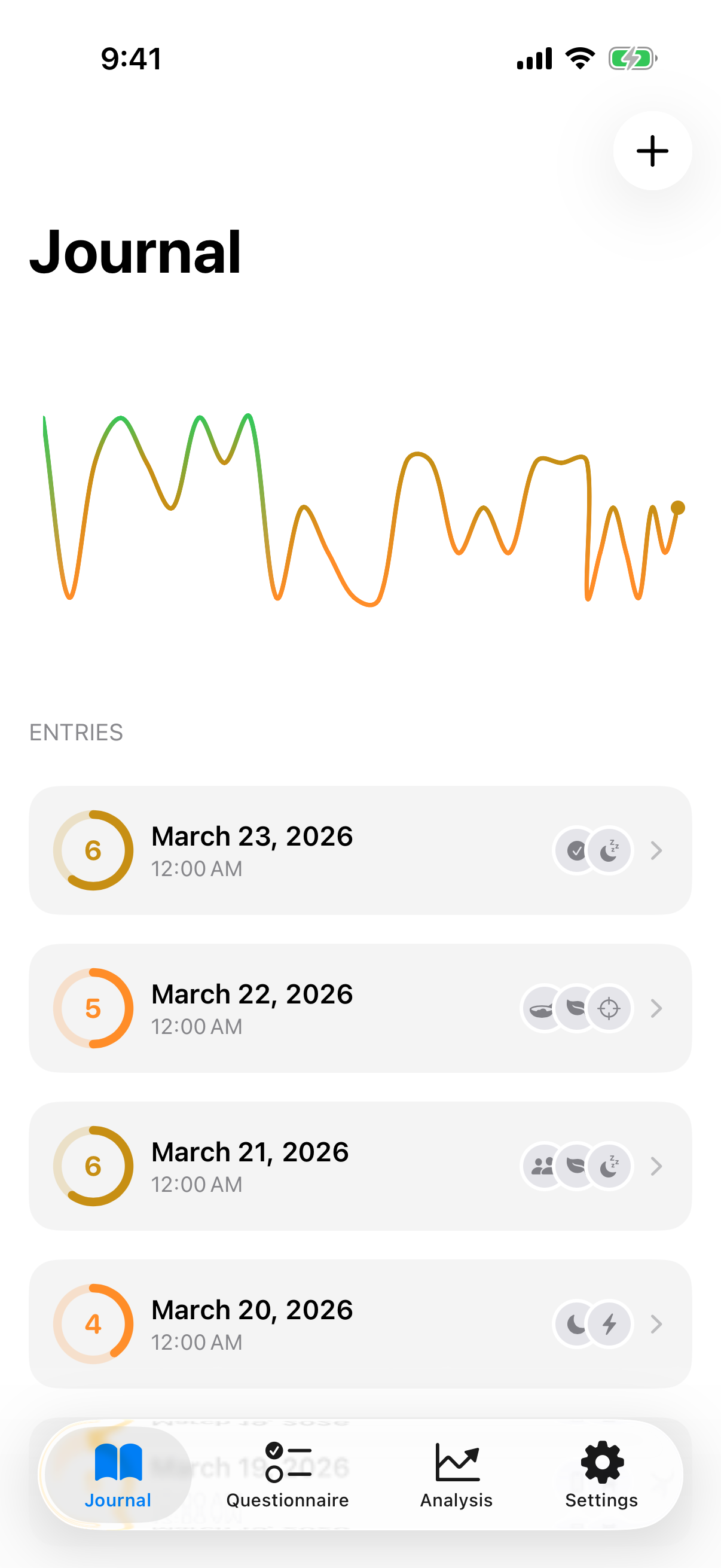
InnerPulse does not walk you through courses. Instead, your own data becomes the source of insight. You log your mood as a 1-10 score plus five sub-dimensions (energy, calm, focus, sleep quality, social energy), and you pick from 100+ pre-built factors across 10 categories, optionally with an intensity slider. Each entry takes about ten to fifteen seconds.
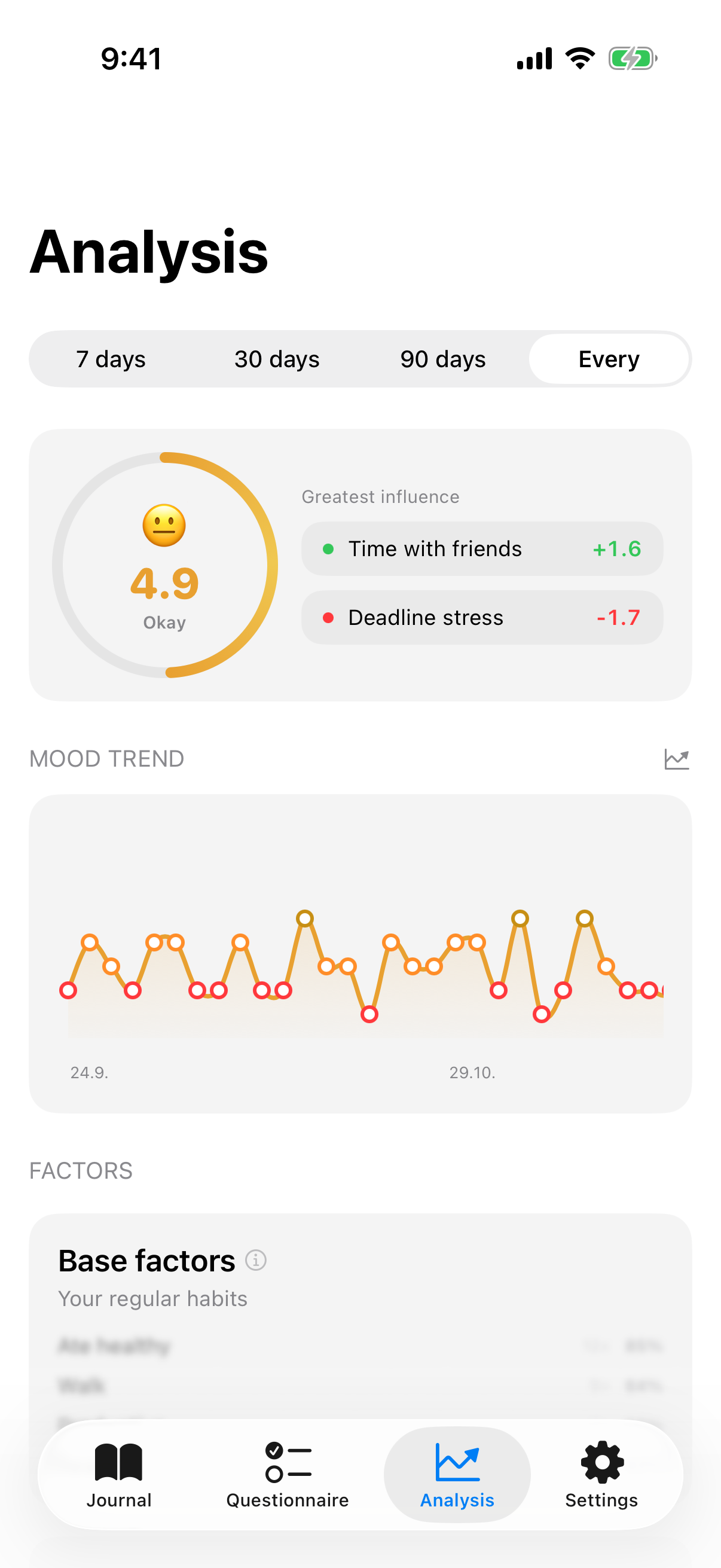
The correlation engine does the rest, entirely on the device. It looks at relationships between factors and mood, on the same day and on the next day, and translates them into sentences you understand right away. For example: "On days with exercise you ate healthy 40% more often," or "After days with little sleep your mood is lower the next day." Instead of a trend curve you have to interpret yourself, you get named patterns from your own life.
On top of that, weekday statistics and a Year-in-Pixels view let you see seasonality at a glance. If you suspect a pattern, such as seasonal dips or a slow slide into burnout, the numbers are here.
The same clinical seriousness, packaged differently
This matters: InnerPulse makes no compromises on the clinical side. The four self-tests are validated instruments, PHQ-9, GAD-7, PHQ-4, and K10, with a three-tier flag system. When the app detects acute distress, it surfaces crisis contacts for the DACH region (AT 142, CH 143, DE 0800 numbers).
Both apps are strict on one point: this is observation and self-assessment, explicitly not a diagnosis. A questionnaire score is an objective number, not a medical verdict. So the difference between InnerPulse and MindDoc is not the clinical claim, it is the architecture around it.
Account and cloud versus 100% on-device
This is the clearest difference. MindDoc works with an account and a cloud. That has advantages: cross-device access, a centrally stored history, and programs tied to your account.
InnerPulse goes the opposite way. There is no account, no cloud, no analytics or tracking SDKs. All data lives locally on the device (SwiftData). You can verify this yourself in a few minutes with a tool like Little Snitch or an HTTP proxy, the app does not phone home. There is an optional Face ID or Touch ID lock, and optional connections to Apple Health and WeatherKit share data only with Apple, not with us. InnerPulse is GDPR-native and Made in Europe. Read more on the privacy page.
The honest flip side: with no cloud of its own, you are responsible for backups. If you have iCloud Backup enabled, the InnerPulse database is included. Without iCloud Backup or an export, losing your device means losing the data. For many people who track medication use, substance use, or clinically relevant symptoms, that "nothing leaves my phone" is exactly the deciding point. If cross-device convenience matters more to you, a cloud model serves you better.
Subscription versus one-time purchase
MindDoc is funded by a subscription. That makes sense for continuously maintained content and courses, because a program that is actively curated costs money continuously.
InnerPulse is €9.99 one-time, no subscription, no in-app purchases, Family Sharing included. You pay once and own the app. If you want a tracking and analysis tool rather than an ongoing program, you are not paying every month for something you only use as a tool. If a subscription-free model matters to you on principle, see mood tracker without a subscription.
The therapy connection: what you need the data for
This is where the character of each app shows most clearly. MindDoc wants to be part of your care itself, with its own exercises and monitoring. InnerPulse sees itself as a supplier to your real therapy.
The CSV export (including per-question), JSON, and the PDF report exist for exactly that: you bring structured evidence to your therapist or psychiatrist instead of reconstructing the last few weeks from memory. That is especially valuable while you wait for a slot (in Germany the average wait is 142 days) or want to gather data between appointments. Read more on InnerPulse for therapy and for the wait for a therapy slot.
When does each app matter?
MindDoc matters when:
- You want guided courses and exercises in a therapy style that teach you step by step.
- You want account-based monitoring that keeps your history central and cross-device.
- A medical CE positioning matters to you as a trust anchor.
- You use Android (InnerPulse is iOS only).
InnerPulse matters when:
- You want clinical screenings but without an account and without a cloud, all on the device.
- Instead of guided courses, you want real correlations from your own data, in plain-language sentences.
- You are collecting data for your real therapy and want to take it along as CSV or PDF.
- You prefer a one-time purchase over a subscription.
- You use an Apple Watch and want to log in seconds on the go.
Where they agree
Both apps take mental health seriously, work with clinically grounded questionnaires, and explicitly do not present themselves as diagnostic tools, but as support. Both want you to check in regularly instead of only in a crisis.
If you are coming from the casual side and are unsure whether you even need a clinical tool, the comparison InnerPulse vs Daylio may help first. You will also find data analyses about mood and factors on the InnerPulse blog.
The honest answer
If you want a guided program, courses and exercises that take you by the hand, and monitoring that runs through an account: choose MindDoc. That is what it is built for, and it does it seriously.
If you want the clinical depth but without an account, without a cloud, and without a subscription, and if you value seeing your own patterns in plain language and taking them along as CSV or PDF to real therapy: choose InnerPulse. €9.99 once, everything stays on your device, and you will know within a week whether this approach fits how your mind works.
See what shapes your mood
Clinical tests, 100+ influence factors, fully offline. One-time purchase.
Get on the App Store