Moodflow is a popular choice for anyone who likes to shape their own mood diary. It is flexible, attractive, and highly customizable: lots of custom fields, your own scales, free-form journaling. It is funded through a freemium model with a subscription for the advanced features. If you enjoy tinkering with your setup and want a tool that adapts to your ideas, it is a good starting point.
InnerPulse pursues a different goal. Instead of maximum design freedom, the focus here is analysis, with a clinical claim. Clinical self-tests (PHQ-9, GAD-7, PHQ-4, K10) are right inside the app, an on-device correlation engine translates your data into plain-language sentences, and the focus is on producing evidence for your real therapy. You pay once, no subscription.
This page explains honestly when Moodflow is the better choice and when InnerPulse is.
| Feature | InnerPulse | Moodflow |
|---|---|---|
| Positioning | Therapy companion, analysis focus | Flexible mood and journaling tool |
| Pricing | One-time €9.99, no subscription | Freemium with subscription |
| Data storage | On-device only, no account | Varies by feature |
| Clinical screenings | PHQ-9, GAD-7, PHQ-4, K10 | None |
| Mood scale | 1-10 + 5 sub-dimensions | Customizable mood capture |
| Customizability | Editable factors, custom categories | Very high, many custom fields |
| Analysis | On-device correlation engine, plain-language insights | Trend overviews |
| Influence factors | 100+ pre-built, intensity, correlation | Custom fields (no correlation) |
| Export for therapy | CSV per-question, JSON, PDF report | Varies |
| Platform | iPhone + Apple Watch | iOS + Android |
| Gamification | None (no streaks) | Varies |
Moodflow's core strength: you build your own diary
Moodflow's strength is openness. You decide what your mood scale looks like, which fields you want to capture, and how your diary feels. If you enjoy configuring and see your tracking setup as a personal project, there is a lot of room here. Free-form journaling, your own categories, customizable capture: Moodflow gives you the building blocks and lets you decide.
That flexibility is real value. Some people do not track to find patterns, they track to write, to reflect, and to record their own rhythm. If that is your goal, Moodflow is well built for it, and that is an honest recommendation: for maximally customizable journaling with many custom fields, Moodflow is the more flexible app, and InnerPulse deliberately is not.
InnerPulse's core strength: structure that leads to insight
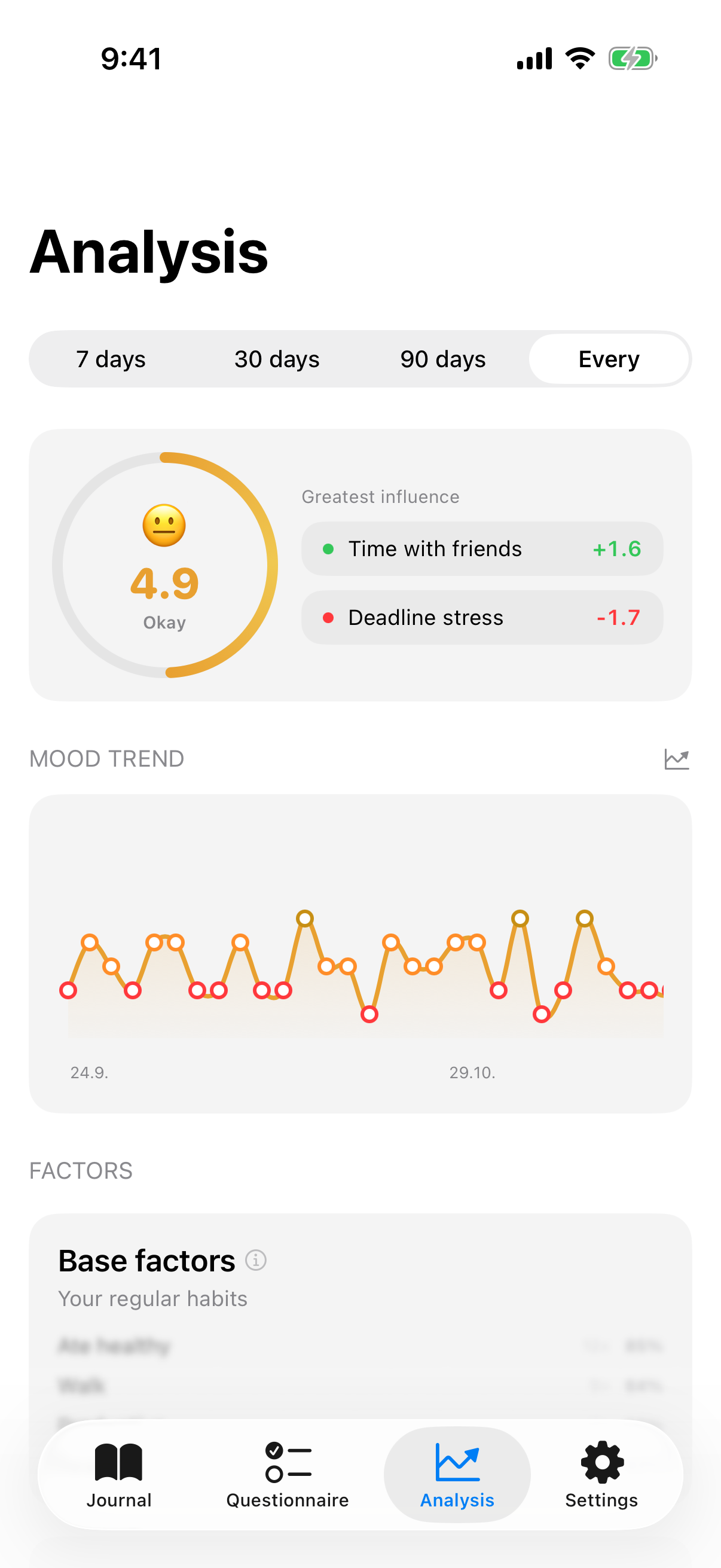
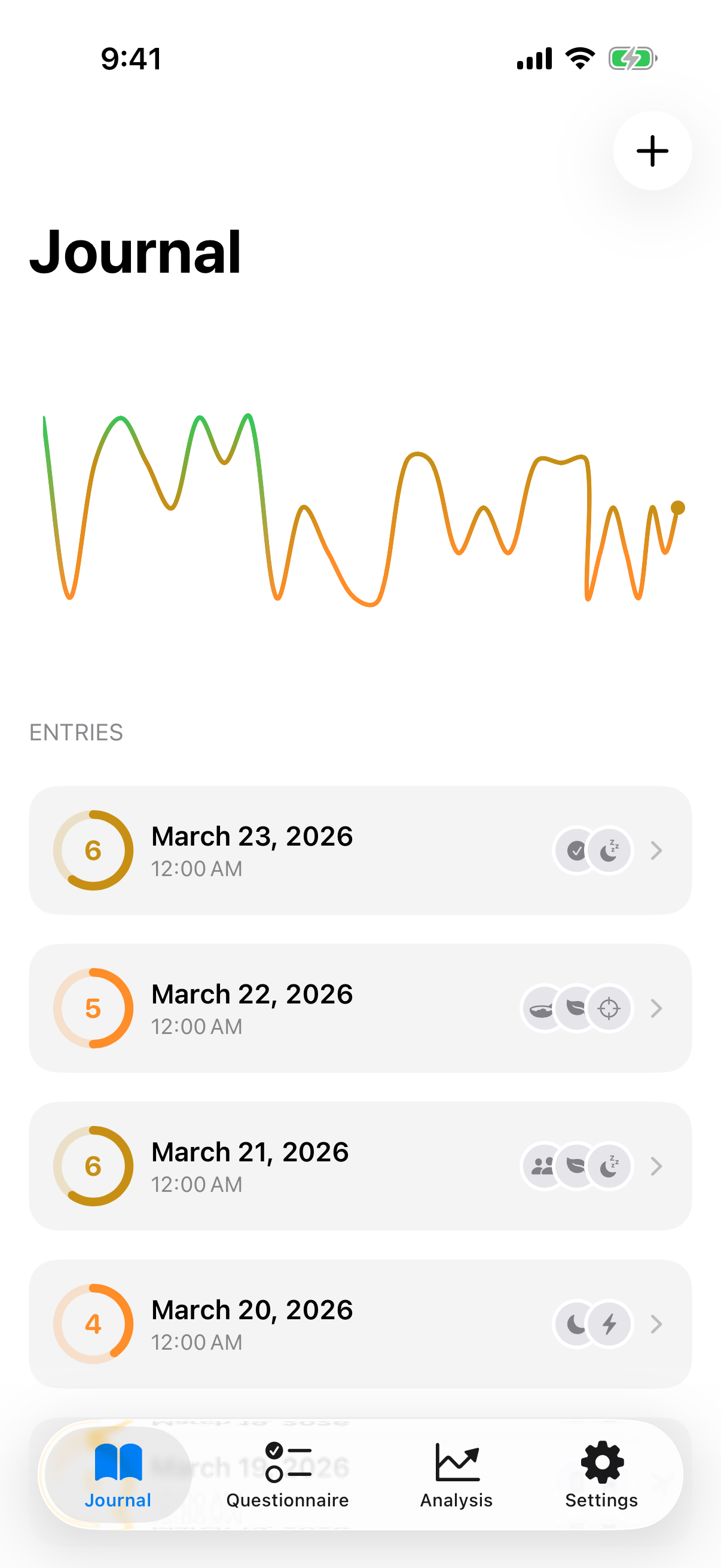
InnerPulse goes the opposite way. Instead of handing you a blank canvas, it gives you a deliberate structure built for analysis. You log your mood as a 1-10 score plus five sub-dimensions (energy, calm, focus, sleep quality, social energy) and pick from 100+ pre-built factors across 10 categories. The factors are editable (title, icon, category, tendency), custom categories are possible, and each factor has an optional intensity slider (1-5).
The decisive difference comes afterward. The correlation engine runs entirely on the device and looks for relationships between your factors and your mood, on the same day and on the next day. The result is not raw data you have to interpret yourself, but plain-language sentences like "On days with exercise you ate healthy 40% more often," or "After days with little sleep your mood is lower the next day."
That is the core: Moodflow gives you freedom, InnerPulse gives you answers. A very open app can end up holding many fields that never lead to an insight. InnerPulse limits the structure on purpose, so that what comes out is an analysis you would not have computed yourself.
The clinical difference
This is where the paths clearly separate. Moodflow is a general mood and journaling tool with no clinical claim. InnerPulse brings validated self-tests: PHQ-9 (depression), GAD-7 (anxiety), PHQ-4 (rapid check), and K10 (general distress), with a three-tier flag system. When the app detects acute distress, it surfaces crisis contacts for the DACH region (AT 142, CH 143, DE 0800 numbers).
Important and true for both apps: this is observation and self-assessment, explicitly not a diagnosis. A questionnaire score is an objective number, not a medical verdict. But if you are dealing with depression, anxiety, or other mental strain, the difference is tangible: InnerPulse speaks the language your therapist uses.
Customizability versus targeted depth
It is worth being honest about customizability. More custom fields sound better at first, but they are not automatically better. A tool that allows everything forces you to make every decision yourself, and the more individual your fields are, the harder they are to analyze or compare against established benchmarks.
InnerPulse makes some of these decisions for you, but not all. The mood scale and the screenings are fixed, because that is exactly where their meaning comes from. The factors, on the other hand, you can adapt and extend with your own categories. That is a deliberate middle path: enough flexibility for your daily life, enough structure for real analysis. If you want to see a similar trade-off in a broader symptom-tracking app, look at InnerPulse vs Bearable.
Freemium versus one-time purchase
Moodflow uses a freemium model: a free entry point, advanced features behind a subscription. That is a common and legitimate model, but it means the features you most likely want are behind an ongoing payment.
InnerPulse is €9.99 one-time, no subscription, no in-app purchases, Family Sharing included. Everything is unlocked from the start. If you do not want to pay a subscription for a personal diary on principle, you will find the reasoning on mood tracker without a subscription.
Privacy and platform
InnerPulse runs 100% on the device (SwiftData), with no account, no cloud, no analytics or tracking SDKs. You can verify this with Little Snitch or an HTTP proxy in minutes. There is an optional Face ID or Touch ID lock, and optional connections to Apple Health and WeatherKit share data only with Apple. InnerPulse is GDPR-native and Made in Europe. The flip side: with no cloud of its own, you are responsible for backups. With iCloud Backup enabled, the database is included, otherwise losing your device means losing the data.
On platform: InnerPulse is iOS only and includes the Apple Watch (quick entry via the Digital Crown, factor quick-add, complications, two-way sync, even offline). Moodflow is available on iOS and Android. If you use Android, that is a clear answer.
When does each app matter?
Moodflow matters when:
- You want maximally customizable journaling with many custom fields.
- You enjoy shaping your tracking setup and see it as a personal project.
- You want to write and reflect more than analyze.
- You use Android.
InnerPulse matters when:
- You want clinical screenings and real correlation analysis, not a blank canvas.
- You want to see patterns in your own data without computing them yourself.
- You are collecting data for your real therapy and want to take it along as CSV or PDF.
- You prefer a one-time purchase over a subscription.
- You want structured tracking that stays easy to open even under ADHD-typical sensory load, see InnerPulse for ADHD.
Where they agree
Both apps want you to look at your mood regularly, both work privately and without selling your data, and both adapt to your daily life, just in different places. If you are right at the start and unsure whether you will keep at it, the comparison InnerPulse vs Daylio with the simplest casual app may help first. You will find data analyses about mood and factors on the InnerPulse blog.
The honest answer
If you want a flexible, attractive diary that you build entirely to your own ideas, and if writing and reflecting matter more to you than analysis: choose Moodflow. For maximally customizable journaling it is the more flexible app.
If you want clinical depth, real correlations from your data in plain language, and evidence you can bring to therapy, all on your device and without a subscription: choose InnerPulse. €9.99 once, and you will know within a week whether this structured, analytical approach fits how your mind works.
See what shapes your mood
Clinical tests, 100+ influence factors, fully offline. One-time purchase.
Get on the App Store